Compact music commentary about artifacts new and old: I enthuse, I don't accuse, but I do refuse–to review anything lukewarm or colder!
Author: philovereem
Music monomaniac, retired English teacher, resident of Columbia, Missouri, former correspondent for ANOREXIC TEENAGE SEX GODS, READY TO SNAP, HITLIST, SUGARBUZZ, THE WAYBACK MACHINE, ROCK THERAPY, and THE FIRST CHURCH OF HOLY ROCK AND ROLL, co-lead singer of the non-legendary Wayne Coomers and the Original Sins of Fayetteville, Arkansas.
Nothing special on this day–other than the songs. I experienced a sudden craving for pithy, 2-to-3-minute country songs, which sometimes get crowded out by my striving to hear everything, stay on top of new releases, and the ascension of jazz as my musical respite of choice. Used to be, around here, that every weekend, especially Saturdays and Sundays, country was always on the box; the friends we saw regularly were also dedicated to the stuff, as well as drinking beer and yelling along with songs. We’re older, busier, and many of our boon companions are raising kids. As well, though there’s plenty of good country songwriting, the singers seem safer–better for them, not so much for the music, and us.
I guess I experienced a flash of reminiscence and had to go back to the well. And in the well was some golden elixir: tales told by a gravedigger suddenly $40 poorer, a daughter realizing that time’s snatched her mourning, a Stetson-less Texan who’s just as big as you are, a heartbroken lover demanding the taverns close so his baby can’t get in, a rounder whose eighth-grade education doesn’t mean he was born yesterday, a leather-clad redhead whom Death gifts a motorcycle, a murderous cuckold lost in the cave of his crime, a scared greenhorn who can’t find the Memphis-Arkansas Bridge…that’s just scratching the surface, but how can one resist their stories.
I’ve prepared a playlist with some highlights. The singers aren’t always the songwriters, but in those cases the songwriters show up as singers later in the playlist. I recommend this to readers who think they don’t like country, or who are startin’ to hate country (but still love cowboy songs).
Short-shrift Division:
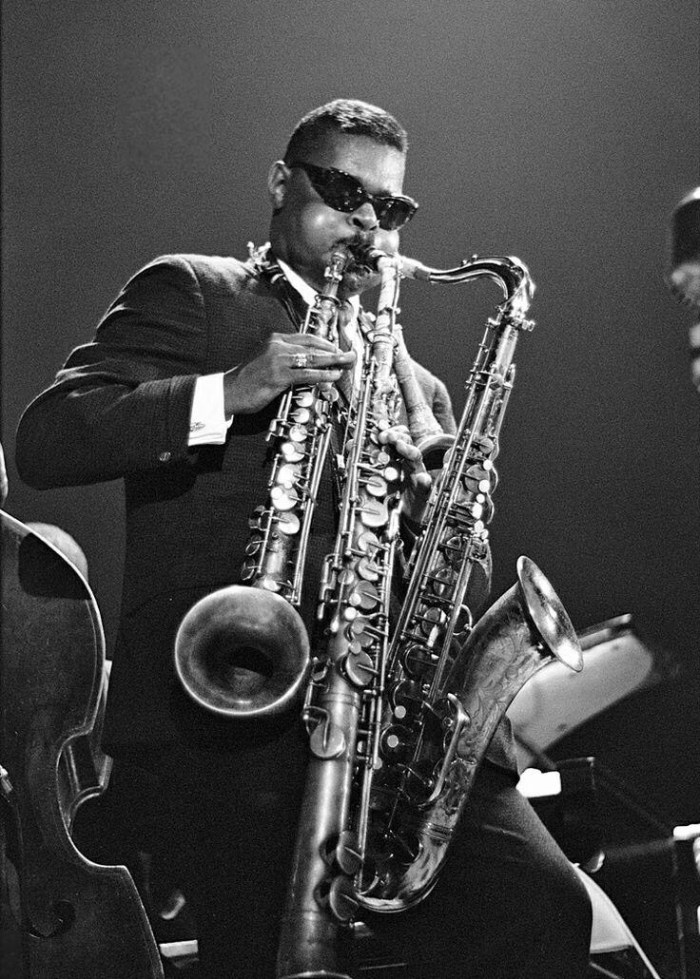
Free jazz I find hard to shake. I listened to the whole of David S. Ware’s Live in The World: three discs of sweeping, dramatic music within which Ware and his pianist Matthew Shipp vie to snatch your heart out of your chest. You haven’t lived until you’ve heard this band take “The Way We Were” into the cosmos; they also push Sonny Rollins’ “Freedom Suite” off the edge of the planet, and Ware’s own “Aquarian Sound” and “Mikuro’s Blues” hold their own with both. A terrific intro to a tenor saxophonist who was gone too soon (the artistic offspring of Ben Webster and Pharoah Sanders!) and a classic quartet that was fairly inarguably the turn of the century version of Trane’s. No shit.
Literary/Photographic Note:
Billie Holiday fans are directed to check out Jerry Dantzic: Billie Holiday at Sugar Hill, a collection of Dantzic’s 1957 photographs of Holiday assembled by Dantzic’s son Grayson. The book opens with a blazing Zadie Smith story in which she inhabits Holiday’s gone soul and looks back on its final days; I advise listening to Smith read it–the inhabitation reaches beyond the written word. Half of Dantzic’s photos capture the singer so incandescently that it’s unfathomable that she’d be dead within the next year; the other half suggest that a termite loneliness is eating her from within. A haunting collection.
Under the weather and confined somewhat to bed, I needed musical medicine. As happens more and more as I age, I turn to free music, and more and more as I turn to free music, I turn to the work of Joe McPhee. This time, it was his Skullduggery album, recorded with Amsterdam’s Universal Indians (named very appropriately after an Albert Ayler composition) and American saxophonist John Dikeman. I find that McPhee’s performances, where he employs multiple instruments in playing reactively to his fellows but also creates , sustains, and deconstructs themes, often mirror the hops, skips, jumps, and stretches of straight travel by which my mind works. Whether I am listening in dedicated fashion or reading, his work (quite frequently without regard to with whom he’s working–and he has many playmates) calms me. I’ve grown deeply familiar with and fond of his sound, whether he’s wielding sax, pocket trumpet, or something else; I feel confident I could pick him out of any free lineup in a blindfold test. Here–try the title track, and listen for what I mean when I say he doesn’t just react in a free context, but creates and sustains (bass player Jon Rune Strok is great here, too):
McPhee’s music may relax me, but my dog? He became disturbed, as this sequence demonstrates (you can see my little Bluetooth speaker on the window’s ledge):
Enjoy more of McPhee, Dikeman, and Universal Indians live, right here, from a year ago:
Recently, I began plotting a scheme by which we could get music into the air earlier in the morning. We keep farmer’s hours–up usually at 4:45ish–and come into consciousness by reading the news or whatever books we have going. It’s not the hour for Captain Beefheart or Charles Gayle, and I prefer not to get up, start picking through the crates and shelves, and fuss with the turntable or changer until after about 8–but some music would be nice. My brother’d given me a neat little Bluetooth speaker for Christmas, I’d snagged a cheap 16g mp3 player after an iPod died, so why not load some dawn-appropriate tunes onto the dang thing? I asked Nicole what she might like to hear, and with stunning quickness and specificity she replied, “Blues-oriented stuff, nothin’ past ’45.” Well, OK then!
It occurred to me instantly what to do. Do you know Allen Lowe? Besides being a terrific saxophonist, guitarist, and composer, Mr. Lowe is a tireless thinker about American music, a man averse to easy truths about its history and determined to constantly revise his own understanding, which is considerable. His book American Pop: From Minstrels to Mojos (1893-1946) is required (and cantankerous) reading for music buffs, and after its publication, Lowe released an equally essential nine-CD companion volume to the book in 1998. The set begins with 1893’s “Mama’s Black Baby Boy” by the Unique Quartette and closes 214 tracks later with Lennie Tristano’s 1946 take on “What is This Thing Called Love?” It’s a great way to hear our music’s beginnings, with blues, pop, jazz, gospel, country, and their variants and hybrids proceeding chronologically but lying side by side. The juxtapositions can be revelatory.
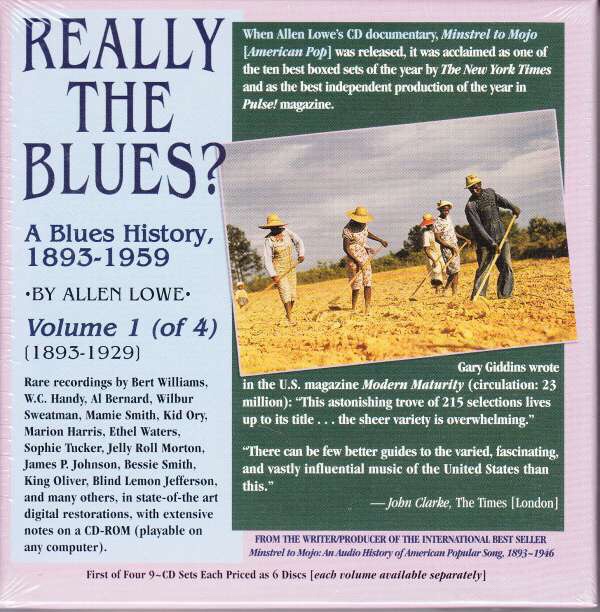
14 years later, Lowe released another musical companion to one of his publications, the perfectly-titled “Really The Blues? (1893-1959); this time, the set stretched across 36 CDs, with little overlap of the previous set and many inclusions that took even aficionados by surprise. Upon having received this treasure chest in the mail, I played all the 36 discs consecutively, across several days, with consistent delight. I remember Nicole hollering from the living room, “Hey, this stuff is fantastic–I haven’t heard very much of it! What is it?”
Wait, you are saying, did you do what I think you did?
Yeah.
I transferred all 45 discs to the mp3 player, set the fucker on “shuffle”…and that oughtta get us to 2019, doncha think? This morning brought us, oh, Charles Ives, Eddie Cleanhead Vinson, Stan Kenton, Jelly Roll Morton, Mary Ann McCall, Maynard Ferguson (yeah, that’s right!), James P. Johnson, Eddie Jefferson, and Mel Brown. A great start to the day, one must admit. Lowe’s curatorial imagination and dedication deserves a channel into all our homes.
The week’s listening. I was ending my tenth semester at Stephens College with students doin’ the final exam wig-out all around me, and the chaos was catching. I also road-tripped. This playlist catches that:
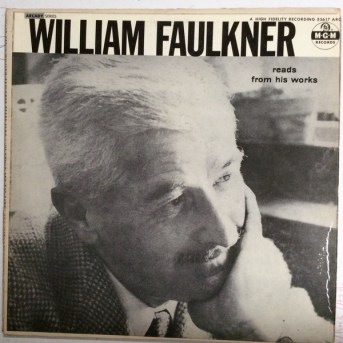
Plucked from History’s Dustbin (best recent purchase of an old record): William Faulkner Reads from his Works (featuring selections from The Sound and The Fury and Light In August; procured for me by the gents at Hitt Records!).
Grower, Not a Shower (old record I already owned that’s risen significantly in my esteem): Rhiannon Giddens’ Freedom Highway; The Rolling Stones’ Some Girls (I already loved it–I just fell even more in love with it, by learning to more fully accept and appreciate “Some Girls,” “Faraway Eyes,” and “Shattered.” Um, it was already showin’ — plenty.
Encore, Encore! (album I played at least twice this week): The Go-Betweens’ 1978-1980; The Rolling Stones’ Some Girls.
Through the Cracks (sweet record I forgot to write about): Sleep, The Sciences; Van Morrison and Joey DeFrancesco, You’re Driving Me Crazy; Salim Washington, Dogon Revisited.
Coming Attractions (Sunday’s Children): Aretha Franklin, Young, Gifted, and Black; Professor Longhair, Crawfish Fiesta; Z.Z. Hill, Greatest Hits.
I road-tripped to my parents’ home in Monett, Missouri, to celebrate my brother’s birthday–he was home from Dickinson, Texas. Unfortunately, my ace-boon pavement podnah Nicole was under the weather, so I was driving solo.
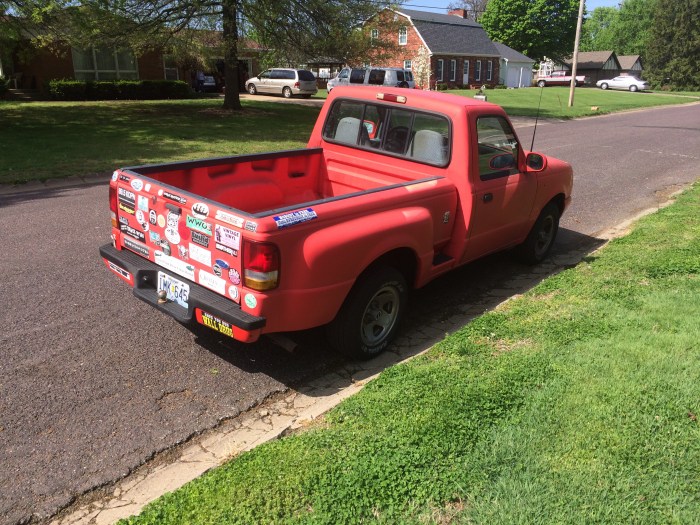
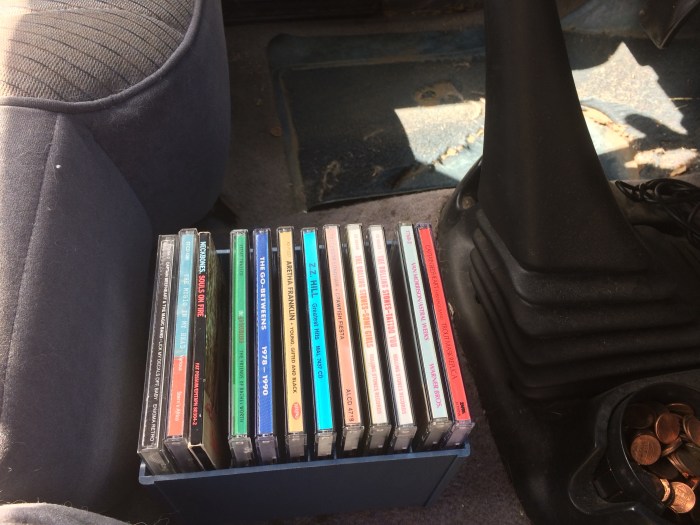
Also, my vehicle is a ’93 Ford Splash with 88,000 miles on it–I don’t entirely trust it, but it does have a nice stereo that masks those worrisome noises. So I selected some special, time-tested records to keep me fully engaged, and to “study” in “The Lab”–my nickname for the truck cab.
Neckbones: Souls on Fire
If the Rolling Stones were from Oxford, Mississippi, fronted by Richard Hell, and drunk on LAMF. Oh yeah: and cut loose with a week’s pay in a casino. But let me pull your coat on lead singer Tyler Keith. I hate to keep making comparisons, but this is true: if you, like me, are a fan of Jeffrey Lee Pierce and The Gun Club, there’s no reason for you to miss Tyler’s work with The Neckbones, The Preacher’s Kids, and The Apostles. It’s got the same fire, the same sense of spiritual hauntedness, the same immersion in the blues-based rock roll verities with a cerrated edge. What it doesn’t have, I think, is Pierce’s doomed aura–and that’s a good thing. Not something you wanna root for, you know?
I’m getting off topic, but proceed thusly through Mr. Keith’s oeuvre:
To prove I’m somewhat objective, I’ve never warmed up to The Preachers’ Kids’ The Devil’s Hitlist or Keith’s kinda-solo Alias Kid Twist, though the cassette-only The Apostle is worth the search. To recap, and I will not have stuttered: Tyler Keith and his projects equal to, if not better, than Jeffrey Lee Pierce’s.
The Rolling Stones: Some Girls and Tattoo You
A few weeks ago, I was having fun making fun of Mick Jagger’s garb and minstrelsy as modeled in videos from these records. Since then, I’ve come back to the videos, then to the records, to just joy in Charlie’s cracking drumming and Keith’s lewd, thick, buzzing guitar lines–sounds of the gods! Played both albums all the way through, loud, with nothing but a smile–and re-re-replays of “Lies,” “Respectable,” “Hang Fire,” “Start Me Up,” and “Neighbors.”
The Go-Betweens: 1978-1990
Yeah, I only listened to this comp THREE TIMES this week. Simply, the cats from Brisbane are my uncontested favorite romantic pop group–the music can rock or be sensuous and luxurious, with constant surprises: spring rain, pool draining, men o’ sand v. girls o’ sea, white witchery + poetry that’s Irish and so black, getting back up on the pony, period blood, cattle and cane. If this album ended after its first 11 tracks, it’d be an A+; as it is, it’s a solid A. Note: I love Grant, but I’m a Robert guy.
Oh, yes, I did. I needed to feel the breeze blowin’ up me, and be reminded what a moon can do (though I was driving into Monett in broad daylight). I also needed to get in touch with the real me before coming all the way home, and the china pig snuffles? They center me.
Short-shrift Division:
I am strange. I grade research papers at midnight to these sounds.
Dennis Gonzales and his New Dallas Sextet: Namesake–Fabulous, passionate, energetic, long-form jazz, from the genre’s most underrated living composer (and one hell of a trumpeter). Secret weapon: on horns and flute, Douglas Ewart!
Roscoe Mitchell: Discussions–The septuagenarian jazz sensei shows no signs of slowing. Playing puts me in a focused, contemplative, unsentimental mood–perfect for scoring freshman essays.
Scrambling today, but I found time to bend an ear to two brave music-makers.
I first saw Janelle Monae on a late-night show and was a bit gobsmacked: clearly, she was deriving her shit from obvious sources, but equally clearly she was her own thang. I remember thinking, “If she can master singing and writing, wowzers!” The next morning I reported to the 12th grade class I was teaching that she was a future star and showed ’em a video; two weeks later, Nicole and I were watching her open scintillatingly for Erykah Badu at the Orpheum in Memphis. I believe this was 2012.
In the interim, I’ve tried everything she’s had to offer, but come away feeling her ideas surpass her actual execution of such: didn’t figure I’d return to the tracks and I haven’t.
Word of mouth on Dirty Computer was hot, so I put it on. Gotta say, musically and lyrically, she’s coming on, and she communicates her wisdom and charisma far more clearly than ever in her singing. “Pink” (the song and video) is the best thing she’s ever done, and the most daring, and the most right–if it were the last thing she ever produced it’d be enough. As for the rest of the record…it’s solid, but, again, its ambitions aren’t quite met by her productions, but she’s a heroine for sure, and I’m proud we both have Kansas roots.
On a tip from my main man Isaac, one of a few observant, sharp-eared friends who keep me seeming smart, I also sampled a newly released recording (made in 2011) by the volatile, leonine, but pretty danged long in the tooth saxophonist Peter Brotzmann. Brotzmann can be a room-clearer, but Ouroboros, where he’s partnered with Fred Longberg-Holm on strings and electronics, is truly one of his most imaginative, varied, and (relatively) accessible albums. It’s still challenging, but not withering to the newcomer; the soundscapes shift and morph surprisingly, with no sacrifice to Brotzmann’s power, and the dynamic settings created by Longberg-Holm put the reedman’s experience to the test. It’s hard to write about this music, but I’m not wrong–it’s one of the best records of any kind that’s been released in 2018.
Here’s a live clip of Brotzmann and Longberg-Holm from approximately the same time as Ouroboros‘ recording.
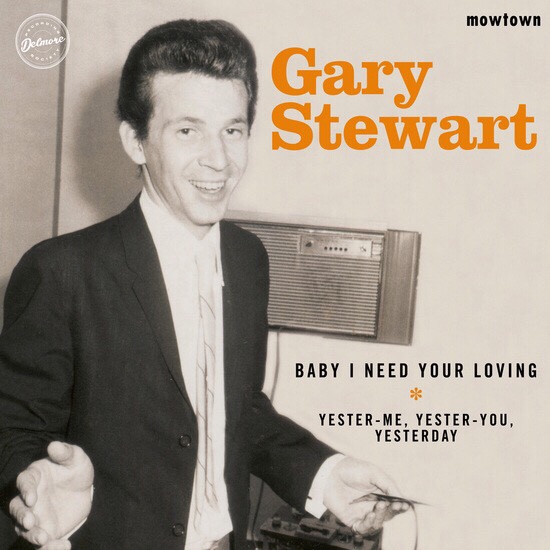
Just when it seems you’ve reached the age and quantity of musical acquisitions (ethereal or physical) where you can just kick back and wait for great new music, an unearthing comes along to remind you the past isn’t even past. I speak here of a 2018 Record Store Day release that confirmed the existence of something I’d just recently written off as hearsay or deteriorated tape: hardcore honky-tonkin’, ill-fated and underrated Floridian Gary Stewart’s legendary Motown-gone-smoke-filled-bar 1970 demo sessions. Worth the wait? Fuck yeah. Worth the price? I don’t do Record Store Day because I have been going to record stores regularly for 42 years, I hate crowds, and 80% of the offerings (at least) are straight-up junk, but I do wait like a fisherman with his bobber the morning after, and I snagged it for $30 off eBay–the same about Gary got paid for the 90-minute session! That’s $15 a song on this 45, and I will die happily with it in my possession.
The “A” is a cover of The Four Tops’ “Baby, I Need Your Loving” (“I Can’t Help Myself” is also listed on the session log reprinted on the 45’s back cover, but it remains vaulted). Gary’s in typically intense voice; his characteristic line-punctuating quaver hasn’t entirely come to the fore, but the desperation for which he would become famous in such singles as “Out of Hand” and “Your Place or Mine” is well-audible. The performance fades out after a half-improv/half-recitative that’s a little awkward, but Stewart’s singing, his churning rhythm guitar (I assume it’s him from the energy but there are no personnel notes available) and the punchy demo mix make the track very stimulating.
Stevie Wonder’s “Yester-You, Yester-Me, Yesterday” is more like it! Titularly, you’d suspect an ill-fitting wince-inducer, but…history shows when Stewart was matched with material in which the persona was reflecting on the past from a point where he was neck deep in ashes, Sally bar the fuckin’ door. On this song, you’re hearing transmissions from the room in the Tower of Song right between Hank’s and Jerry Lee’s.
I also received the Cincinnati band Wussy’s new EP, also a 45, in the mail. They are, with Yo La Tengo, the epitome of a critic’s band, but in spite of that, the group’s so very human writing and singing, plus their tendency to rock on out, places them in my pantheon. Unfortunately, the lead Beatles cover here sucks left hind tit, and their run on Jennie Mae Old’s “Runaway” only a shade better. Taste only gets a critic’s band so far.
Fortunately, the B is, weirdly, one of my favorite rock and roll responses to Trumpism so date, even if it wasn’t designed that way. It leads with an old recording, of The Seedy Seeds’ “Nomenclature,” one of the greatest songs ever about identity, and leaps and bounds better than the original–only now it seems to get at something defiant and real about gender fluidity that’s under attack. And the cover of The Afghan Whig’s “Retarded”? Well, I probably won’t willingly listen to the original again, but I can just repeat-play this one by virtue of Lisa Walker’s delivery of the line, “Who’s retarded now?”
As far as other burning questions go, do you need Neil Young’s newly-available 1973 live recording of Tonight’s the Night, performed at The Roxy in Hollywood? No. It’s really good, don’t get me wrong: after a month of recording the studio release, Neil and band showed up to play it for folks (prophetic of a current and tiresome tour gambit), and they’re sharp. The stage banter’s a bit cynical; I’ll leave it to you to decide whether you need to pay for “Roll Out the Barrel,” ironically positioned though it may have been. Personally, I really miss “Come On Baby Let’s Go Downtown,” which would have blazed live–Nils was right there, man!–and “Walk On”‘s presence doesn’t quite make up for its absence. You’re fine if you simply have the studio release, which is live’er than this could possibly be.
Short-shrift Division:
I know The Kinks are The Village Green Preservation Society is legendary, but it’s also a quarter marred by insipidity. Just sayin’.
Go-Betweens, Maxwells, New Year’s Eve, 1983/84, NJ � Laura Levine
The nice thing about having the memory of so many songs in your head is that, so often, a pebble of a thought–a word or a phrase–rolls to the fore, settles defiantly, and won’t budge until you seek out a related line of a song you just have to hear. For me, on this day, a weather app on my phone set the process in motion: it’s just recently become spring-like in Missouri, blossoms are busting out all over, and I was checking just to make sure we weren’t going to get boomeranged by a cold front (again). The mid-evening forecast. Rain. Spring rain. Is change actually coming? Coming down like sheets? Wait–what’s that itch?
I tried to suppress it, but fragments of those phrases kept buzzing my brain. When I returned home from work, I headed for the living room stacks (there’s one in almost every room of our house) and just randomly (I thought) chose three CDs for the changer: Glasvegas’ eponymous 2008 debut, The Go-Betweens’ so-stellar-it’s-almost-toxic 1978-1990, and Rhiannon Giddens’ Freedom Highway. You will, I hope, notice that the alphabetical progress of those titles does indeed support my theory of (attempted?) random choice.
I loaded ’em up, flopped onto the couch with the Sister Rosetta Tharpe bio I am trudging through, and promptly read two pages, dozed, read three pages, dozed–then was brought bolt-upright by a chorus that came hurtling from the speakers:
Dressed in a white shirt with my hair combed straight
Here in my black shoes and me without a date
Me without hindsight, me without
When will change come, Just like Spring Rain
Falling down like sheets
(falling down like sheets)
Coming down like love
(coming down like love)
Falling at my feet
(falling just like)
Spring Rain
The itch that will be scratched. The thought-pebble grown to a boulder that will roll away at the proper command:
Of course, I repeat-played the song! A wonderful guitar jangle of an opener, Robert Forster’s aching, utterly convincing lead vocal (haven’t we been there? yes, we have), and Lindy Morrison’s military snaps leading into and out of those words that were born today out of a weather forecast. (Don’t get me started on this compilation’s other treasures; better to get yourself started if you’ve yet to, and it’ll be a friend for life).
Quick observations about my other “random” choices: I really need to listen to Glasvegas’ other music, but I’ve been hooked on the Scots’ fledging effort since I first played it a decade ago. It’s not my usual cuppa–the attack is unabashedly romantic and straightforwardly pop–but there is something about the bits and pieces of rock and roll history from which James Allen and his band construct songs, and about Allen and Rich Costey’s Phil Spector-cum-Steve Lillywhite production, that makes my knees weak. The tunes are memorable wall-to-wall, and Allen’s yearning tenor crying out from inside the grand sound-chamber is consistently affecting. As for Giddens, her past work has struck me as a bit too prim, pure, and proper–a mite flu-la-lute, as my old friend Cassandra would say–to sell her material and concept (whether solo or with the Carolina Chocolate Drops). However, I bought her 2017 record because, in that moment (January, I think), I felt like I was going to support anything defiant, and a glance at the song titles suggested that maybe, just maybe, Rhiannon would be angry enough to cut through her…I’m not sure it’s composure, but something like that. And she does, though I kept being bugged by how much it reminded me of a ’60s folk album (ultra-righteous in tone, very correct in selections) and figured I would return to rationality and dismiss it. HOWEVER, that’s yet to happen. I’ve played this sucker at least 15 times and it keeps getting stronger; the songs aren’t just correctly chosen, they’re audaciously chosen, and Giddens doesn’t trip on them). Believe me, I wasn’t sure anyone needed to be, for example, covering The Staples’ “Freedom Highway”–no point, you will not improve that any which way, young lady. But I’ve come to even admire that, on which she’s ably aided by another young, righteous, and talented artist, Bhi Bhiman. The damn thing’s won me over, and that’s that.
Short-shrift Division:
I am on a 33 1/3rd Series reading kick, and guess what book I’m picking up next?
I selected three jazz CDs I hadn’t listened to in awhile to celebrate the day. They all were good medicine.
Junko Onishi: Baroque
Ms. Onishi put her all into this outing, which is clearly an homage to her pianistic mentor Jaki Byard, a player of deep-pocketed wiles who ought to be a household name, jazzwise. Best in show are her own Byard-Mingus (and Brechtian) nod “The Threepenny Opera” and a Byard-Months cover that continues, unfortunately, to resonate: “Meditation on a Pair of Wire-Cutters.” Abetted her powerfully in her aims are the irrepressible James Carter (on four instruments in his best performance of the ‘teens), the fiery trumpeter Nicholas Payton, and Detroit secret weapon Rodney Whitaker on bass, whose opening to “Threepenny” will crack your neck.
Houston Person and Ron Carter: Chemistry
These two old pros embody the title concept. The menu is Tin Pan Alley with a side of Monk, and, before you roll your eyes, let me tell you, a) in jazz at least, never underestimate masters who know the nooks and crannies of the grand canon, and b) this is one of Rudy Van Gelder’s last sessions behind the board, which I only mention because the tenor man and the four-string snapper seem to rise to the occasion’s gravitas.
Sun Ra: Discipline 27-II
As I’ve written before in this space, the valve’s all the way open on Sun Ra’s leavings, and not only are they considerable, but, of course, they aren’t all prime. I’m a helpless Ra collector, but I do have a bullshit detector, and this Corbett vs. Dempsey excavation is fo’ real. “Pan Afro” and “Discipline” are not only wonderful, but they are underrepresented in the Arkestra’s recorded pantheon. There’s plenty of prime John Gilmore blowing, and just enough and not too much space for June Tyson and The Space Ethnic Voices. There’s a squeak-squawk add-on, but I judge this the best of the raging Sonny Blount reissue boom.
Short-shrift Division:
Fugazi: 13 Songs
Ahhh, youth. They leaned a bit too heavily on staccato guitar and Minutemen innovations, but, returning to them almost 30 years after they backgrounded the relationship that changed my life, I find they’re a largely perfect companion for my rage at the ugliness of my state and federal representation. A linguistic theme is burning, and it all still is, right now, in the moment.
One day, I hope to produce an oral history of this after-school venture that ended up being, if not the accomplishment I’m most proud of in my public school career, the most fun I’ve ever had as a club sponsor (and I sponsored several). The first five years of the club’s existence seemed to produce something new and exciting each season–and not due to anything special I did other than seldom saying “No.”
A thumbnail history of the club, in need of some updating, currently appears on Hickman High School’s Wikipedia page. I am not confident it will last forever, so I am going to back it up right here.
Hickman High School boasts one of the most innovative music appreciation societies in United States public education. The Academy of Rock was founded in late January 2004 by students David Kemper, Dylan Raithel, James Saracini and teacher Phil Overeem. The general purpose of the club was initially to plan and execute a “Battle of the Bands” between Hickman and its Columbia rival, Rock Bridge, but soon grew to encompass several other enterprises.[citation needed]
Since its inception, the Academy of Rock has hosted nine Battles of the Bands, three at Hickman High School and two at a local rock-and-roll venue, The Blue Note.[20] These four events raised a total of nearly $7,000 to support what sponsor Overeem calls “demotic music” (in other words, music created by and for the masses). Each Battle has pitted four Hickman bands against four Rock Bridge bands, the winners being as follows: J Murda and the Musicians (Hickman, 2004), The Tipper Gores (Hickman, 2005), Wayfare (Rock Bridge, 2006), Graffiti Out Loud (Hickman, 2007), and Molly Trull and Anodyne (Hickman, 2008),[21] the Dorians (Hickman, 2010), the RPs[22] (Hickman, 2011),[23] Table for Five (Hickman/Rock Bridge, 2012), and The IRA (Hickman, 2013). The winning band not only has the privilege of hosting a summer benefit concert at the Blue Note but being staked to recording time in a local studio owned and operated by local Columbia musician Barry Hibdon, Red Boots. The four summer benefits have raised a total of over $3,000 for VH1‘s Save the Music Foundation,[24] Columbia’s community radio station KOPN,[25] the Muscular Dystrophy Association,[26] the Voluntary Action Center of Columbia,[27] the University of Missouri’s Thompson Center for Autism and Other Neurodevelopmental Disorders [1], and the effort to rebuild Joplin, Missouri, after the 2011 tornado. In addition, Academy of Rock-sponsored bands have also raised over $2,000 to assist in rebuilding after both the Sri Lanka and New Orleans disasters, and the group co-sponsored a fund-raiser for Hurricane Katrina survivors that netted nearly $27,000.[28] In 2013, The IRA, the winning band in that year’s Battle, opted to donate its recording proceeds to the Central Missouri Humane Society.
Besides the Battle of the Bands, the Academy of Rock also sponsors, mans, and programs KWPE 98.3 FM,[29] the school radio station (home to Rock Therapy[30]); curates the American Roots Music Listening Library in the school media center,[31] which has been funded largely by the Assistance League of Mid-Missouri;[32] partners with Columbia art theater Ragtag Cinemacafe[33] for “The Academy of Rock Showcase,” which gives high school bands the opportunity to hone their chops in front of audiences and make money; partners with University of Missouri radio station KCOU in a “Take-over Program”, during which eight pairs of Hickman DJs operate the college station for 12 to 16 hours in one- to two-hour shifts; sponsors a monthly music documentary series in the school’s Little Theatre; and coordinates a live performance series that has featured free unplugged concerts by artists ranging from nationally known acts like The Drive-By Truckers[34] (March 2005) and The Hold Steady (December 2006) to cult artists like former X co-lead singer-songwriter Exene Cervenka[35] (see video),[36] and Baby Gramps[37] to local Missouri musicians like Witch’s Hat, The F-Bombs, Bockman, and Cary Hudson.[38]
On February 19, 2009, the Academy staged an electrifying free performance by a contemporary of Muddy Waters and the inventor of folk-funk, Bobby Rush. The Academy of Rock has even made headlines in the national music press, thanks to a feature article by Lisa Groshong in the July/August 2005 issue (#68) of Punk Planet, and received a $500 “Music is Revolution” Foundation grant from Michael and Angela Davis, the former the original bass player for Detroit punk rock legends the MC5. Other recent developments in the club’s activities are to arrange performances for budding Hickman musicians at lunch on Fridays and coordinate after-school jam sessions, at which student musicians arrive, write their names on slips of paper, and drop them into buckets labeled according to their instruments. A supervisor then randomly draws a slip a piece from each bucket, and the four to five musicians whose names are on the slips must come to the stage and improvise a performance. In September 2007, in conjunction with Hickman’s student government, the Academy provided over 100 volunteers for the city’s first annual Roots N Blues N BBQ Festival.[39] and in October 2008, served as an artist-relations crew for one of the three featured stages at the second festival.
In 2008, University of Missouri student Chad LaRoche shot a brief documentary about the club to help those who are interested understand the club more clearly: Part 1[40] and Part 2[41] of the documentary are available on YouTube. A further technological aspect of the club spawned during that year was the “Rock Therapy” podcast [2], which featured Battle of the Band recordings, raw tracks from the concert series showcases, and the sponsor’s eccentric, lo-fi forays into the world of pop music.[citation needed]
April 2009 brought further recognition for the club: the national-award-winning regional magazine Missouri Life [3] featured the club in an article by John Hendel [4]. As soon as the 2009–2010 school year was under way, the Academy of Rock brought Pacific Northwestern punk-garage legends The Pierced Arrows (formerly Dead Moon) to the Little Theater stage for an October 13 concert-and-Q&A. In the spring of the same school year, in collaboration with the Missouri Arts Council, Theater NXS, and MO Blues Society, the club presented northern Mississippi bluesman and Fat Possum recording artist Robert Belfour in two workshops involving over 100 students. Also, again aided by a grant from the Assistance League of Mid-America, the club augmented its existing media center CD collection with a selection of American classical music.
The Academy of Rock initiated a new program during the 2011-2012 school year: the “Local Music Showcase”. This program was designed to expose Hickman students to musicians in their own community and facilitate conversations through performances and question-and-answer sessions that could serve to inspire students to pursue their own futures in music. The opening performance in the series, on November 10, 2011, featured Moonrunner [5]; on February 9, 2012, Columbia “indyground” rapper Dallas held court [6]. 2012-2013 was a very quiet year for the Academy of Rock, though, true to its mission, it initiated some new programs: a Sunday Night Showcase series at Columbia’s The Bridge [7], which featured concerts by Volatile, Space, Time, and Beauty, Ross Menefee, and The Pound Game, and a music-lesson scholarship [8], in partnership with The Columbia Academy of Music [9]. The scholarship offers $250 worth of lessons to one underclassman boy and one underclassman girl per year. The club also procured two grants, one each from the Assistance League of Mid-Missouri and the Hickman PTSA, to expand the school’s CD library [10]. Co-founder Phil Overeem retired from teaching at the end of the school year, turning the club reins over to Mr. Brock Boland.
Currently, Mr. Boland and his fellow English teacher Mr. Jonathan McFarland sponsor the Academy at Hickman; another English teacher, Mr. Jordan Smith (a former Academy of Rock member beginning in his ninth grade year) has overseen the establishing a branch at Columbia’s Battle High School. Yay, English teachers!