Today was the second and final day of my pop music / comp students’ informal research presentations. From what I already knew about the subjects of the research, I was uncertain if my personal enjoyment level would match Tuesday’s class, but I was pleasantly surprised.
Kathleen Hanna
I assigned Ms. Hanna to one of my very best writers, who’d asked for one rather than chosen her own. Kathleen “does a lot of yelling and uses vulgar language,” she told us, “but after you let it sink in, it’s very interesting.” The kid’s a Joan Jett fan, and she chose a perfect song for us to think upon:
Guiding Question: Where do you think feminism has gone since this song was released in the early Nineties?
Answer: It didn’t really get answered, but some of the other students were able to connect it to personal styles that “are more accepted today.” Yeah–I think so. Plus the presenter enlightened us a bit on fourth-wave feminism!
Whitney Houston
I will admit freely I have never been a fan of the late Ms. Houston, but the student who’d chosen to research her (who earlier in the semester had turned me on to a great metal band) did an amazingly thorough and passionate job of arguing for her. She chose to have us consider two performances, and damned if I didn’t actively enjoy both:
The sweat, soul, grit, and green outfit caused me to yell “Uncle!”
Guiding Question: Actually, the presenter, who will be a great teacher one day if she chooses to try it, asked us a pretty full stylistic analysis that I can’t express as a simple question.
Answer: Well, she answered for us, quite accurately–in general, arguing that her vocal power and dynamics, as well as her facial expressions and gestures, sold the songs. Yep!
Aaliyah
Guiding Question: How would you describe her vocal style?
Answer: “Mellow.” Alluding to a comment made by a student during Tuesday’s class, I added, “That song isn’t about a boat, is it?” I hadn’t heard it since it was forced on me by my middle school students back at the time of its release, and I’d not ever paid attention to the lyrics. The more you know. Please tell me R. Kelly didn’t produce and direct the video…
Pat Benatar
Here is one research subject I was hesitant to approve, because I wasn’t sure how far the student could get, but she was sure she could make a feminist / personal fulfillment argument so I surrendered. The following was difficult to watch stoically after the passage of three decades:
Guiding Question (not my favorite): So how is love a battlefield?
Answer: It’s hard. Well, yes. I wanted to offer that it’s hard to tell if the love referred to is parental or romantic or both, but I chose to remain mute.
Stevie Nicks
The student who’s researching La Nicks can take her study several different interesting directions, and I can’t wait to see which way she decides to go. The young lady presented sans PowerPoint, which won her some minor brownie points with me as she delivered the goods. Her song choice?
Guiding Question: How does “landslide” function as a metaphor?
Answer: like an avalanche, love can overwhelm you. As can research…
The students of my freshman comp / pop music class formally opened up their final unit with informal presentations on their research subjects. Not that this will thrill any readers, but here’s the research project they’re undertaking:
English 107 Pop Music Research Project: Specification
Objectives:
Form a clear and specific argument about a performer’s or group’s musical work after sampling it broadly and deeply.
Support the argument with both specific evidence (lyrics, descriptions of musical passages, etc.) and expert commentary gathered through research.
Reflect on the connections you made with the performer’s or group’s work, referring specifically to your past thoughts, feelings, and experiences.
Execute a cleanly-formatted MLA research paper that elaborates your argument, presents your evidence in organized fashion, and shares your reflections.
For your final exam, present (through audio only) two of your performer’s songs that demonstrate your research and reflections, setting up each song with guided questions for the class, commenting knowledgeably after each song, and taking two questions (15 minutes minimum).
Restrictions
The performer must identify / have identified as a woman; if a group is chosen, it must be led (or artistically dominated) by a performer who identifies (or performers who identify) as a woman. The performer needs not be currently living, nor does the group need to be active.
The bulk of the performer’s or group’s work must have been produced prior to January 2001.
All genres of work are allowed, as well as any nationality from which the performer or group might have sprung. It is suggested that you select a performer or group from a genre of which you have some working knowledge.
Your argument must be about the work, not about the performer or group as human beings.
You are required to use your preferred streaming/listening methods to listen to at least three non-compilation albums, and at least one compilation. Each album must contribute a work that is MLA-cited in the text of your paper; each album should be listed among your paper’s Works Cited.
Sources must qualify as expert commentary. You will have to research the writers who provide it to determine that. Also, this project requires that you look into at least one book—and you may need to look into more than one.
Suggestions for Arguments
Arguments may focus on themes or preoccupations that are explored by the artist or group in their songs.
Arguments may focus on the artist’s or performer’s style, as it is represented through writing, singing, playing, or arranging. Be conscious of the fact that writing about singing, playing, or arranging may well require specific musical vocabulary and a heightened attempt at description.
Arguments may focus on artists’ or performers’ achievements in the context of their field. Be conscious of the fact that, to make such an argument, one must know the context.
Arguments may focus on constructed personae that artists or groups create through their work.
Arguments may focus on the artistic growth of an artist or group over time.
Arguments may focus on a combination of any of the above, though it is essential that there be a common thread that runs through the entirety of the combination.
No argument may focus on anything not represented by Numbers 1-6.
Additional Specifications for Essays and Final Exam Presentations
Minimum 1,700 words / maximum 2,500 words.
Suggested structure: intro + argument –> background (only essentials) –> presentation of evidence (multiple paragraphs) –> personal reflection –> conclusion (reiteration of argument + statement of performer’s / group’s importance) –> works cited.
Sources: four articles (via databases, trustworthy Internet sources, and periodicals), one book, three regular-issue albums, one compilation album (MINIMUM). Each source should be cited in the text and listed appropriately among the works cited.
Point distribution for essays (detailed scoring guide to follow): grammar and mechanics (10 points); structure (10); argument and evidence (25); personal reflection (20); formatting (10) = 75 total points.
Point distribution for final exam presentation (must be accompanied by a PowerPoint or visual aide): clarity (argument, pre-song guided questions, post-song debrief, evidence) (25 points); speaking attributes (volume, modulation, diction) (12 points); Q & A (3 points).
Scored Components for Entire Project:
Proposal (subject + working thesis) 10
Introductory presentation 25
Sentence-form outline 15
Essay rough draft (must be submitted through Canvas) 20
Essay final draft (must be submitted through Canvas) 75
Presentation (final exam) 40
Total 185
NOTE: The instructor reserves the right to refuse any request to explore certain performers or groups, but will provide a reason for such refusals. The instructor will also happily provide suggestions regarding performers or groups, or simply assign one to a student upon request (the advantage of the latter option is that you will be assigned a subject that provides a bounty of writing and thinking opportunities).
Now even you hate me, right? Seriously, though, I have been striving to find the right research project to both fit my course design and more easefully transition them into higher-level research demands they’re sure to encounter during their remaining years at Stephens. If I can admit to being excited about a research project, I have high hopes for the reflective aspect of the essay. My aim is that the integration of a section composed of personal insights and a slightly less formal voice with cause the construction and grading of the projects to be less grueling. We shall see. I need to, but don’t want to, write a model.
So: to the presentations. The purposes of these were to introduce the class to the range of subjects under review and give me an idea of not only how much preliminary research students had already done but also how committed and enthusiastic they were about the work. In ten minutes or less, students were required to introduce us to their artists through three important facts and their own initial responses to the artists’ work, focus us with a guiding question about, then play an official video (if available) of, one of the artist’s best works, then lead us in a quick discussion of possible answers to the guiding questions. As usual, I started with a model presentation on Yugen Blackrok (big surprise if you’ve been keeping score) that fell a bit flat (“She doesn’t have beats!”), but at least I snuck in some learning on apartheid and Afro-Futurism. Half the class then presented, as follows:
Guiding Question: “Can you figure out the metaphors used in this song?”
Answer: “That verse isn’t really about deep-sea diving, is it?”
Guiding Question (not a good one): “So, what’s good about the song and what’s not?”
Answer: “Ewwwwwwwwwww. I can’t stand the way she sings. I had to plug my ears.” Another student rushing to the rescue: “I LOVE HER SINGING! She’s so exciting and rebellious!” (Yay.)
Guiding Question (a stellar one): Does Ms. Blige sing with a chest voice or a head voice?
Answer: A little of both–mostly chest, but her head’s in there, too.
Guiding Question (again, good!): Pay close attention to the childhood images in the video, contrasted with Dolly’s adult self, and be ready to talk about that.
Answer: None given to that question, but several new questions posed (“Is she dead?”)
Guiding Question: How would you describe her singing style?
Answer: “Her voice sounds messed up!” Teacher counters with: I hear a core of yearning and loneliness to her singing that fits nicely with the video content.”
We’ll see how Thursday goes, but I must admit, their choice of research topics should make for interesting research and enjoyable reading. Should.
Since I began integrating pop music discussions and writing assignments into the freshman comp class I teach at Stephens College, a private women’s liberal arts school here in Columbia, I have tried to convince working music critics to visit the classroom, dollop out their wisdom, and talk about their philosophy, process, struggles, victories, and obsessions. Wednesday, Hyperallergic and SPIN reviewer Lucas Fagen valiantly Skyped into class (it was 6 a.m. his time) and, after some annoying technical delays, engaged us in a very interesting and wide-ranging discussion.
Only seven of my already small class of 11 appeared (it’s midterm week), of those who did, only two had read any of the selected Fagen essays I’d assigned–and only one of those read all the essays I’d assigned. In addition, I was flustered from the tech delays and slightly off-balance when Lucas wasn’t sure what I wanted him to tell them about his life. I switched quickly into moderator mode, and posed the first couple of questions while prompting the class to think of some of their own (we’d spent 20 class minutes last week brainstorming a long list of those, which were apparently bound away in the ether). They owe me a record review rough draft Tuesday, and the whole point of Lucas’ visit was for him to share tips.
Fortunately, by the time Lucas had clicked away back to Portland, we’d discussed preparation, record review non-negotiables, writer’s block, negative reviews, ideal writing environments, audience relations, striving to suggest (rather than state) judgments, the relevance of private lives, a bad Randy Newman record (I’d wanted to discuss Lucas’ Lil’ Uzi Vert review, but my students’ abstention from homework rendered that direction null and void), cultural context, other young writers we should read, and the impossibility of objectivity (on the part of the reviewer, but also where songwriters are concerned). I judged that be evidence of fair success, and students affirmed to me they had gained some confidence in their upcoming task. I really wish, though, that one of them hadn’t asked if Lucas were single.
Once question I was hoping some student would ask was, “Hey, what reviews are you currently working on?” As time was winding down, I wedged it in myself, and Lucas responded quickly, in a burst of enthusiasm: “I’m reviewing Jonghyun’s new album! The title isn’t great–Poet / Artist–but it’s my album of the year so far for 2018.” I expected to see uncontrollable twitching overcome the class, as K-Pop has been a frequent topic of very animated student discussion since 2015, but apparently this lot is immune to its charms.
As had I been; students having subjected me to several K-Pop videos in past classes, the genre seemed a frenetic blur of hyper-ramped, blindingly colorful, rap-n-r&b-influenced tween-tunes…ummm, do you remember that scene in High Anxiety?
That has been K-Pop’s effect on me. However, Mr. Fagen’s impassioned defense of the artist’s and the record’s merits, plus my ever-creeping suspicion that I have become a calcified old fart, forced me to promise him I would listen to the album carefully once I could cloister myself properly. I must admit, too, that the artist’s suicide late last year, apparently simultaneous with his having reached a creative pinnacle, saddened and intrigued me.
If you’d like to take some time, you can simulate listening to the album with me:
Now. If this is where K-Pop might be going, I’ll hitch a ride there. I found the young man’s singing marvelously flexible; he shifts effortlessly in and out of a wide range of moods: jubilant (“Shinin'”), desperate (“Only One You Need”), chilled-out (“#Hashtag,” tinged with Steely Dan cool), seductive (“Take the Dive”), and desolated (“Before Our Spring,” the deeply poignant closer). Admittedly, I’m guessing at some of these since I hear in English only, but it’s further proof of the young man’s skill that his singing’s consistently affecting beyond vocabulary’s reach. Also commendable is that the young man doesn’t over-sing. He’s in full control, floating, dropping in and out, modulating, easefully riding the album’s varied tempos and rhythms.
Poet / Artist‘s musical settings, pop/r&b-flavored, are clean, percolating, and unobtrusive, staying out of Jonghyun’s way and providing him just the right walls off of which to bounce. I’m a bit of a gestaltist–as much as I love classic singles, I’m rather helplessly an album guy, a listener after a vaster artistic whole–and, by those lights, Poet / Artist is stellar. Only what I hear as a holding-pattern filler cut (“Rewind”) would keep it from my own early-2018 Top Three; it’s certainly a Top Five for me now. At 27–not again! have they started up yet?–Jonghyun left us far too soon, but nonetheless I’m eager to explore his back catalogue, and maybe hunt down some translations (YouTube seems a good resource).
Now…if each of my seven students who were present had at least one similar breakthrough moment as a result of Mr. Fagen’s talk, I’ll forgive them that unprofessional proposition (after all, what if the parties’ genders had been reversed?).
One of the most effective strategies I’ve used in teaching across four decades is writing models of the kind of essays I’m assigning students to do. This practice has so many advantages, and demonstrates so many essential ideas:
That you are not above the task you’ve asked them to do.
That you can actually complete the task you’ve asked them to complete.
That the work can be fun.
That you’re not afraid to open yourself up to critique.
That, being a teacher, you can do and do do.
That there is a way to do the task correctly.
That thievery is an essential action in creation (“Take from me, my child!”)
That communication between writers about writing is hugely advantageous.
That teaching, in case you or your students have any doubt, is about leadership.
That, being a teacher, you are not above Trojan-horsing into the classroom material you’re enthusiastic about!
Why am I going on about this? Well, my freshman comp/pop music students are taking their first steps toward writing their first record reviews, and of course I am preparing a model for them to look at and possibly follow. I will lead them to believe I just wrote it, when, in actuality, I’ve been tinkering with it for almost exactly a year. Of the many I’ve written, this one is the best. It’s clean, focused, true to my actual voice, specific, and–here’s the tough part–as well-angled to my 18-and-19-year-old audience as I can get it. That last is what I’ve mostly been tinkering with. If you’re curious, take a look!
Phillip M. Overeem
English 107
February 28, 2018
Every Day Above Ground: Jinx Lennon’s Past Pupil Stay Sane (Septic Tiger Records)
Though the 21st century’s first seventeen years have not exactly been an easy ride, 2017 proved so turbulent in its first two months that the name “Woody Guthrie” crossed many a music fan’s mind. Guthrie, the Oklahoma-born songwriter, poet, and memoirist, though an intricately flawed human being, was a master of speaking truth to power during the first half of the last century, in songs like “This Land is Your Land” (the uncensored version, of course), “Deportee,” and “Jesus Christ.” He even wrote a distinctly unflattering song about our president’s dad. Where is our Guthrie now, you can hear crusty old musical and political history buffs (like me) asking.
Only I am not asking it, because we have a Guthrie. Sort of. He isn’t an American; he’s from Dundalk, County Louth, Ireland. He isn’t a star; in fact, he’s only played across the pond on scant occasions, and he isn’t even well-known in his home country. However, the ideas he sings about, and how he sings about them, are what we desperately need right now, and that his songs are about the struggles of the people of Dundalk (“I Know My Town,” he titles one of the songs here—and he does) should be no barrier for us. We have the same struggles.
Mr. Lennon’s musical attack is basic. Though he is sometimes described as a rapper, he is more accurately a yeller, a concept familiar to any rock and roll fan, except Jinx sings like he’s yelling over Saturday night pub noise, sometimes inserting a “YEAH!” to make sure we’re paying attention and getting his point. His accompaniment is spare: a guitar (usually acoustic, but sometimes amplified), a drum machine, occasional alien instruments (like a trumpet), and back-up singing (from his wife Sophie). This basic attack adds up to something important: a sound anyone can make, uncluttered but unpolished, that is direct. That is a compliment one cannot extend to so many of the sounds we’re hearing stateside right now.
The album title also communicates something important. Mr. Lennon’s songs are indeed about staying sane amidst the welter of bellicose social and political messages that sting our ears and unsettle our guts on a daily basis. One reason to buy this album is that we can feel less alone in the knowledge that U. S. citizens aren’t the only ones grappling with their mental stability in times of upheaval. From health care crises (“Bed Blocka,”in which Jinx sides with ailing working-class patients against fast-processing hospitals: “Why you shoutin’ at them like that?/Who do you t’ink you are?/These people built the country around ya!”) to amped-up consumerism (“Shop Thy Neighbor”) to money worries (“70,000 New Jobs”—in this song, not a number over which to rejoice) to immigration (“Not Bad People”), the subjects of Lennon’s songs about post-Celtic Tiger Ireland suggest he might as well be American.
However, the beauty of the man’s art is that he doesn’t leave you wallowing in despair over these ills; countering every song that gives one a reason to be anxious is another illuminating a reason to be cheerful. In “Chinaman in Dundalk Town,” the song’s persona rejoices in a simple moment experienced with an immigrant: “He spoke to me!” He reminds us that “Every Day Above Ground is a Good Day.” He commiserates with us in “Don’t Let the Phone Calls Annoy You.” He proves quite gallant and empathizes with women (worthy of lauding always, but especially lately) as he chides a fellow pubgoer to “Learn How to Talk to Girls.” He recommends the liberating quality of playing music in “God is In My Guitar.” He even lionizes the humble “Water Meter Man.” Perhaps most striking, though, in Lennon’s efforts are his urgings—the first step toward our recovery—that we not retreat to a state of denial:
Yeah, there’s good t’ings, and there’s bad t’ings ‘ere.
Yes! WE CAN LOOK AT IT!
We can do it! Let’s do it—YEAH!
I will walk the railway line out the countryside
Where my grandparents used to live:
They built a big motorway right t’rough the center of it. (“I Know My Town”)
It isn’t easy to deny denial—but it’s necessary. Lest you think Jinx’s relentless focus on the travails of real life might be hard to take over the course of a 24-song album, the man is also very (and very frequently) funny: Future and Lil’ Wayne might get a laugh themselves from Lennon’s song “Cough Medicine,” and, as for “Fireman Meets Samurai Sword” and “45 Degree Angle Phone Face”? Let those be a comic Siren call to the uninitiated!
What’s not to like about this record? First-time samplers may require time to get used to Lennon’s in-your-face delivery, as well as his reliance on repetition in order to make sure his messages stay gotten. No doubt the hour-long-plus running time and 24-song playlist could stand some pruning; with an artist as ebullient, energized, and boisterous as Lennon, the listener must be game if she does not want to be worn down.
On the other hand, though, the same listener might just enjoy a good, long drink of something clean, clear, powerful, and empowering after many months of having to force-guzzle dirty water. During the Great Depression, Woody Guthrie inspired many citizens to endure—to not give up on their fellow men and women. Jinx Lennon is capable of the same, if we can reach across the water (via Bandcamp) and pull him across. As critic Robert Christgau pungently writes: “All he wants is to keep us out of the circle of shit and help make a better world….”
Works Cited
Christgau, Robert. “Jinx Lennon: Know Your Station Gouger Nation!!!” Robert
Mardi Gras Day is always going to be alive in our house–wherever we happen to be, and whatever we happen to be doing.
For me, in the morning, I was teaching: expository modes in composition, to be exact. How did you jimmy Mardi Gras into that, I feel you asking? Easy. I had planned way ahead. Les Blank’s classic 1978 documentary Always for Pleasure is communicates a joy that expands exponentially with each viewing, and I make sure I view it plenty. I find it can fit into most any lesson an English teacher might teach, and I test that finding every February. This year, I prepped my students by explaining that, in order to continuing to practice thinking in expository modes, which we’d already done by reading some model essays, we’d be watching the work of a filmmaker who, in his best work, employed many. Their jobs were to spot precisely what Blank was trying to “expose,” or illuminate, for the viewer, what modes he was working in, and which of his examples were most effective. Then, after taking notes as they watched, students would post their observations on-line and respond to peers’ posts. Wow–so did I kill the film with all that? I don’t think so (sharing a King Cake helped). On the surface, Always for Pleasure seems like a ton of parade footage strung together, broken up on occasion by interviews (Irma Thomas on red beans and rice, Allen Toussaint on jazz funerals) and performances (Professor Longhair, The Wild Tchoupitoulas), but watched and heard leaning forward, the film renders up much enlightenment. The latter performance within that last set of parentheses is a film-capper that also glows brighter each time the viewer beholds it. Behold it now:
(Is that entire performance in someone’s vault? Two live songs are present in the film. Ye gods of the vault, issue forth the goods!)
Yes, but did the children learn in a manner that can be measured, Phil? Hell, I didn’t fall off the peach truck yesterday! I’ll let you know when their posts are up Tuesday morning. By the way, I did the unpardonable and offered extra credit to college students! “Listen to this Mardi Gras playlist I made, choose your five favorite songs, and use an expository mode in justifying your love (in making a case) for each.” I’m incorrigible.
Later, I had to clean house, but two loads of the CD changer made that deeply enjoyable!
Round One:
Professor Longhair, Crawfish Fiesta (maybe the greatest NOLA piano record of all-time, and I have two copies)
Huey Piano Smith and the Clowns, Havin’ a Good Time (glorious, devilish rhythmic lunacy by a band that should have been inducted into the Rock and Roll Hall of Fame in the atrocity’s first year)
The Wild Tchoupitoulas (if you clicked above, I need say nothing)
Round Two
On a Facebook music forum I happily participate in, I recently deliberately tried to stir the turd (I guess it’s called…trolling?) by claiming that, among the Rolling Stones’ late ’60s/early ’70s run of classic recordings (defined as the studio albums from Beggars Banquet to Exile on Main Street), my favorite was the UK version of Between the Buttons–a bit outside that definition. I was just playing, but I do love that album for many reasons: killer drumming by Charlie, Wyman playing road-grader bass, Keith’s first vocal plus some nasty guitar as per usual, Brian’s last album as a serious contributor, Mick scornful as usual but also light-hearted (booga-booga-ness not yet a factor, and many wonderful songs seldom (if ever) to see the light of day again (“Miss Amanda Jones”). Since drawing a little return fire for my posting, I haven’t been able to get the lads out of my memory’s ear, so I went the whole hog:
Between the Buttons (UK version)
(This playlist is the US release.)
Aftermath (UK version)
(Again, the US version here:)
Beggars Banquet
I still love love love Between the Buttons!
(Don’t you know this one by heart?)
(Note: if you don’t already know, those UK versions include great songs held back from the domestic version in order for the ol’ corporation to squeeze out Flowers.)
I closed out the day with a very appropriate inappropriate indulgence, though I do not observe Lent. If I ever get a tattoo, it will be based on this album’s title song.
Today at Stephens College, where I teach freshman comp with a pop music focus, I executed one of those rare lessons that works on every level you hope it will. Feel free to steal and/or adapt it!
My students’ next essay assignment is to focus in on a music-related topic they’re interested in, then choose the appropriate expository mode for exploring it. On Tuesday, we reviewed some of the expository modes I’m encouraging them to try (comparison/contrast, problem-solution, description, definition, cause-effect, classification), but I sensed some anxiety and disconnect. As of last night, partially due to being hella busy this week, I still didn’t have a solution for that condition, so I just slept on it, then woke up with this (funny how that happens to teachers):
In class, we are going to listen to (and watch) four excellent singers–Billie Holiday, Anita O’ Day, Jamilia Woods, and Dolly Parton–in action.
As you listen and watch, you are going to think about the following expository modes of analysis and writing, and jot down corresponding observations you make in your notebook or on your device:
Description (external) – What does the singer sound like and how does she present herself?
Definition (internal) – Who or what does the singer seem to be?
Classification – How would you classify the singer, according to official and unofficial terms of classification?
Cause –> Effect – In listening closely to the singer, what effects do you feel as a result of her performance? What specific aspects of the performance cause those effects?
Comparison/Contrast – How are these singers similar? How do they differ?
By Sunday night, transfer your findings in coherent, expanded, and more specific form to the associated discussion board, and be prepared to respond meaningfully to one fellow students’ post.
We began with the above clip from “The Sound of Jazz”–the famous last hot flame from the doomed Billie Holiday. I prompted them by reviewing the above modes, then played the track for them. Afterwards, just for modelling’s sake, I asked students to share some of their observations:
Description: “soulful,” “relaxed,” “rhythmic.”
Definition: “A woman who knows pain.” “She has experienced a lot.” “She is a singer who connects with her band and the audience.”
Classification: “Blues singer.” “No! Jazz singer!”
Cause–>Effect: “She was glowing!” –> It mesmerized me.” “She was getting in tune, effortlessly…”–> “It left me in awe.”
I could not have responded more accurately myself. From the evidence, my idea seemed to be working. I’ll know for sure when I see the discussion board posts and the essay rough drafts.
The other tracks I played them (I need little reason to show the first to every class I teach, regardless of subject).
As I reported earlier in this space, I teach a freshman composition / pop music class at Stephens College, and I’d assigned my students the task of not only highlighting every record they’d heard in this year’s Village Voice Pazz & Jop poll (so I could inventory their listening experiences and tailor my instruction to them), but also choosing an album or two they hadn’t heard, listening to it in full, then posting a reaction / assessment of it. This assignment has ended up being one of the best I’ve ever given. We’ve been taking about it avidly ever since they began working on it, and they took their explorations seriously. So seriously, in fact, that they began assigning me homework! One of my sharpest and most consistently surprising students chose to test-drive Power Trip’s Nightmare Logic, loved it, and insisted in her commentary that I check it out myself. I am not much of a metal fan, I’ll admit, but, especially on the above song, they have a punk power that pulled me in–and, hey, I could understand the lyrics (hmmm–a sign I am getting old)! I wrote the student about my reaction, and made a commitment to keep following the group; her typical interests are Latin music, EDM, and old school rhythm and blues!
Another student, who’d earlier this semester laughed at me because I had not heard of Cardi B, recommended not that I listen to something I’d asked her to explore from the list, but that I listen to something she’d picked out on her own: in this case, some “early” Cardi B, my objective being “hearing” the difference between her explosive current work and where she started. Specifically, she asked me to listen to (and watch, since I’d made a big deal about Cardi’s videos) “Foreva.” Actually, I had to admit that, while she hadn’t come into her own, really, that she started off a pretty effective MC. Here’s what I turned in, via email, on time:
Cardi B: “Foreva”
I hate to see women at each other’s throats, but they have to pay for that kind of back-stabbing! (Her teeth look fine!) All in all, her flow’s pretty good, but, you’re right, the lyrics are kind of standard. However, the chorus and music are pretty catchy, and I like the video. I swear, that woman looks different in every single video–facially different! My grade: A-
The student also asked that, since I frequently belabor students with my current passions (lately, Princess Nokia, Amodou and Mariam, P-Funk), I be “forced” to deal with one of hers: the Chicago MC Lil’ Durk. Again, she assigned me a specific song:
Don’t get the impression I was interested in any apple-polishing:
Lil’ Durk & Tee Grizzley: “What Yo City Like?”
Now, see, this reminds me why I didn’t get all enthusiastic about Durk: he rushes too much, and I don’t hear that much character in his delivery. The song’s subject matter is sad, but that’s how it is, and I like reports from the front. The detail is pretty good, but it could be more specific. Tee Grizzley didn’t make much of an impression on me, either.(actually they sound a little too alike to be teaming up). My grade: B
We all had a blast–I got some smart and entertaining feedback on my reaction, and, most important, the students seemed very excited about future explorations and exchanges. It must certainly seem a no-brainer, but these kind of exchanges are among the most effective tricks in the teaching book. I was happy to realize I hadn’t forgotten them, though, honestly, their application wasn’t pre-planned. Spontaneity has its place in the classroom, too, and not one in the darkest cobwebbed corner.
While we’re on the subject of teaching, during my time as a high school British literature teacher, I used to teach mini-lessons under the heading “Brit Lit Songwriter Series,” during which we’d explore the stylistic and thematic traits of some of the U.K. and Irish greats: Richard Thompson, Ray Davies, Shane MacGowan, Leonard Cohen, Joni Mitchell, Van Morrison, Strummer-Jones, and even Lemmy! The sneaky purpose of such units was to loosen students up for literary analysis; they tended not to realize they were doing what I wanted them to when music is involved. To my great regret, I never got to fashion one of these side-trips around the great Ian Dury.
Yesterday, in The Lab, I listened to a recent Dury acquisition. Have you ever had the realization you’ve relied to heavily on a particular artist’s greatest hits or best-of package, to the neglect of great album tracks? It became clear that I’d done so with Dury, as I was repeatedly delighted by tracks from New Boots ‘n’ Panties, the CD in question, that I’d never heard before:
(A great Father’s Day track!)
(A guaranteed public school smash!)
(A quite timely skewering of a misogynist!)
(A riotous character study!)
Talk about some opportunities for analysis, thematic investigation, and literary term application (by the way, a dollop of naughtiness always helps, and, in such cases as these when they actually arose in class, I always kept in mind the old Raymond Chandler idea about Shakespeare, and I’m paraphrasing and tweaking out a gendered noun: “Without vulgarity, there is no complete human.”):
Good evening, I’m from Essex In case you couldn’t tell My given name is Dickie I come from Billericay And I’m doing very well
Had a love affair with Nina In the back of my cortina A seasoned-up hyena Could not have been more obscener She took me to the cleaners And other misdemeanours But I got right up between her Rum and her Ribena
Well, you ask Joyce and Vicky If candy-floss is sticky I’m not a blinking thicky I’m Billericay Dickie And I’m doing very well
I bought a lot of Brandy When I was courting Sandy Took eight to make her randy And all I had was shandy Another thing with Sandy What often came in handy Was passing her a mandy She didn’t half go bandy
So, you ask Joyce and Vicky If I ever took the mickey I’m not a flipping thicky I’m Billericay Dickie And I’m doing very well
I’d rendez-vous with Janet Quite near the Isle of Thanet She looked more like a gannet She wasn’t half a prannet Her mother tried to ban it Her father helped me plan it And when I captured Janet She bruised her pomegranate
Oh, you ask Joyce and Vicky If I ever shaped up tricky I’m not a blooming thicky I’m Billericay Dickie And I’m doing very well
You should never hold a candle If you don’t know where it’s been The jackpot is in the handle On a normal fruit machine
So, you ask Joyce and Vicky Who’s their favourite brickie I’m not a common thicky I’m Billericay Dickie And I’m doing very well
I know a lovely old toe-rag Obliging and noblesse Kindly, charming shag from Shoeburyness My given name is Dickie I come from Billericay I thought you’d never guess
So, you ask Joyce and Vicky A pair of squeaky chickies I’m not a flaming thicky I’m Billericay Dicky And I’m doing very well
Oh golly, oh gosh Come and lie on the couch With a nice bit of posh From Burnham-on-Crouch My given name is Dickie I come from Billericay And I ain’t a slouch
So, you ask Joyce and Vicky About Billericay Dickie I ain’t an effing thicky You ask Joyce and Vicky I’m doing very well
Today was one of those rare days where I didn’t have the room for much music. I did teach a very successful class to my freshman comp/pop music students at Stephens: I’d assigned them to read their choice of four (out of nine) professional “personal” essays about music, identify the writers’ arguments and stylistic traits, then establish their own positions. In addition, they had to select an album they enjoyed from The Village Voice‘s year-end music poll and briefly defend it. They spent the hour reporting their thoughts, and it went splendidly. I heard from them on essays about Loretta Lynn (“It doesn’t matter that she’s a Trump supporter), Chris Brown v. Rihanna (“Some women can kick a man’s ass!” v. “Domestic violence shouldn’t be normalized!”), Lana Del Rey v. Radiohead (“She put enough of her brand on it that the similarities are irrelevant!”), and one on Lady Gaga that they thought was most notable due to writer Mary Gaitskill’s esoteric approach. The makers of the albums from 2017 that they loved? Kendrick (no surprise), Harry Styles (no surprise), SZA (not really a surprise), Lee Ann Womack (cool!), Jason Isbell (hey!). Next class they have to listen to and post commentary on a record from the poll they’ve never heard before. That should be pretty exciting. I’ve assigned myself The War on Drugs–just kidding.
Otherwise, I had essays to grade, an injured dog to attend to (corneal ulcer, freshly removed cyst), and a spouse to nurse (bad stomach and headache) and chill watching Broadchurch with. Plus, I had to change out the straw in our outdoor cats’ huts. Worked up a sweat!
Aside from continuing to mourn Mark E. Smith (heavy dose of The Fall before work, no pints later as I am practicing “Dry January”–I can hear Mark laughing from beyond the grave), I was able to revisit Raekwon’s Only Built for Cuban Linx II. A worthy sequel? Yeah. I mean, there are multiple producers (including Dr. Dre and J Dilla) but it still sounds Wu-ish; the subject matter certainly conforms, including one very heinous oral sex scenario that I cannot unhear; and, though Raekwon is in fine form, Ghost and Meth pretty much steal the show. The one track the sticks with me is a Dilla-produced tribute to ODB, “Ason Jones,” which is genuinely moving. So, maybe no, if only one track is still sticking this morning. I am a sucker for Wu atmospherics, Ghost’s “crying” delivery, and the flying daggers of flow, accent, and vocab that result from a Clan collab.
As I do with my reading, I follow my nose when I explore music. I read, I chat with folks, I read some more; what I don’t tend to do is put myself in an algorithmic cage, which isn’t that different from radio other than the cage has broader dimensions. In the case of the most explosive and deeply felt music I listened to yesterday, neither YouTube nor Spotify nor Pandora (nor most certainly radio) would have helped me, as I only happened to learn about this particular recording through a perusal of jazz critics’ best-of-’17 lists in Jazz Iz(a publication I seldom see but happened to notice in the rack shadows in a local grocery store). You could say I sniffed it out. You might also carp about critics being gatekeepers, but, look–their job is to listen, and they have the time to do more of it than we do because of that. And lists are very important: right now I know I am not alone in hoping that the Village Voice eventually provides all voter ballots for the 2018 Pazz and Jop Poll, which are almost always a better resource than the list itself and its accompanying lists.
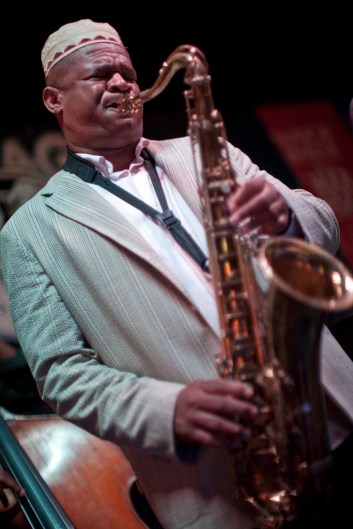
Cutting to the chase: the album I am speaking of is Transient Takes, Chicago saxophonist and AACM member Ernest Dawkins‘ 16th as a leader. Dawkins, 64, is in magisterial form on alto and tenor, shifting easefully between woolly blues, passionate ballads, and no-holds-barred free scrums that unsurprisingly landed the record on two Jazz Iz correspondents’ lists–and at the very top of one of those. Reinforcing Dawkins’ powerful, emotionally complex, and witty playing is Vijay Iyer, one of jazz’s most preeminent pianists, but also one who is frequently accused of being too cerebral and cold (a stereotypical assessment, perhaps). Frankly, Dawkins (if not such observers) seems to inspire Iyer to some of the earthiest playing I’ve ever heard from him–and I’m a big fan. Isaiah Spencer on drums and Junius Paul also provide solid, rousing, and sensitive support, and the crisp live recording makes a very present group performance even more immediate. Transient Takes is one of the best American releases of any kind from 2017; it would have been on my year-end list had I known about it in time, but I’ll vote for it next year anyway!
The catch: Should you like a copy of Transient Takes–and if you are a fan of Dawkins, post-Trane jazz in general, the AACM, the Chicago tradition, saxophone, or Iyer, I believe you should like one–you’ll need to a) trust me re: the above take (or dig David Whiteis’ review in Jazz Times), because there’s not much commentary out there; b) write Mr. Dawkins directly at the following address for a copy ($20 if shipped in the U. S., I think)–because you’ll not find it streaming, or for sale anywhere but from him.
Ernest Dawkins, P. O. Box 7154, Chicago, Illinois, 60680
You might think it’s perverse for an artist not to “get his work out there,” but in this world of free and instant access, I found it refreshing. The process of obtaining Transient Takes took me back to the days when, hunkered down in my college dormitory, I mail-ordered punk albums from Trouser Press.
Note: According to his website, Dawkins is working on two very interesting commissioned projects that might be reason to stay informed.
OK, those were the apples. Now for the oranges….
I will freely admit to being slow to the dinner table when it comes to pop music. I don’t club, I don’t listen to the radio at all, I don’t follow the charts (my nose can’t smell them for some reason), I feel creepy listening to Taylor Swift, I’ve perhaps become too temperamentally and philosophically aligned with the world of underground, experimental, and otherwise marginal music, I don’t trust megasmashes–the list goes on and on. Though when I read Neil Postman many years ago he annoyed me, for some reason when I think of contemporary pop music, I detect him whispering in my ear, “This is what I was talking about.” However, I like to think that, particularly after friends and fellow writers wear me down and I make an effort, I do eventually bow at the feet of the Undeniable Pop Smash.
Cardi B is undeniable. Migos are undeniable. I am warming back up to Ms. Minaj. And–I am feeling my forehead here–I am even interested in Bruno Mars, thank to this:
My Stephens students laughed out loud at me this morning when I told them I had just listened to a Cardi B song for the first time yesterday (true statement). I had distributed to each of them the above Pazz & Jop poll results, and assigned them to highlight every album and song they’d heard, star each one of those they could defend in public, and otherwise notate records they hadn’t heard but were curious about, which filled them with immediate enthusiasm, but also some reticence, especially when I mentioned I’d voted in the poll. I could see on their faces a look that anticipated my stern judgment of their choices, but in response I said, “How smart can I be if I just listened to Cardi B yesterday?”
My ol’ Hickman High School pal and current pop culture instructor Juan Antonio Diaz gives his charges a life soundtrack assignment, but he made the mistake of letting too much word get around, so even his adult peers are trying to turn it in late. This is for my former comrades Jonathan McFarland and George Frissell, too. (Note: I had to go to second- and third-string choices due to some songs’ absence for the playlist function):
1) Opening credits: Roland Kirk/”Serenade to a Cuckoo”
2) Waking up: Eric Bibb/”Turning Pages”
3) Going to school: Tuli Kupferberg/”Social Studies”
4) Falling in love: Bob Dorough/”Love: Webster’s Definition”
5) Breaking up: Harry Nilsson/”You’re Breakin’ My Heart”
6) Prom: Gram Parson/”I Can’t Dance”
7) Fight song: Gene Maltais/”Gang War”
8) Life: Flipper/”Life”
9) Mental Breakdown: Peter Davies/”Eight Songs for a Mad King” (featuring Julius Eastman)
10) Driving: Terry Allen/”Amarillo Highway”
11) Flashback: The Bicycle Thief/”Hurt”
12) Getting married: Warren Zevon/”Let Nothing Come Between You”
13) Birth of a child: Loudon Wainwright III/”Dilated to Meet You”
14) The Final Battle: Lonnie Mack/”Why?”
15) Death: Reverend J. M. Gates/”Death May Be Your Santa Claus” (I wanted Scarface’s “I’m Dead,” but it wasn’t available for playlisting)
16) Funeral: Albert Ayler/”Ghosts”
17) Closing credits: Mississippi John Hurt/”Let the Mermaids Flirt with Me”


 Living To Listen