Progress Report (March 26th, 2018, Columbia, Missouri)p

This was a slow music day–music isn’t the end-all be-all (he sez to himself)–but in honor of the piquant writer Luc Sante’s great essay on the subject for Pitchfork, I thought a lot about Something Else by The Kinks. That album was the centerpiece for a mini-unit series that was a regular part of my practice as a teacher of British literature at Hickman High School. As a way to ease reluctant students into the process of literary analysis, I would guide them through a quick study of the work of notable songwriters from or associated with the British Isles. I’d give them some brief background and guiding questions, provide them a packet with selected lyrics, play each song, then solicit their observations, gradually pulling my own back. The Kinks’ Ray Davies couldn’t have been a more perfect writer for such a lesson: his command of voice, tone, characterization, ambiguity, irony, and droll humor ensured students would walk out knowing more than they did coming in, and that many would leave big fans–especially after “Waterloo Sunset,” which closed the class. That’s a classic example of a song that means far more than its author and most critics have claimed for it–or so my students would annually prove to me.

Please sample the album, linked above, and check out Mr. Sante’s reconsideration of its quality import.

As far as the post title’s concerned, since things are slow, it’s a good time to reflect on how this blog, which I resolved to rejuvenate on New Year’s Day, is faring.

A) I was largely trying to break out of writer’s lethargy, and I’ve posted 86 straight days. Check.

B) My concept was to simply keep a diary of my listening, which I mostly have unless I’ve repeat-played something over several days, which I occasionally do. This was a way to triumph over a fear of having nothing of worth to say, which is largely true, but I’ve surprised myself at least four times, mostly because the unpredictability of daily circumstances has interceded. Still, though, most of the entries are just gussied-up shares of links. Check-minus.

C) It’s become clear to me that embarking upon this undertaking is a way to replace something that’s been missing in my life. I am honestly pissed and sad that the evolution of technology has rendered my making mixtapes pretty superfluous. For probably 25 years, I was often the only person many folks knew who had access to a ton, and a wide range, of music. From party-people pals to students, enough humans sought me out for musical grab bags and commissioned projects that I started taking great pride in fulfilling their needs. I invested many hours and much cogitation, crate-diggin’, taping and erasing, and creative labeling during that quarter-century–then poof! All gone. Should have seen it coming! I mean, it’s not like I couldn’t occasionally find a way to spend a couple hours in my old favorite way–like, recently, providing filmgoers a specially selected Rahsaan Roland Kirk CD to accompany their viewing of the great Adam Kahan Kirk doc The Case of the Three-Sided Dream–but even then, hell, they could’ve Spotified it for themselves. And now I only have 15-25 students a year, as opposed to 125, to whom to preach the gospel. SO–writing these posts at the very least creates the delusion that I’m still playing that old role, which I deeply savored. Check-minus?

D) It’s nothing profound, but as I approach 60, I think about being gone more frequently than I ever have, and, well…these posts proved I walked the turf, and a cornucopia of sounds lightened my step. Check-plus.

E) I was in New Orleans at the beginning of the year, and thus was frequently annoyed at having to knock the early entries out on my smartphone. Would it be easier on my ol’ desktop! Surprise surprise, but I’ve gotten so used to single-finger tapping, I prefer writing them on my phone, though my editing isn’t as careful. Check? Hmmm…

F) I did hope a few friends and other humans might read it. And I am thankful they have. Big check.

G) I have enjoyed this. At least five times, I almost decided to take a day off, usually for a seeming lack of real subject matter; each time, an idea formed that I had to seize upon. Whether it’s teaching, being married, sitting in solitude, or writing into a yawning digital chasm, I have always been driven to embue my activities with…FUN. For me, at the very least. So, a final check.

See you tomorrow, and thanks to Scott Woods, Rex Harris, Kevin Bozelka, Alfred Soto, and Hardin Smith, Expert Witnesses who each gave me a spark to get this going, and to my wife Nicole, who has been living with me and listening for 28 years. It’s not like I won a damned award, but it feels like it, just writing every day.

Thinking Young and Growing Older is No Sin (March 25th, 2018, Columbia, MO)

Sad to say, but most of my friends who are within 10 years of my current age (56) or older are settled comfortably into their musical preferences. Most. This is not to say that the yout’ can’t be fixed in their earways; I teach 19-year-olds that will not venture out of Harry Styles’ circle. Nonetheless, I associate aural adventures with the 15-to-35 set (no science there). And it’s why I’m inspired by my best buddy Mike, who’ll join me at cincuenta e seis in a little bit.

We met at a house party in Springfield, Missouri, in the mid-Eighties and were talking Minutemenese within minutes. Later in the decade, we also shared a bachelor pad, a structure that was a church for beer and the guitar. He was a groomsman in our wedding, and we’ve continued to be Brothers of the Rock to this day.

BUT…Mike struck out earlier this decade into a full-on later-in-life Bob Marley walkabout. It was splendid to hear him enthuse over the phone about Nesta magic he was hearing with fresh ears that I’d not noticed in multiple listenings of the same piece. Marley led him to Fela–no surprise, and as deep, if not a deeper well–which led him one day to engage me in another exaltation-laced phone conversation (mid-February ’17, Trump taint in the air) that then led me, post-call, to drop a good chunk of cash through Bandcamp for new-to-me Kuti cuts. I thought I was on top of the man’s discog, but Mike’s research revealed I’d not fully or properly tapped the source. On top of it, my expense was donated to the ACLU. Here’s what I got, and I’ve worn ’em out:

Now Mike’s ranging further across and around Africa, and a few weekends ago he tipped me to the great Ghanaian musical master Ebo Taylor. He flat-out told me to listen to this album, which I did yesterday, and now I’m not just telling you to, I’m making it convenient:

Thanks, Mike, and, like Malcolm X strove to do, may you continue to refine your music magic detector and share the results with me, to keep me on the path!

Short-shrift Division:

Miguel: War & Leisure–Can’t believe this dude is already 33, but he’s got a big bag of tricks and–don’t take this too seriously, but I am serious–if you miss Prince, this might bring temporary surcease of sorrow. As will its predecessor, Wildheart. Also, he makes a little sumpin’ sumpin’ of the title pairing.

Willie King: Jukin’ at Bettie’s–I’m still raiding the appendix of Robert Gordon’s new essay collection Memphis Rent Party, and this Prairie Point, Mississippi, live recording by an Alabama boogie practitioner put me deep in a hypnotic blues mood. Not as eccentric as North Mississippi hill country trance music, but it finds the itch that just begs a half-hour scratch.

A Perfect Night with Friends and Music (March 24th, 2018, Columbia, Missouri)

Music often plays a part in the Overeems’ social gatherings, and over time I have finally learned not to try to exert control over the hangout playlist. I mean, I am obsessed, my knowledge base is wide and deep, and honestly, if you ever notice me sitting silently in contemplation, I’m probably not contemplating the nature of existence. I am more likely wondering, for example, who played that great guitar on so many Joe Tex hits (note: probably Jimmy Johnson). Seriously.

Last night, we spent some deeply pleasurable time with our friends Janet and David. We picked them up, drove to one of our current favorite getaways, Fulton, Missouri, ate delicious Cajun food at Fontenot’s, and came back to their place to sip maple syrup Old Fashioneds. Main topic of conversation: ol’ Adolf’s single testicle. However, the really weird thing was, I didn’t make a single musical suggestion or try to take over Spotify in the car, and the results couldn’t have been better:

On the way to Fulton:

The full album, containing this, chosen by Nicole.

This house favorite (and several others), streaming over Fontenot’s sound system:

This delightful and fascinating classical composition, proffered by David, an expert in such things (he also, generous man that he is, gave us a copy):

This splendid Carmen McRae live album I’d never heard of, chosen by David to demonstrate his $16,000 turntable that looked like something a cat burgler’d need a glass cutter just to operate:

And these two ol’ chestnuts, demanded by Janet when David returned to Shostakovich and would not let us be (always the Russians these days!):

All very satisfying to me, and I didn’t raise a finger or voice a request. I might even place myself under Russian influence again today.

Short-shrift Division:

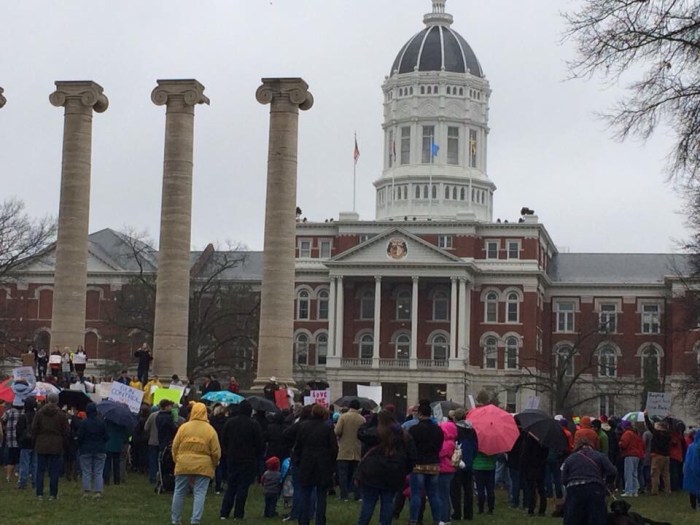
Early in the day, Nicole, our friend Denise, and I participated in Columbia’s iteration of the national March for Our Lives against gun violence.

Sometimes you don’t have to a play a song; it just plays in its entirety in your head. From us, to the heroic Emma Gonzalez:

Lay down your arms, indeed.

Free Man and Woman (March 22-23, 2018, Columbia, Missouri)

March 22

Our anniversary celebration continued as we witnessed a dynamic, playful, and moving performance by the great Chicago saxophonist Chico Freeman and his band. Freeman performed at Whitmore Recital Hall at the University of Missouri’s School of Music (where over 20 years ago we’d heard his legendary father Von); with him were Kenny Davis on bass, the impish young drummer Mark Whitfield, Jr., and a pianist whose name escapes me (as it briefly did Freeman) but who played smartly in the absence of Anthony Wonsey, who was snowed in on the east coast. The show was part of Columbia’s “We Always Swing” series, and earlier in the day Freeman had dedicated the series’ jazz lending library, which is named in his father honor. The elder Freeman, unfortunately passed from this plane, was himself a majestic and original saxophonist of great skill and wide influence.

If you’ve not chanced to hear him play, Chico Freeman regularly captures the same moody, searching tone Coltrane gets in songs like “Equinox.” Like any graduate of Chicago’s Association for the Advancement of Creative Musicians, he’s a heckuva writer, too, and in the AACM tradition, his set, with the exception of one standard that he took apart Rollins-style and introduced with a magic cadenza, the tunes were either his or other jazz players’. The highlights of the show both tapped into the Coltrane legacy: Freeman’s own “Elvin,” an emotional tribute to that giant of drumming, and a set-closing trip through McCoy Tyner’s “African Village.” The concert was engrossing, and we thank Mr. Jon Poses, the mastermind behind the quarter-century-old series, for working tirelessly to bring jazz geniuses like Freeman to mid-Missouri.

The complete set list (w/links to other performances of the songs by Freeman):

Black Inside

Elvin

Free Man” (written for Freeman by Antonio Farao)

Dark Blue” (for Duke Ellington)

“My One and Only Love” (we think)

“To Hear a Teardrop in the Rain”

Dance of Light for Luani” (for his daughter)

African Village” (McCoy Tyner)

March 23

Morning: I celebrated my liberation unto Spring Break 2018 by giving some blood then stirring up what I had left with some more saxophone music, this time courtesy of the Swedish maniac Mats Gustafsson and the band ZU, whose new record, intriguingly titled How to Raise an Ox, is one of the year’s best jazz records. It is not for the faint of heart.

Afternoon: I sampled, on a Xgauvian tip, the new electronic-y Monk tribute by Tim Conley (aka MAST) called Thelonious Sphere Monk. I’ll give anything Monk-oriented a spin, and I did kinda like this–in the right mood I’ll put it on again–but it did smooth out the inventive angles that are one of the many wonders of Thelonious’ music. In a related development, it also makes these famous compositions ideal for occupying a social background–a place they’ve always stubbornly resisted, in my experience. I dunno. Not giving up on it yet.

Evening: After a few margaritas and tequila shots, Nicole, finally freed herself from the grip of public school teaching, and I drove carefully around our neighborhood YELLING THE ENTIRETY OF THE BEATLES’ CLASSIC ALBUM BEATLES FOR SALE AT THE TOP OF OUR LUNGS! Try it some time–it’s good for the soul!

Classroom Clatter, Part 2 (March 22nd, 2018, Stephens College, Columbia, Missouri)

Today was the second and final day of my pop music / comp students’ informal research presentations. From what I already knew about the subjects of the research, I was uncertain if my personal enjoyment level would match Tuesday’s class, but I was pleasantly surprised.

Kathleen Hanna

I assigned Ms. Hanna to one of my very best writers, who’d asked for one rather than chosen her own. Kathleen “does a lot of yelling and uses vulgar language,” she told us, “but after you let it sink in, it’s very interesting.” The kid’s a Joan Jett fan, and she chose a perfect song for us to think upon:

Guiding Question: Where do you think feminism has gone since this song was released in the early Nineties?

Answer: It didn’t really get answered, but some of the other students were able to connect it to personal styles that “are more accepted today.” Yeah–I think so. Plus the presenter enlightened us a bit on fourth-wave feminism!

Whitney Houston

I will admit freely I have never been a fan of the late Ms. Houston, but the student who’d chosen to research her (who earlier in the semester had turned me on to a great metal band) did an amazingly thorough and passionate job of arguing for her. She chose to have us consider two performances, and damned if I didn’t actively enjoy both:

The sweat, soul, grit, and green outfit caused me to yell “Uncle!”

Guiding Question: Actually, the presenter, who will be a great teacher one day if she chooses to try it, asked us a pretty full stylistic analysis that I can’t express as a simple question.

Answer: Well, she answered for us, quite accurately–in general, arguing that her vocal power and dynamics, as well as her facial expressions and gestures, sold the songs. Yep!

Aaliyah

Guiding Question: How would you describe her vocal style?

Answer: “Mellow.” Alluding to a comment made by a student during Tuesday’s class, I added, “That song isn’t about a boat, is it?” I hadn’t heard it since it was forced on me by my middle school students back at the time of its release, and I’d not ever paid attention to the lyrics. The more you know. Please tell me R. Kelly didn’t produce and direct the video…

Pat Benatar

Here is one research subject I was hesitant to approve, because I wasn’t sure how far the student could get, but she was sure she could make a feminist / personal fulfillment argument so I surrendered. The following was difficult to watch stoically after the passage of three decades:

Guiding Question (not my favorite): So how is love a battlefield?

Answer: It’s hard. Well, yes. I wanted to offer that it’s hard to tell if the love referred to is parental or romantic or both, but I chose to remain mute.

Stevie Nicks

The student who’s researching La Nicks can take her study several different interesting directions, and I can’t wait to see which way she decides to go. The young lady presented sans PowerPoint, which won her some minor brownie points with me as she delivered the goods. Her song choice?

Guiding Question: How does “landslide” function as a metaphor?

Answer: like an avalanche, love can overwhelm you. As can research…

An Anniversary Top 10: Recordings That Got Our Love Train Rollin’! (March 21st, 2018, Columbia, Missouri)

Today’s my wife’s and my 26th anniversary. Music was one of the first things that bonded us, and it continues to; I think we both used it as a litmus test on each other as well. It’s only fitting that we now bend our ears to 10 early signpost platters (and other miscellany) that set us on our increasingly great adventure.

Number One: The first album I taped for Nicole–before we even knew what was in store!

Number Two: A segment tape-recorded directly from a film that was one of many highlights on the first mixtape Nicole made me. I knew after this I’d met a live one!

Number Three: The first album we totally agreed upon (before we really knew we were falling in love), which I then gave to her, which we later framed, and which is now hanging by the front door:

Number Four: The cassette I bought for Nicole on my way to meeting her for a Coctails show at Murphy’s in Springfield, Missouri, that wasn’t a date but during which we decided to go steady, baby!

Number Five (Three-in-One): Three albums I think we played every single day immediately after we started dating.

Number Six: The first album I bought for Nicole that she (and I) didn’t like but then chastised ourselves about years later when its greatness finally penetrated our thick skulls and ears (the movie’s great, too). Note: Nicole is adept at spotting albums with great covers and buying them for that reason alone, which was my method in buying this for her, which backfired. I still remember us sitting on her bed, shaking our heads, and saying, “This is legendary?” A temporary chink in the ol’ armor.

Number Seven: The song (and album) Nicole listened to on the way back from an All concert that I couldn’t go to with her, which she said made her think for me, which kept her awake, which is still one of the nicest things she’s ever said to me.

*Number Eight: A highlight from a cassette (Uncommon Quotes) we played continually until we basically had it memorized. I still like it better than any of his books. The old sod could read aloud–his utterances were like music to us! He was a rather disturbing, but indeed effective, spiritual advisor to us as we sallied forth into love:

*Number Nine: Thank God a video store carried this in Springfield back then. We consider John Waters our cultural uncle (we actually invited him to our wedding), we remain ardent fans, and we watched this film in the early days as much for the awesome soundtrack as for its cinematic thrills and spills!

Number Ten: A track from the first great album and band we discovered together, though Nicole actually discovered them first at their concert in New Orleans during which I was incapacitated in the back seat of our friend Kenny’s car, to my eternal regret:

BONUS TRACK!: The bride’s dance at our wedding reception.

*Beginners, take note: Gay geniuses are a fantastic influence on straight couples! That’s a fact.


I Miss Bowie–Lester, That Is (March 19th, 2018, Columbia, Missouri)

Today’s jazz does have a reputation, to a great extent deserved, for being a bit too serious too much of the time. Yesterday, I was reminded of how wonderfully playful the great St. Louis and AACM trumpeter Lester Bowie could be–and he regularly was. Often donning a lab coat on stage, Bowie was not only a scientist investigating the roots and structure of jazz, but also a surgeon who delighted in taking a mischievous scalpel to the genre’s corpus. The genre could currently use someone who extends Bowie’s acumen for aural amusement of the anarchic variety.

On 1974’s Fast Last (listen to the whole delightful album above), several greatly varied warhorses find themselves operated on–sometimes resulting in what one might call anatomical rearrangement. Ornette Coleman’s “Lonely Woman” sounds not all that unhappy about that state of being. “Hello, Dolly!” would seem to be a great risk–how much more jubilant and radiant could one play it compared to Louis Armstrong, one of Bowie’s idols? Turns out if you slap a warhorse on the right flank it might have more get-up-and-go than any listener would have a right to expect. “F-Troop Rides Again”? Well, maybe not–if you think about the subject matter of the associated television series, you can hear Bowie and drummer Bobo Shaw roll the patient out of the hospital and onto a minefield. Besides Shaw, Bowie is abetted on this recording by Lincoln University products (that’s complicated, kind of) Julius Hemphill on alto and John Hicks on piano, as well as his brother and Black Artist Group stalwart (with Shaw) Joseph on trombone. Do not try to read or iron or something like that while this record’s on–it demands, and deserves, your full attention, and you will laugh as you’re surprised by its sounds.

Another great album that will remind the listener how much a sense of humor can add to her enjoyment of a jazz performance is Bowie’s 1975 Rope-a-Dope, with brother Joe and Shaw back on the scene along with Lester’s fellow Art Ensemble of Chicago mates Malachi Favors (bass) and Don Moye (percussion). Their group’s assault / embrace of “St. Louis Blues” is worth the price of admission. By the way, both of these albums are officially out of print but can be picked up as a twofer used as American Gumbo. enjoyed my listening experience so much I picked up the only available copy on Discogs in between my last surge of keyboard pecks.

Classroom Clatter, Part 1 (March 20th, 2018, Stephens College, Columbia, Missouri)

The students of my freshman comp / pop music class formally opened up their final unit with informal presentations on their research subjects. Not that this will thrill any readers, but here’s the research project they’re undertaking:

English 107 Pop Music Research Project: Specification

Objectives:

  1. Form a clear and specific argument about a performer’s or group’s musical work after sampling it broadly and deeply.
  2. Support the argument with both specific evidence (lyrics, descriptions of musical passages, etc.) and expert commentary gathered through research.
  3. Reflect on the connections you made with the performer’s or group’s work, referring specifically to your past thoughts, feelings, and experiences.
  4. Execute a cleanly-formatted MLA research paper that elaborates your argument, presents your evidence in organized fashion, and shares your reflections.
  5. For your final exam, present (through audio only) two of your performer’s songs that demonstrate your research and reflections, setting up each song with guided questions for the class, commenting knowledgeably after each song, and taking two questions (15 minutes minimum).

Restrictions

  1. The performer must identify / have identified as a woman; if a group is chosen, it must be led (or artistically dominated) by a performer who identifies (or performers who identify) as a woman. The performer needs not be currently living, nor does the group need to be active.
  2. The bulk of the performer’s or group’s work must have been produced prior to January 2001.
  3. All genres of work are allowed, as well as any nationality from which the performer or group might have sprung. It is suggested that you select a performer or group from a genre of which you have some working knowledge.
  4. Your argument must be about the work, not about the performer or group as human beings.
  5. You are required to use your preferred streaming/listening methods to listen to at least three non-compilation albums, and at least one compilation. Each album must contribute a work that is MLA-cited in the text of your paper; each album should be listed among your paper’s Works Cited.
  6. Sources must qualify as expert commentary. You will have to research the writers who provide it to determine that. Also, this project requires that you look into at least one book—and you may need to look into more than one.

Suggestions for Arguments

  1. Arguments may focus on themes or preoccupations that are explored by the artist or group in their songs.
  2. Arguments may focus on the artist’s or performer’s style, as it is represented through writing, singing, playing, or arranging. Be conscious of the fact that writing about singing, playing, or arranging may well require specific musical vocabulary and a heightened attempt at description.
  3. Arguments may focus on artists’ or performers’ achievements in the context of their field. Be conscious of the fact that, to make such an argument, one must know the context.
  4. Arguments may focus on constructed personae that artists or groups create through their work.
  5. Arguments may focus on the artistic growth of an artist or group over time.
  6. Arguments may focus on a combination of any of the above, though it is essential that there be a common thread that runs through the entirety of the combination.
  7. No argument may focus on anything not represented by Numbers 1-6.

Additional Specifications for Essays and Final Exam Presentations

  1. Minimum 1,700 words / maximum 2,500 words.
  2. Suggested structure: intro + argument –> background (only essentials) –> presentation of evidence (multiple paragraphs) –> personal reflection –> conclusion (reiteration of argument + statement of performer’s / group’s importance) –> works cited.
  3. Sources: four articles (via databases, trustworthy Internet sources, and periodicals), one book, three regular-issue albums, one compilation album (MINIMUM). Each source should be cited in the text and listed appropriately among the works cited.
  4. Point distribution for essays (detailed scoring guide to follow): grammar and mechanics (10 points); structure (10); argument and evidence (25); personal reflection (20); formatting (10) = 75 total points.
  5. Point distribution for final exam presentation (must be accompanied by a PowerPoint or visual aide): clarity (argument, pre-song guided questions, post-song debrief, evidence) (25 points); speaking attributes (volume, modulation, diction) (12 points); Q & A (3 points).

Scored Components for Entire Project:

  1. Proposal (subject + working thesis)                                                   10
  2. Introductory presentation                                                                    25
  3. Sentence-form outline                                                                            15
  4. Essay rough draft (must be submitted through Canvas)             20
  5. Essay final draft (must be submitted through Canvas)                75
  6. Presentation (final exam)                                                                      40

Total                                                                                                                      185

NOTE: The instructor reserves the right to refuse any request to explore certain performers or groups, but will provide a reason for such refusals. The instructor will also happily provide suggestions regarding performers or groups, or simply assign one to a student upon request (the advantage of the latter option is that you will be assigned a subject that provides a bounty of writing and thinking opportunities).

Now even you hate me, right? Seriously, though, I have been striving to find the right research project to both fit my course design and more easefully transition them into higher-level research demands they’re sure to encounter during their remaining years at Stephens. If I can admit to being excited about a research project, I have high hopes for the reflective aspect of the essay. My aim is that the integration of a section composed of personal insights and a slightly less formal voice with cause the construction and grading of the projects to be less grueling. We shall see. I need to, but don’t want to, write a model.

So: to the presentations. The purposes of these were to introduce the class to the range of subjects under review and give me an idea of not only how much preliminary research students had already done but also how committed and enthusiastic they were about the work. In ten minutes or less, students were required to introduce us to their artists through three important facts and their own initial responses to the artists’ work, focus us with a guiding question about, then play an official video (if available) of, one of the artist’s best works, then lead us in a quick discussion of possible answers to the guiding questions. As usual, I started with a model presentation on Yugen Blackrok (big surprise if you’ve been keeping score) that fell a bit flat (“She doesn’t have beats!”), but at least I snuck in some learning on apartheid and Afro-Futurism. Half the class then presented, as follows:

Guiding Question: “Can you figure out the metaphors used in this song?”

Answer: “That verse isn’t really about deep-sea diving, is it?”

Guiding Question (not a good one): “So, what’s good about the song and what’s not?”

Answer: “Ewwwwwwwwwww. I can’t stand the way she sings. I had to plug my ears.” Another student rushing to the rescue: “I LOVE HER SINGING! She’s so exciting and rebellious!” (Yay.)

Guiding Question (a stellar one): Does Ms. Blige sing with a chest voice or a head voice?

Answer: A little of both–mostly chest, but her head’s in there, too.

Guiding Question (again, good!): Pay close attention to the childhood images in the video, contrasted with Dolly’s adult self, and be ready to talk about that.

Answer: None given to that question, but several new questions posed (“Is she dead?”)

Guiding Question: How would you describe her singing style?

Answer: “Her voice sounds messed up!” Teacher counters with: I hear a core of yearning and loneliness to her singing that fits nicely with the video content.”

We’ll see how Thursday goes, but I must admit, their choice of research topics should make for interesting research and enjoyable reading. Should

Anyone know when Yugen Blakrok was born?


We Interrupt This Music Diary for a Promotional Announcement (March 19th. 2018, Columbia, Missouri–Memphis in spirit!)

Memphis_Rent_Party_grande

If you don’t know who Robert Gordon is, he’s a fine documentary director (check out The Best of Enemies) and stellar chronicler of southern music: his Muddy Waters biography is currently the definitive one. It’s when he’s writing about his hometown, however, that Gordon is most smashing. I have read his It Came from Memphis at least three times and manically thumbed through it about 15 times more: it convincingly argues for that city as the hub of American cultural change through much more subterranean and esoteric means than just Elvis’ pelvis, and, in terms of spirit and tone, it rocks and rolls. It’s also the only book I know that has threeseparatecompanion CDs, all of them magic.

Gordon’s newest book, available preferably from Burke’s Book Store in Memphis but also from Fat Possum (still trying to do their best by offering a companion LP I’d recommend), gathers numerous fascinating shorter pieces and interviews from Gordon’s exciting career observing Bluff City weirdness. I’m not finished reading it yet, but on the basis of the Jim Dickinson and Tav Falco interviews and the appendix alone, it’s worth your ducats. One of my favorite of Gordon’s discoveries so far is the existence of a “Levitt Shell Archive” YouTube channel. The Levitt Shell (formerly the Overton Park Shell) in Memphis’ Overton Park was the location of Presley’s first paid appearance (opening for Slim Whitman), and has not only survived several attempts to raze or repurpose it but is currently a thriving rock and roll/blues/country venue. At its best, Memphis music always contains a dollop of all three of those flavors!

You can spend hours watching clips from this channel. Here are a few that I listened to and loved today:

The great Memphis blues pianist Mose Vinson:

Calvin Newborn, the guitar-playing member of the famous Newborn family:

Alvin Youngblood Hart covering Neil Young:

Also–and, now, you gotta promise to buy it if you like it!–here’s a handy YouTube playlist of the Memphis Rent Party companion.

“I Think I’m Just Going to Listen to This Album First” (March 17th, 2018, Columbia, Missouri)

Distracted by a cat emergency (cats are cooler than humans) and March Madness (I am a species hated in Missouri–a Rock-Chalk-Jay-fuckin’-Hawk), I didn’t get much music in. What I did spin may have been too obviously St. Pat’s-y: Shane MacGowan’s The Snake (see yesterday’s post), The Pogues’ piquantly (and accurately!) titled Rum, Sodomy, and the Lash, and Van Morrison’s It’s Too Late To Stop Now (Volumes II-IV). The former two are indisputably A+ records; the latter piggy-backs on a vintage A+ record but staggers in a B+ / A-.

It’s not like I have a story for every single one of the over 10,000 records I own, or have heard–I’ve not thought deeply about it, and maybe I should. But concerning the original It’s Too Late to Stop Now, I do have one that I bet a few readers can relate to. It reveals something about me that I’m mildly proud of, and mildly embarrassed by. It goes a little somethin’ like this:

I was a senior at what was then Southwest Missouri University. Now it’s rather desperately called Missouri State University. I’d been buttonholed for a double-date opportunity by two old hometown friends who’d been dating forever (they’ve been married pretty much since), and the set-up was another hometown friend I’d always had a crush on but…well…timing is a pain, and when I was hot for her, she was otherwise occupied, and when I was hot for her–she was always otherwise occupied. But at this point–I assumed–she was free.

I have never been smooth. For every hetero male I’ve ever known, sexual intimacy appeared a matter of getting from Point A to Point C. For me? Point A to Point Z–with a videogame-like intricacy of obstacles in between, so complicated seeming that, I will freely admit, I just became determined not to give a shit. If the prelude to sex was a Rubic’s Cube–fuck fucking. Don’t get me wrong: this did not make me happy. But it all seemed the law of diminishing returns. Easier to bow to God Onan, you know.

So, back to the double-date. We went out to eat at some quasi-swank place in Springfield (there were no other kinds of high-end places). I recall a relatively pleasurable time, though my mind was literally racing with ideas about records, films, and books, and that mind-spray was just not gonna be tapped at this soiree. Was I thinking about getting laid? Yeah. I was 21. But it was like imagining you were going to survive The Walking Dead; that’s how it felt to me.

We retired to my friends’ apartment. In our dinner small talk, I’d discerned that my date was still seeing her old boyfriend, another hometown friend whom I’d attended every level of elementary with, whom I’d played many years of football with, and who–other then almost breaking my finger for kicks when I was a 10th grader–had always maintained ace-boon relations with me. The lights were dimmed, the wine was poured. The pre-existing couple faded almost imperceptibly into their bedroom, leaving me and my date. She whispered, “I’m going into the guest bedroom, just to relax some. Grab a beer or something and we’ll talk.”

So what does all this have to do with It’s Too Late to Stop Now? As I sat on the precipice of satiating long-tendered lust, my eyes drifted to my friends’ LP stack. If you’re reading this, I know you do it, too. I do it with books, I do it with music–though I can’t see into a hard drive. In the middle of their modest collection was Van’s double-live record. In the good ol’ “red” Rolling Stone Record Guide, Dave Marsh had “meh”-ed it with three (out of five stars). Because I was a dipshit, and was unwisely smitten with Marsh’s bad attitude, I’d taken that as deific judgment. Still, though–I fucking LOVED Astral Weeks and Moondance, and was in deep like with His Band and The Street Choir and St. Dominic’s Preview. How bad could a live Van performance from that period be? Seriously? I heard my date kind of rustling around in the guest bedroom, so I figured I had enough time to put the first disc of It’s Too Late to Stop Now on the turntable–and buy myself some time to figure out whether I’d be cheating on my childhood buddy (oblivious, some 50 miles away), even though his woman was broadcasting serious overtures right to my thick forehead.

Well, if you know the record, Van’s band is fuckin’ crack, the recording quality is superb, Morrison is dialed in (as he tells an enthusiastic audience member, he’s “turned on already!)”, and the damn thing has dynamics out the wazoo. As Van moved from totally committed Bobby Bland and Sam Cooke covers through very idiosyncratic takes on his own quirky originals, I found myself mesmerized. “Three stars? Motherfucker, this is a FIVE!”

Suddenly, I snapped back to reality. There was a woman, who’d been rustling around, and she was in a bedroom ten feet away. She had seemed to be beckoning me hither–what was that, 10 minutes ago? 20? I got up from my position right next to a speaker, tipped into the bedroom–and she was out cold. I paused on the verge of regret–then tipped back out to listen, happily, to the rest of the record. I sat amazed as Van sang through the songs, and put hooks in the audience’s lips–also, that damn Jack Schroer was a devastating secret weapon on sax.

Better than sex? I’d made the call on that. And looking back across 25 years, I not only hold to that assessment but, corny as it may seem in this era when all bets are off, feel assured that my old first-grade buddy didn’t get betrayed. I have no religion–no God compelled me not to breach a relationship that, technically, was sinful in itself. But–talk about a higher calling in the moment? My moral compass was unerring, at least in that case.