Pair of Threes (July 7th, 2018, Columbia, MO)

Pair of three from Louisiana this morning:

The great Bechet’s intense vibrato and thrilling, surprising upward swings on soprano sound almost avant-garde to my ear. He played pretty masterfully from the beginning of his career to the end; today, I concentrated on his Blue Note recordings (mostly 1940s sides), a reliable place to start for a beginner.

Louisiana’s most ferociously skilled and (one of its) longest-lasting Cajun groups knocked it out of the part with the fairly recent Carencro. Besides their usual solid originals en Francais, they take James Brown, John Coltrane, and Fred McDowell to the swamp. Never underestimate the Brothers Doucet–they can play any damn thing and swing you.

It’s hard to imagine any trumpeter getting within spitting distance of Louis Armstrong’s shining sound, vivacity, and invention–even in the Crescent City. Red Allen of Algiers was one of a few, however, who could, and he wasn’t a bad singer, either. These days, he’s overshadowed, but he enjoyed a solid career into the early ’60s. Here’s where it starts.

Pair of three kinda-sorta “outside” jazz albums this afternoon:

Nicole and I have been fortunate to see one of the great jazz father-and-son teams in person, though not playing together as they do here. Stereo-separated for aural convenience, the two Chicago tenors converse and “reason” (as a Rasta might say), Papa Von sounding just like an eccentric but leagues-wise elder in the left channel, sonny boy Chico in the right blowing open the barn doors like the young turk he was at the time–but able to shut and lock them tight with skill, finesse, and economy, too. Rhythm section’s crack as well.

I went through a Blythe binge not long ago when he passed from this life; I’m back on another thanks to reading of his Watts exploits in service to Horace Tapscott’s Arkestra in the excellent The Dark Tree. The above track is the only one on the abso-fab Lenox Avenue Breakdown during which guitarist James Blood Ulmer’s turned loose–it’s also the only track that’s fully out–but Black Arthur’s piercing, driving, yet lyrical alto remains the main attraction.

Hill’s another player who crossed paths with, and likely was encouraged, if not influenced, by Tapscott. This record’s challenging, even jittery (if that makes sense), the leader and band are in top form, and here’s one of very few chances to hear (Sun Ra) Arkestra star John Gilmore blow his horn in another context.

Hooked (July 6th, 2018, Columbia, MO)

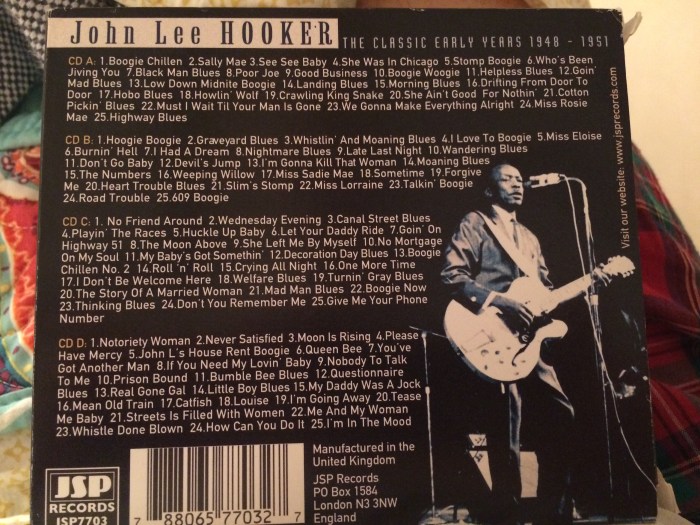
John Lee Hooker. 1948-1951. Stripped down. Foot poundin’. Guitar plonking out a trance-line, then exploding into foreign, menacing noise. Whether they’re lines straight out of his head or he’s repurposing something he’s just heard on the radio, he stamps ’em with his late-night lonely moanin’ sound. Across these tracks, he already sounds old as the Mississippi–his recording career was just getting started, but he was already in his thirties.

Four discs, 100 tracks, played consecutively today and not a bored moment in my ear or brain, and that’s considering the man had three-four structural and rhythmic moves that he preferred to use repeatedly.

To cease with the waxin’ not particularly poetical, if you do happen to be looking for a way in to the world of John Lee Hooker, and you’re into buying material goods, the above set from JSP–the notes aren’t great, but the sound is stellar–will run you around $10 and it’s loaded with goodies: the original and often superior versions of Hooker masterpieces like “Crawling King Snake,” “Boogie Chillen,” “Sally Mae,” “Burnin’ Hell,” “Hobo Blues,” “House Rent Boogie,” and “I’m in the Mood,” plus great rarities like “No Mortgage on My Soul,” “Streets is Filled with Women,” and “Stomp Boogie.” The format is usually John Lee alone, and his stomping foot is miked up high. Maybe you don’t need all four discs, but every American home ought to contain a selection from this period of the artist’s life. On that note, enjoy the video (from about 15 years later):

Note: Living to Listen is hittin’ the fuckin’ road for 16 days starting just before dawn tomorrow. I may not be posting daily, but then again, last time I tried to stop I couldn’t. We’ll be traveling close to 5,000 miles by jalopy, so it might be reports from the road-trip playlist. But we’re listening to books, too, so it may not. Stay tuned!

Tapscott Trio (July 5th, 2018, Columbia, MO)

Up to my ears in a project today, so not much to say other than my continued exploration of Horace Tapscott’s (and UGMAA’s–the Underground Musicians and Artists Association) music continues to bring me great pleasure.

Tapscott plays great on this live recording, as does bassist Robert Miranda, but percussionist Sonship Theus is the star, sustaining an almost ritualistic tension for the better part of the set. Thing about Tapscott: his comrades are purt-near always ready, willing, and able to wreck shop.

Tapscott isn’t present on alto saxophonist/ flautist Dadisi Komolafe’s Hassan’s Walk, but Komolafe is one of the most aggressive players to emerge from UGMMA, and the rhythm section is the same as above, and equally impressive. Though Komolafe does fine on Monk and Shorter covers, his own title tune lets him step all the way out, and the tone he establishes on the traditional “Calvary” lives up to the song’s title.

Yep, this one is Black Panther-commissioned and Black Panther-sung, but the band arrangements and the group piano is Tapscott–enough to get him an FBI file.

Short-shrift Division:

I can only go with an album trailer here, but the energy and repetitions are so intense and even wild that, though it would drive most sane folks insane, it just might be my favorite jazz record of 2018. If you know Roscoe Mitchell’s Nonaah, imagine it ablaze.

Buzz Me, Baby (July 4th, 2018, Columbia, MO)

In the great George Jones documentary Still the Same Old Me, Johnny Cash, near tears, recalls raising a toast with Nick Lowe to The Possum: “To the best damn country singer in the world.” I get that feeling when I listen to Louis Jordan, as I did today while making tamales with Nicole. Jordan wasn’t exactly the best at anything, but his sly singing, ripping alto playing, sharp bandleading, and sterling songwriting and -picking touched almost everybody within earshot who was anybody in the next generation–by their own admission. Ray Charles (think of his boisterous version of Jordan’s “Let the Good Times Roll”), Sonny Rollins (think of Newk’s grabbing tone and mischievous wit), Bo Diddley (think of his “Say Man” series), and Leiber and Stoller (can you really imagine The Coasters’ 45 RPM comic slices of black life without Louis’ example?)–they were all touched. Further support for Jordan as a holy conduit from swing to rock and roll is that all roads to the matchless American landscape that flowed from Chuck Berry’s mind must travel through songs like “Ain’t Nobody Here But Us Chickens,” and that’s not even to mention Tympani 5 guitarist Carl Hogan’s riffwise influence on Berry. In short, this was patriotic listening today, and it wasn’t even that facile, as Louis still had a little toe inside the minstrel tent (listen to “What’s the Use of Getting Sober?”). He tears me up ’cause he had a vision that was fruitful beyond his own realization.

Short-shrift Division:

As long as Strut Records keeps sending me their subscription-only reissues, I’m gonna rep ’em. Vox kinda corny, rhythms and guitar not AT ALL.

Aaron’s never been better than on these gospel classics, sharpened and deepened by Joe Henry’s production and studio aces, augmented by none other than Allen Toussaint’s subtle, elegant touch.

For the house 4th of July activity, we watched one of the great rock and roll movies of all-time: Luis Buñuel’s The Exterminating Angel. If you haven’t ever, you might do it now for resonance’s sake:

Are You Sure Outlaws Really Done It This Way? (July 3rd, 2018, Columbia, MO)

Some simple forays into the music today.

On a prestigious critical recommendation, I sampled Armadilloes & Outlaws, a new compilation surveying country’s “Roaring ’70s” and purporting (or seeming to purport) to represent the range of players involved. I am already well-versed in the stuff, but I’d heard there were surprises. There were a few good ones: a Jessie Colter tune I really dug, a new-to-me Tom T. Hall cautionary, an incandescent early version (I think–I have no notes) of “Dallas” by the Flatlanders, and Lou Ann Barton taking on an Irma Thomas classic fronting an early version of Stevie Ray’s Double Trouble. But. The rest of the solid tracks are totally predictable. The proto-outlaw Doug Sahm is unaccountably missing–his influence is too strong for him to be omitted, and there’s plenty cross-licensing power behind the collection. [CORRECTION: Sahm’s “Groover’s Paradise” (and a few others I didn’t hear yesterday, are included in the album but not available for streaming, for some reason. Those significantly upgrade the overall quality—but I still consider it an infield single, if you will.] And there is baaaaaad shit. David Allan Coe’s “I Still Sing the Old Songs” is unspeakable Confederate apologist nostalgia; the usually good for a laugh Bobby Bare and the overly vaunted Jerry Jeff Walker are avert-your-ears dated; and Michael Murphy should have just kept on ridin’ into the cosmos–out of earshot. I usually abjure the dis, but this compilation could have been leagues stronger, and more representative.

I am reading Steven L. Isoardi’s outstanding overview of the South Central Los Angeles jazz scene and social environment surrounding the too-little-known giant Horace Tapscott, The Dark Tree; the title comes from one of Tapscott’s greatest compositions. I’m only a quarter in, but today I encountered a story of a bespectacled alto saxophonist who entered Tapscott’s circle, which was filled with fearsome players, and just cut heads. Jimmy Woods was the name, and agile, speedy, inventive lines were apparently his game. I look forward to more musical discoveries from Mr. Isoardi.

Self-Determination (July 2nd, 2018, Columbia, MO)

Just a day of powerful music.

Early, early morning: the great clarinetist John Carter and the unsung trumpeter Bobby Bradford make the greatest Ornette Coleman album not actually made by Ornette, with the criminally unsung bassist Tom Williamson keeping it anchored:

I think most folks think M.I.A. is over. Has been over. But on ‘phones, listening to Matangi, I think they’re wrong. I’m with her politics, and I appreciate the abrasive sexiness:

Afternoon: folks, Wynton Marsalis can play, teach, and converse. I’ve long resented his tight-ass views, but having seen him and the Lincoln Center jazz orchestra wail, I surrender. And this comp of live performances does the impossible: justifies the hoary white icons hornin’ in on the NOLA thang. Dylan and Clapton don’t bite it, Buffett doesn’t sound like a fuck, and Lovett actually survives a “Trouble Man” rip. James Taylor is still marked for death, and Natalie Merchant needs to just stop. NOLA trad jazz can redeem almost anyone:

Early evening: If you don’t know the great Johnny Thunders solo album So Alone, shame on yer ass. Besides featuring his inimitable one-trick guitar, it perfectly captures his matchless stray cat, streetwise, born to lose, girl-crazy, doomed persona. On Record Store Day this year, one of the few attractive items was a “alternative” version of So Alone. Sucker bait–for sure. Horrible title: So Alonesome. Dubious label name: Remarquable Records. But goddamit, they even had procured some alternate album art, and subbed “Dead or Alive” and T-Rex’s “The Wizard” into the 10-song running time. Verdict: by god, it’s a must for fans of the original, and any “new” together Thunders is essential subject matter for those who are hangin’ back, bored shitless.

Short-shrift Division:

Spa 700 (with Moor Mother): 700 Bliss and Moor Mother X Mental Jewelry: Crime WavesListen to your mother, come on! She knows what’s up…and what’s down:

Ring The Alarm (June 26 – July 1)

Out in the real world, in real time, it was a terrible, terrible week. Maybe these years are like a bad boil that’s eventually gonna be lanced; maybe they’ll leave a nasty scar that’s never going away. As I told a friend, I’m a hair away from despair, but music, love, and liquor has seen me to this Sunday. As is my custom, here’s a Spotify playlist that contains the best tunes of the week, should you care to partake. I’m hoping that one day I’ll want to (be able to?) look back and see how I stayed sane.

Aaaaaand…this week’s awards!

Plucked from History’s Dustbin (best recent purchase of an old record): Blackfire, One Nation Under.

Grower, Not a Shower (old record I already owned that’s risen in my esteem): Soft Machine: Third.

Encore, Encore! (album I played at least twice this week): Nidia, Nídia É Má, Nídia É Fudida

Through the Cracks (sweet record I forgot to write about): Spa 700 (with Moor Mother), 700 Bliss; Wynton Marsalis & Friends, United We Swing.

Sunday’s Children: The Mekons 77, John Coltrane.

Talk About a Dream (June 30th, 2018, Columbia, MO)

We’re talking about particular records. The question for today is, do you remember records from your teens that presented you an alternative life? I had one. Bruce Springsteen’s Darkness on the Edge of Town, released when I was 16, posited a life, a culture, a town, a world that was so far from my own it was ridiculous. I was literally forced to get my driver’s license–driving terrified me, and even when, after three tries, I finally got my license at 17, I drove a ’63 Plymouth Belvedere (I totalled that one), a ’74 Dodge Dart (granny car!), and (somewhat impressively) a ’71 Pontiac Bonneville–and I couldn’t have worked on or talked about a car’s guts to save my life. Classwise, my mom was stay-at-home, and my dad made a very humble salary, but I always thought we were well-off, quite contrary to the abyssic confrontations in Springsteen’s most personal songs.

HOWEVER, I did in fact feel alienated ’77-’80, my high school years. I postulated a life about 35 degrees higher an angle than what I was seeing. Something a bit more dramatic, where the stakes were higher, where “the things we loved” that were “crushed in the dirt” were what we, nonetheless, strove for–it seemed my peers were shooting for something a little more casual, and temporal. When the rubber met the road, the record affected me this way: I meant it, man–sincerity was my goddam calling card, and as much as I thought that would be what set me apart, it was the thing that shot me down in flames. If I had just gotten my hands on The Dictators’ Go Girl Crazy instead, I’d have ended up less tortured. I vowed to show up in Candy’s room with total commitment; perhaps I should have striven to be a two-tub man, or a teengenerate. I did not, absolutely did not get, that girls just wanted to have fun–they weren’t interested in someone who was necessarily gonna get them the fuck out (maybe that’s more Born to Run), or blow that Camaro out in that first heat, they wanted to laugh, fiddle around, figure it out, exercise their hormones, and get on down the road.

Thus…this record is very important to me, but I am not sure it didn’t fuck me up.

If You Were in The World’s Greatest Record Store, and You Had Enough Money for One Record, and You Didn’t Have ANY of the Records You Have Now, Which One Would You Buy? (June 29th, 2018, Columbia, MO)

I apologize for that mouthful of a title, but what else was I going to call this? Today, I’m listening to the record I bought when I was virtually in the situation it describes.

I was 19 going on 20, a sophomore at the University of Arkansas, and I’d scraped up enough money to road-trip with three friends to New Orleans to see the Rolling Stones at the Superdome. I had gas money, food money if somebody would only feed me ONE meal, beer money if the beer was very cheap, I had my ticket in hand already–and I had a ten spot to spare. For incidentals.

Up to that point, I’d shopped in my hometown record store (Ken’s Records, in Carthage, Missouri), an equally small store in Joplin, Missouri that really, really catered to Elvis Costello fans, a few mall outlets (cut-out heaven!), and two shops in Fayetteville, a kind of headshop-cum-bootleg emporium called Record Exchange and a decent-sized (I thought) store called White Dog. By the point of the New Orleans trip, I owned maybe 50 records, eight-tracks (yes–can you imagine listening to Van Morrison’s Into the Music on one of those), and cassettes, all of ’em housed in my dorm room. Imagine dealing with a record collection in college today! I’m sure a few folks do–but with much less reason, and with CDs dead, I wonder how many of today’s students can shell out $29.99 for a 180-gram vinyl copy of Dookie? Looking back, I’d call the gems of my collection–the ones I thought were gems–Public Image’s Second Edition, Professor Longhair’s Crawfish Fiesta, 1969 Velvet Underground Live (with grooves already worn and my name stamped on the label!) and Fenton Robinson’s Loan Me a Dime. Because I thought the artists were obscure, I assumed to records were hard to get, and that White Dog carried them because they were an untoppably cool store.

I knew little little about New Orleans at that point other than an unrealistic fantasy of the French Quarter, a sports nerd’s familiarity with the Saints and the Jazz, and Fess, whose above album had been listed in a year-end poll and which I’d bought strictly on the merits of his strange name and the provocative album title. There was no Internet, so I didn’t even know Mr. Roy Byrd was from New Orleans until I read the album credits. Getting my bills and coins together and doing my best to budget, I figured that, given all the other things we’d be doing, a ten-dollar bill, folded into a little square and hidden in a special crease of my wallet, would be all I’d need if we even found a record store that had good records.

About 11 hours later, the four of us were wandering on the south end of the Quarter, down by Jackson Square, and shuffled into an impressively two-storied record store called Tower Records (this is my memory at work with regard to the geography). I had damn-near memorized the old orange first edition of The Rolling Stone Record Guide–I may have known a few things about New Orleans from it–especially all the five-star record covers I knew to look for if I was lucky, and definitely the great albums that, at that difficult time in record fiend history, were out of print, among them most of the Velvet Underground’s, Stooges’, MC5’s, and Dolls’ studio releases. We talked about those all the time. I was so certain I wouldn’t see any of them that they were way off my radar–honestly, I can’t remember what I was looking for. I do remember being stunned, and paralyzed, bu the sheer volume of the store’s inventory.

Within ten minutes–and, by the way, we didn’t have all the time in the world–I’d already spotted both of the Dolls’ Mercury albums and Dr. John’s Gris Gris. I know I didn’t see any Velvets albums or I would have gotten one of those–maybe I didn’t have time to get to the “V”s–but I dimly recall staring into Ig’s mug on the cover of The Stooges. We had places to go and things to do–we’d soon see Keith and Ronnie duck into doorway on Royal, and we could drink legally, which we would, of course, at Pat O’Brien’s–and the dudes hollered at me to hurry up and make a decision. Also, I had to pee so badly I was in exquisite and excruciating pain. It all just figured.

Panicked, I flipped through a last random row of records, barely scoping the titles and tearing my cuticles, when I landed on this one:

The cover looked great, I was for damn sure a fan of the Killer already, I knew his history and “live in 1964” sounded like a good bet, and–I had to fucking go. Out of all the great records in the most amazing store I have even been in to this day, I impulsively scoped and grabbed that one without the barest calculation, fished out that tenner and hit the banquettes.

Perhaps I do not need to tell you that Jerry Lee Lewis Live at Star Club, Hamburg, Germany 1964 is only barely arguably the greatest live rock and roll album ever recorded. The Killer is in absolutely furious form, totally in command, so on fire he’s audibly amazed at his own mastery (now think about that for a second), roaring through his hits and other folks’ so as to put them in deep, dark relief–has anyone ever cut Little Richard, Elvis, and Hank Williams on one record?–and captured in phenomenally rich and clear fidelity for its vintage. It was so damn good to me I’d write a paper about its virtues the next semester (my only straight A out of a run of B-plusses and A-minuses–Dr. Bob Henigan was tough!), and here I am 36 years later, rocking out to it on about “8” and still in possession of my original copy, as well as two separate CD editions. It is that good.

If I were able to carry everything I know now–the memory of everything I’ve ever listened to as I’ve sat agog, and my mental files on the, oh, 5-6 things I’ve still not been able to find–back to the moment before I chose this record, and happened to find myself divested of the 10,000 or so I currently own, I would buy this one again. No hesitation.

Which brings me to the title question for the reader. Feel free to comment to this post with your answer, because I’d really like to know it and, especially, the story behind it. One thing I’m fairly sure of: it won’t feature the artist chanting his own name along with the crowd, then stopping to shout at them, “Alright–alright already!”

Latin Lightning (June 28th, 2018, Columbia, MO)

Fresh from knocking out my first-half-of-’18 list, a fellow music maniac tipped me to several new records I’d missed, mainly because they’re from Latin America and Mexico and haven’t shown up in my usual channels. I haven’t made my way through all of them, but the two I have heard, ahem, made a serious impression.

Legendary Brazilian singer Elza Soares (listen above) has a fairly new record out. This is notable for at least two reasons: she’s 81 and feeling 19, and has succeeded in following up a very impressive previous record (and big favorite of mine), A Woman at the End of the World, issued just two years ago. Like its predecessor, Deus E Mulher (I think that translates to “God is a Woman,” and I’ll buy that) is influenced by the innovative angular rhythms, instrumental alienation effects (that’s a compliment in these parts), and skillful Brazilian music syntheses of her country man Tom Ze–only her vocals add an allure Ze would have difficulty matching (she’s been called the Brazilian Tina Turner, but that’s a bit inexact). The guitars, and keyboards that sound like guitars, sound like they’re strung with concertina wire and scraped with scrap-iron picks, and Soares ducks in and out of their accents when she’s not riding just above them. Also, the compositions flow a little more consistently here, which may be a downer for more adventuresome listeners (I’m one) but I consider an improvement.

I was also encouraged to sample another current Brazilian release, Anelis Assumpção’s Taurina. While this record’s a bit more conventional–pretty clear samba and bossa nova influences, though never really freaked into anything Tropicalia-like–it’s also fetchingly sung, very catchy, and possessed of the seductive, flirtatious movement the country’s musicians have minted. However, don’t get the idea it’s too smooth; you can also count on Brazilian guitarists to keep you honest, as Ms. Assumpção’s do on several tracks, especially “Segunda a Sexta.”

My happiness with those platters sent me back to something I listened to in a somewhat distracted mode last week and loved out of the corner of my ear. This time I bore down, and was not disappointed; in fact, Nidia’s Nidia E Ma, Nidia E Fudida is one of two recent electronic dance music albums created by women that have bewitched and beguiled me over the last year and a half, the other being the somewhat mysterious JLin‘s footwork masterpiece, Black Origami. At least, I think Nidia’s work is EDM; informed sources tab it as the Angola brew known as batida, Apple Music calls it “bass,” and given Nidia’s Portuguese heritage, its ingredients may account for happy impurities that make for what it sounds like to me: original, mind- and feet-engaging, and just this side of being undanceable (hence the JLin connection). Fortunately for a stiffly-bending 56-year-old like me, it’s fun to listen to and think about, and I do not sell our youth short–I am sure some kids can step between her startling and surprising beats.

Short-shrift Division:

The little “Make Me Choose Between Two Bands” game on my Facebook wall is near to stretching into its third week, with thousands of comments, new participants every day–and some repeat pairings, such as today’s “Al Green or O.V. Wright?” That’s one I didn’t have to let marinate either time; as deep-soul amazing and intense as Wright is at his best (with the same studio band behind him as Green enjoyed on his Hi hits), that’s like Hercules (only half-God) vs. Zeus–wait, maybe I mean Eros. Yeah. Full god, deity of love and sex. Anyway, yeah–AL. But I had to get out MCA’s handy Duke/Peacock label compilation, The Soul of O. V. Wright just to be fair. If you don’t know the man’s work, suffice it to say that he invests titles like “I’d Rather Be Blind, Crippled, and Crazy,” “Ace of Spades” (easily as tough as Motorhead’s), “Eight Men, Four Women,” “A Nickel and a Nail,” “Drowning on Dry Land,” and “He’s My Son (Just the Same)” with the exact commitment, grit, barely contained agony, and verisimilitude that you’d dream. Not only that, but could he bring gospel warhorses like “Motherless Child” and “Don’t Let The Devil Ride” (here, jiggered into “Don’t Let My Baby Ride”) back from the graveyard of overexposure. I hope I just demonstrated that the pairing was fairer than it seems.

After that dose of O. V., I had to keep that Memphis rhythm rolling, and reached for Ann Peebles: The Hi Rhythm Years. I try not to take folks for granted, but if you happen to be a big Al Green fan and always sit amazed at Willie Mitchell’s production and the Hi Rhythm Band’s prowess (Howard Grimes on drums, Teenie Hodges on drums, and Do Funny Hodges on slithery organ, especially) on Green’s hits, and you haven’t heard St. Louis’ Ann Peebles in front of the same band–change that not. You’ll be forced to give this 99-pounder credit where it’s due and beyond, or she’ll tear your playhouse down. She might just anyway.