We have a tradition in out house over Dr. King’s weekend: we listen to the Impressions. The best of Curtis Mayfield’s writing for the group consists of delicately coded messages of encouragement for black Americans during the civil rights struggle, the most famous, perhaps, being “People Get Ready,” “I’m So Proud,” “We’re a Winner,” “It’s Alright,” and “Keep On Pushin’.” The titles do not suggest much coding, but the lyrics can be heard (and were heard by many, I am sure) as deeply romantic. A deeper dive into the Sixties Mayfield songbook, however, will reward you with more complex gems, such as “Long, Long Winter” and, especially, “Isle of the Sirens.” The former would resonate powerfully with Mayfield’s fellow Chicagoans, both in their activism and their tilting against that cold wind they call “The Hawk,” but it’s the latter that stuns me most. First, have a listen:
On the surface, as perhaps the only pop music representation of an episode from The Odyssey, it’s stunning enough: the lyrics, which could easily have been strained, are expertly crafted; the vocal arrangement reinforces the fact that the episode (and America’s climate) threatened a group; and the guitar? If you’ve ever wondered why Jimi Hendrix was so rapt in his attention to Mayfield, think of Jimi’s gentler compositions and listen to this again. But beneath the surface, the shout of “Keep course!” is where the real action is.
I wish Mayfield’s songs weren’t still so relevant and necessary. We’ll be playing them all day Monday.
Short-shrift division:
Guitar-heroes : Bassekou Kouyate and his ngoni army, wailing as a coup is being launched outside the studio walls in Bamako, on Jama Ko.
Injuns comin’ (it’s Carnival Time): Donald Harrison, Jr. stitching tribal chants into modern jazz on Indian Blues
Joy from Acadiana: the magical soundtrack to J’ai Ete au Bal– see the movie, luxuriate in (and dance to) the music.
Who are the artists whose releases you buy sound unheard, critical word unread? I am assuming this is a practice of yours, and that you do still buy music. Mine have changed over the years. In my twenties: George Jones, Minutemen, Replacements, Husker Du, Prince, anything George Clinton-related, Tom Waits. In my thirties: Public Enemy, Mekons, The Oblivians, James Carter. Over the past 17 years, though (my forties and fifties), skepticism’s cold hand has fallen on my shoulder and my coin has not been offered so automatically. When it has been, it’s been for artists with unique vision who live on the margins, like Tyler Keith, Swamp Dogg, Bobby Rush, MF Doom. Today, I spent time with two of those.
Ever since I first laid ear to Jean Grae, she’s been one of my favorite MCs. She has a flintiness of tone that reminds me of Rakim, a winning emotional tension created by toughness and vulnerability, a deadly and surprising pen, and, until recently, a consistency that satisfies my preference for album artists. One terrific Grae record even fans of hers may have missed is Evil Jeanius, created in collaboration with Blue Sky Black Death. All the above qualities are in play, but of special note is the mesmerizing “Threats,” which features multiple cascading Etta James samples that reinforce them:
Elsewhere, the team makes use of one of John Cale’s violin stabs from “Venus in Furs.” Though I can’t help but encourage Jean’s recent attempts to diversify artistically (into singing, television, and books), it’s not been great for her rapping, but I’ll still buy any record she releases.
I have a weakness for old folks who’ve prospered doing very unconventional things on the margins for decades. Such is the case of Poughkeepsie’s finest, saxophonist/trumpeter/percussionist/composer Joe McPhee.
McPhee, who turned 78 in November, makes wonderful music out of blips, blaps, squeaks, squeals, wails and whispers. The unconverted have been known to say that all free jazz sounds alike, that such artists are “just playing” anything, but I’d know a McPhee performance a mile away. Joe’s new record, Imaginary Numbers, on Clean Feed, showed up in my mailbox yesterday, and did not disappoint. Try this:
Short-shrift division:
Roxy Music: For Your Pleasure. I love post-Eno Roxy, but I wish he’d stuck around a little longer.
Shame: Songs of Praise: Read in The Guardiantoday that these guys could be the next punk thing in the UK. I wasn’t knocked out, nor was I repelled–I guess I just want to note that today was the day I first heard them (across a room and hallway’s distance, and not cranked, so I need to return to the record).
After reading an article on death cleaning, I’ve been pruning my CD collection. I do this annually anyway, but this round, well…hundreds are going out the door and to our wonderful local shop, Hitt Records.
While loading up a Zapp’s box to haul away, I noticed two items I had second thoughts about and decided to give them one last spin. Turns out they will remain in the stacks. I must be brief as I’m fading:
Various Artists: Spirit of Malombo – Malombo Jazz Makers, Jabula and Jazz Afrika 1966-1984
Strut Records does a great job, but all I could remember from my first spin was repetitive and somewhat drifty percussion pieces. I must have been distracted; at times, it’s like Mongo Santamaria and Blood Ulmer are jamming, with focused intensity.
Various Artists: I’m Just Like You–Sly’s Stone Flower 1969-70
Don’t be fooled by the dates: if you’ve always had a jones for …there’s a riot goin’ on and Fresh, like I do, you may have to own this collection of Sly-produced side projects, prominently featuring that drum machine that he used so expertly on his own records. I was getting rid of it because it seemed patchy, and it is, but, as is Light In The Attic’s wont, it’s well-packaged and sharply annotated, with a fairly recent interview with Mr. Stewart. And those rhythms? Yeah.
Short-shrift division:
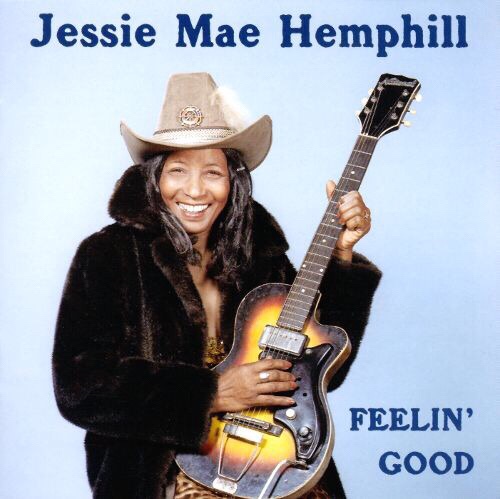
Fat Possum never did a record on Como – Senatobia (MS) she-wold Jessie Mae Hemphill, but if you’re fan of the North Mississippi Hill Country drone, you need her Feelin’ Good. (I was not getting rid of this, by the way.)
I spent the afternoon listening to all five discs of the heralded American Epic box set while reading about race, labor, inequality, and the deafening sucking sound of American capitalism’s profit vacuum really cleaning “the carpet.” I’m not going to go into all that, but I will say that this collection will cross-reference about any decent book you might be reading while it’s playing.
Some simple observations:
1) I got it for Christmas, as every American household should have, for free, at the cost of the government.
2) The shit holds up extremely well after almost 90 years. In terms of emotional intensity, lyrical wit, and, heck, catchiness, it makes much current American music sound sleep-walked through.
3) As an owner of the Harry Smith Anthology of American Folk Music, American Epic‘s predecessor and model, I can confirm the sound is audibly improved (sometimes astonishingly so), there’s not that much song overlap, the non-Anthology selections are astute, the lyrics are consistently a trip, and the annotations are mostly primary sources–the performers themselves when possible–rather than scholars.
4) Not just because it’s different than the Smith collection–and it is, it’s got a different organizing principle–but it occurred to me that I no longer like Greil Marcus’ adjective “weird” in his famous quote about this stuff. It’s not weird; in fact, it’s the sound of normal humanity wrestling with life. Maybe it sounds weird to many of us because we’re more effectively repressed…not to say muzzled.
5) At $45 (the price I see most frequently), it is a bargain, baby. I’m thinking about buying one for a former student!
A favorite of mine from each disc for you to sample if you don’t know what this is–and, folks, there are no tracks that are merely good among the 100:
Disc 1:
Disc 2:
Disc 3:
Disc 4:
Disc 5:
Short-shrift Division:
I am still cranking The Best of the Ronettes in “The Lab”–my nickname for my truck cab, where I can be fully immersed. Such divine and sexy salvos!
Sometimes the words, no matter how irritating they are, just don’t matter. This band, and its sometimes too randomly glib front man, went a long way toward proving that, forcing me into a love-hate relationship with them that felt resolved today when I activately enjoyed the album of theirs I once most despised:
Sometimes, the music might be underwhelming, or maybe a bit cliche-ridden, but when the right words are hung on its bones, they can transform the music into something special. I hadn’t listened to these Brits in a good long while, but this record sounds better than ever. Their front man, still at it with an excellent record released in 2017, may be the only songwriter ever to end a verse with the word “dissipated” (a rhyme, of course).
It’s only words / And words are all I have!
Short-shrift Division:
Greatest live vintage soul recording you’ve never heard? Johnnie Taylor’s Live at the Summit Club? I dare you not to get swept up in the sweat and guile and soul claps here, driven home by a furious “Jody’s Got Your Girl and Gone.”
The Best of the Ronettes: Oh man. That foxy quaver riding atop that mammoth clatter!
I spent the first half of the day rearranging and alphabetizing about one-fourth of my CD collection–you don’t want to know how many that is. I was on the verge of despair, as I’d just lost the organizing thread about two years ago and had been having trouble finding things. It had started as a “new acquisitions” section, then turned into a Chinese dragon that wound out of the living room into the family room and back to the guest bedroom. I can hear you whispering, “This guy’s in trouble.” I did get the project finished, though, thanks to a big boost by Princess Nokia out of NYC, and the deluxe version of her new 1992 mixtape. Best new stuff I’ve heard in MONTHS; the kid’s got spunk, nips (which she actually praises in a verse), sass, brains, and talent. I was already in love with it when this came on and fixed the hook deep in my lip:
Sports, fast food, fashion, sex, school: she’s interesting about it all. She even convincingly brags about her physique, winningly, too, because by her own account she’s not Beyoncé and could care less. I was actually hurt when the thing was over! I’d listened to Charli XCX’s Pop 2 just prior*–that youngster’s pretty good herself (very much assisted by sensational production), but the Princess knocked her out the box. I strongly suggest you download 1992 like now! This shit even motivated me to alphabetize my New Orleans shelf!
Short-shrift Division:
That wise old man Mose Allison dropped a killer-diller before he died, packed with his typical eye-twinkling wisdom: The Way of the World.
Makaya McCraven’s Highly Rare is even better, I think, than its predecessor. He’s got a thing: a cut ‘n’ paste jazz percussion jam style with a bewitching groove. No surprise this is out of Chicago.
Now I’m listening to Smithsonian’s Letters from Iraq, which is quieting and beautiful.
*The reader will notice I ate my veggies today (see yesterday’s entry) and am better for it.
Get caught up with some hot new youth music that one can dance to. I had two such albums in the chamba: Charli XCX’s Pop 2 and Princess Nokia’s 1992 (Deluxe), the latter of which I am quite excited about hearing.
What I actually DID do:
Listened to two of my all-time favorite albums of New Orleans-based music, both starring famous Mardi Gras Indian Big Chiefs: The Wild Magnolias(with Bo Dollis and Monk Boudreaux, plus Snooks Eaglin on guitar) and The Wild Tchoupitoulas (with George Landry, plus Ziggy Modeliste on drums). Definitely danceable, still sounds young, oh so comfortable to my ear, heart, and mind. All triggered by a friend changing his Facebook profile to a Mardi Gras Indian pic. Hey–it’s…
Also, to create a great environment for Nicole’s cooking, I played Eddie Cleanhead Vinson’s absolutely magnificent Kidney Stew is Fine, on which he is supported by none other than Jay McShann on piano and T-Bone Walker on guitar, and the out of print Down the Road A Piece: The Best of Amos Milburn, on which you can hear where Johnnie Johnson probably picked up some tricks. That latter also has the great Maxwell Davis on sax and arrangements.
Short-shrift department: All those 45s I bought in Louisiana, plus the Sarayah CD, which I repeat-played all over again.
There was a time when you couldn’t just stream, steal, or buy any piece of music ever recorded–in fact, a few works are rather elusive even now. I remember at the advent of the CD so many items I’d only read about but never seen in a store appearing before my eyes: The Velvet Underground and Nico, Funhouse, Out to Lunch. But even then, much very legendary music was either trapped in legal limbo or poorly distributed. I miss such exciting moments now, but in the latter half of the 1980s, if I saw an outlet mall along the highway, I never passed it by, because (this is just one example) you could always find King label r&b and country reissues (actual releases, not compilations) in the cut-out bin for anywhere from $5 to $8. The voracious but not particularly scholarly or careful folks at Gusto Records had snapped up all of King’s stuff (apparently, STILL has the rights to it!), and just slopped it out with no annotation or attention to sonic enhancement. I didn’t care about that then at all: I just relished the opportunity to actually hear George Jones’ raw Starday hits, the classic Stanley Brothers’ albums, and–especially–the Five Royales’ and Midnighters’ tracks that some argued might be the real beginning of what we used to call rock and roll.
Yesterday, I loaded the CD player carousel with Rhino’s ace compilations (now, like those Gusto cheapos, also out of print) of those latter two bands, Monkey Hips and Rice and Sexy Ways (respectively). They still sound HOT! The Five Royales, in particular, sound more amazing every year, thanks to Lowman Pauling’s nasty six-string knife-throwing and astonishingly varied and adult songwriting. The classics? “Right Around the Corner,” “Slummer the Slum,” “Tell the Truth,” “Think,” the original “Dedicated to the One I Love,” “When I Get Like This” are just a few. As a Missourian, sometimes I think subversive thoughts when I listen to this stuff and think about Pauling in comparison to the much better-known and officially lauded Chuck Berry. The gospel-fired group and solo vocals of the Royales (mostly courtesy of Johnny and Eugene Tanner) are nothing to sneeze at, either.
Hank Ballard’s Midnighters, in most ways, aren’t really in the same league (they even had to change their name from the Royals to avoid a confusion that probably would have benefited them). But Ballard’s unbridled, lusty hollering across the great “Annie” (and “Henry”!) series still sounds exciting and dangerous. And, though you might expect that the sequels would be sound-alikes, “Annie’s Aunt Fannie,” “Annie’s Aunt Fannie,” and “Henry’s Got Flat Feet” are distinct compositions that stand on their own, especially due to Ballard’s inventive lyrical twists and fiery contributions by Cal Green on guitar and the great Arnett Cobb on tenor. The expertly selected tracks include Ballard’s original version of “The Twist,” his JB-beloved ballad “Teardrops on Your Letter,” and the late dance masterpiece “Finger-Poppin’ Time.” Not that Hank forgot his meat and taters, as “Open Up the Back Door,” “Look at Little Sister,” and another sequel, “Let’s Go Again (Where We Went Last Night).”
I am happy that, via streaming, any listener can likely experience anything by these groups seconds after they learn about their existence (if they ever do, in the rushing tide of new). But I miss the thrill (and duration) (and surprises) of the hunt. It’s hard, but it’s fair–I hope as much to the artists’ estates as the listeners’ learning, but I have my doubts.
Short-shrift division:
I was in an experimental jazz groove otherwise.
Jason Moran’s fizzy and appropriately loose-limbed Fats Waller tribute, All Rise.
Listened to two unlikely records today made by some stereotype-busters.
One artist hailed from deep Acadiana, and–though he did go on to play in the Cajun super-group Lil’ Band of Gold–studied and sang Gregorian chants, worked with Phillip Glass, Talking Heads, and Laurie Anderson, and created, through tape-delay and overdubbing, the incredible one-man record 15 Saxophones. Supposedly minimalist, the sound is maximal–a swirling storm of horn, a fever dream of reeds.
The name? Dickie Landry.
The other artists (actually, a group) had made their names backing everyone who was anyone in country music in the 1950s, often innovating on their instruments. But in 1960, they were invited to the Newport Jazz Festival (they also liked to swing!), and though a youth riot kept them from taking the stage, they knocked out some joyful jazz for a small yard audience after the riot was quelled, a performance recorded and released under the title After the Riot, credited to the Nashville All-Stars.
All-Stars? Do the names Hank Garland, Chet Atkins, Boots Randolph, and Floyd Cramer ring any bells?
Hey! You get full albums!
Short-shrift Division:
The absolutely stellar live companion to the Preservation Hall Jazz Band’s magnificent 2017 studio recording, So It Is, called Run Stop and Drop (The Needle), recorded where else but Preservation Hall in NOLA. It’s looser, and a bit hotter, than the official release. Here’s a KEXP in-studio performance to tease you (guess the shrift wasn’t that short):
I’ve been resolving to write more frequently, and meaningfully, for a year, and a fat lot of good that’s done me. I’ve always been good at attributing blame for my inaction, and 2017 gave me plenty raw material: a national predicament with distraction as its personality, multiple part-time jobs that were “interfering with my creative continuity,” my 55th year of life–which, for me, somehow symbolized the absurdity that I would have anything meaningful to say about music–and my lifetime bibliomania (“Why write when I can read?”). You name it, I have had it handy: enough excuses not to write as there are cards in a deck.
Well, no more!
I’m serious!
Nudged by a fellow music fanatic’s comment on a question I stole from Rough Trade Records’ Twitter feed and posted on a music forum, I’m attempting to make journaling about my listening a daily habit (along with, let’s see, meditation, exercise, reading 80-100 pages a day, I’m sure there’s more–I am a habitual man). Perhaps I’ll have something stimulating to say, but, at the very least, when someone asks me what I’ve been listening to today, or lately, I’ll be less likely to reply as I have been lately: “Ummmm…let’s see…uh…dammit…I can’t remember!” That, after, usually, a day when I’ve listened to several hours‘ worth of music. All of the technology in my life is reducing my need for memory, and that scares the living fuck out of me. Fear: the great motivator.
I shall now sally forth. I doubt every entry will be this detailed when I’m back to work, but I will strive for it.
Last night, the final one of a truly terrifying year, found us holed up in this hotel, watching a decent movie (Ingrid Goes West), playing Phase 10, and, of course, listening to a tsunami of music, while a 40-degree drizzle reigned outside. Rather than just be scrolling through song choices every five minutes, I utilized some YouTube playlists I’d created. Since I, wisely or unwisely, subscribe to YouTube Red, we didn’t have to hear ads; this comes in handy in my pop music/freshman comp class at Stephens College, when I’m using them for instructional purposes.
One of these was a “life playlist” I’d created for a fellow instructor, Juan Diaz, when I was teaching high school at Hickman. He’d made the assignment for his pop culture class and I couldn’t help joining in. You’ll have to guess at what kind of life event each song represents. Or maybe you’d better not.
Another was a Top 20 mix that plucked a dandy song off each of my favorite records of 2017. I was a bit nervous about how some of the songs would land on Nicole’s ear, as she’s (mostly) a staunch American music classicist; in particular, she adores ’50s and ’60s electric Chicago blues and Dinah Washington. Fortunately, she didn’t seem to mind some of the stranger items on this playlist. Listening to the great young EDM artist JLin in the context of her fellow Top Tenners gave me even more confidence that I’d rightly placed her in their company.
We closed out the evening and the year with an in-progress companion I’m making for music scholar Rich Kienzle’s fascinating but prosaically titled out-of-print Great Guitarists, within the pages of which I’ve found many obscure classics, several included here:
Through the vodka-smudged chambers of my memory, I believe Elmore James’ exploding, abrading slide guitar was the last musical sound I heard in 2017.
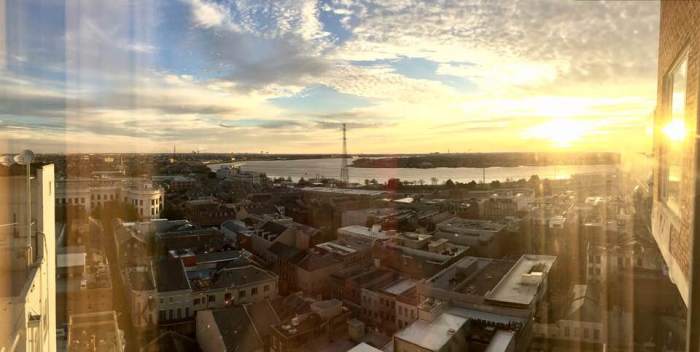
This morning, after arising and pouring down some coffee, Nicole and I went up to the roof to see the early morning sun shining over The City That Care Forgot. The best view accessible to us, unfortunately, was in the stanky hotel fitness center, but the hotel employee in charge noticed us taking pictures and snuck us into the super-secret rooftop conference room, the view from which was stunning.
Blissed out by such views, we went down to the hotel restaurant to dine (in case you’re curious, I enjoyed–I mean enjoyed–chicken-fried green tomatoes, boudin blanc, and poached eggs–but no cocktail). Every time we’ve eaten at Criollo, the music has been fantastic; they lean heavily on ’50s Verve-label jazz, but it’s clearly curated, not just thrown together. While waiting for breakfast to arrive, we heard Ella Fitzgerald’s version of Rodgers and Hart’s “Bewitched, Bothered, and Bewildered,” a song I knew best from Anita O’Day’s version, which I thought definitive. After all, who better than the headfirst-into-the-flames Miss O’Day to convey the exquisitely detailed and varied pain suggested by the lyrics?
I’m often wrong, and I was again. Ella’s often written of as projecting a girlishness, but her delivery almost sadistically twists ecstasy and injury in a manner only available to someone who’s been to the bottom of lust’s (and love’s) well. Here, try it yourself, and check Hart’s lyrics, which I assume from what I know of his sex life were written about a man:
I must away to attend to finishing Richard Lloyd Parry’s haunting account of the destruction of a school and most of its students and teachers, Ghosts of the Tsunami: Death and Life in Japan’s Disaster Zone. Cheerful stuff, but masterfully written.


 VS.
VS. 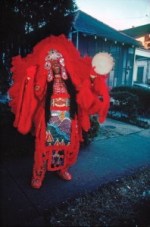
 Living To Listen