Category: Uncategorized
The Best Band in America, Live in the Studio, Seattle
I Recommend an All-Time Desert Island Top 20 (plus a 50-item appendix to prove I am not an old fart) to a Class of 12th Graders
Temporarily deluded that they might want my advice, I put together a list of rekkids I believe every true United States citizen should own for my 12th grade students last week. What follows are a link to a Spotify playlist I put together to further induce them (again, I am deluded: they prefer YouTube), the list of 20 accompanied by annotations aimed at them–as opposed to specialists–and my roughly 2001-2014 old fart repellent Top 50. I am already regretting choices–where’s Neil Young’s Rust Never Sleeps?
1. Bob Dylan (with some help from The Band): The Basement Tapes. In my not so humble opinion, you are not a true United States citizen if you do not own a Dylan album. This one’s special. Having recovered from a possibly faked motorcycle accident in the middle of some freakish fame, Dylan retired into the country with his pals and wrote some ageless songs that conjured the mysteries, absurdities, and tragedies of life. Curiously, few young Dylan fans have tried it.
2. The John Coltrane Quartet: A Love Supreme. For 37 minutes, the most obsessively questing jazz saxophonist of the 1960s communes with his Higher Power. Some of the most powerful spiritual music ever made in this country. If you don’t believe in Higher Powers, simply dig a 37-minute composition in three distinct movements that will set your soul on fire. If you don’t believe in souls, give your ears a present. Note to drummers: Check out Elvin Jones on this recording. You think you don’t like jazz? Try this before you make up your mind.
3. Hank Williams, Sr.: 40 Greatest Hits. The Hillbilly Shakespeare, as he is known by adepts, wrote 50 of the 100 greatest country songs of all-time before spina bifida, quack doctors, the one-two combination of his mama and his ex-wife pounding away at his self-esteem, and his own self-destructive ways sent him to meet Jesus at 29. And he could sing a little bit—especially if you like voices that channel unvarnished yearning, heartbreak, despair, dread, and, on more than a few occasions, joy. If you don’t know him, our educational system has failed you, but surely you know “Hey, Good Lookin’” and “Your Cheatin’ Heart”? Attention students of African descent who might not feel country music has anything to do with them: at Williams’ massively-attended funeral in Montgomery, Alabama, more blacks attended than whites; plus, the man learned his basic stuff from a black musician. Great American music: NEVER SIMPLE.
4. Minutemen: Double Nickels on the Dime. At this point, punk rock peaked in terms of how expansive it could be and still be called punk rock. Then…the slow decline. “Our band could change your life.”
5. Al Green: Greatest Hits (Expanded Edition). Speaking of Reverend Al, and speaking of the world’s greatest singers, he sounds great enough in his mid-‘60s (check out his most recent album, produced by ?Love of the Roots), but when he was ruling the charts in the ‘70s, no one, not even Aretha Franklin, could match his range, command, and pure seductiveness. This version includes a DVD that shows that his voice was not the only weapon in his arsenal; also of interest is one of Memphis’ greatest studio bands, totally in synchronization with even the most sudden improvisatory impulses of the star.
6. Billie Holiday: Lady Day. This two-disc set showcases 1) a singer of limited range but unmatched intelligence and instincts who could alchemically turn song-crap into eternal gold and who utterly changed one somewhat significant guy’s approach to singing (Frank Sinatra, anyone?) by flirting with the beat, usually trailing titillatingly behind it; 2) an assortment of studio bands that represented the greatest jazz musicians of the Thirties, specifically including Lester Young on tenor, who laces accompaniment through Holiday’s vocals like vines through a trellis; 3) many of the greatest pop songs ever produced in this country—ones she didn’t have to transmute.
7. Professor Longhair: Crawfish Fiesta. Having spent five or six of the greatest weeks of my life (including my honeymoon) in New Orleans, and recognizing that its people have the most indestructible spirit in the country, I’d have to have something from the Crescent City with me while lying in the sand. “Fess,” one among many piano “professors” in the New Orleans tradition, invented his own style: a gumbo of boogie woogie, rhumba, blues, and traditional second-line parade rhythms that is sheer intoxication. No one’s yet matched it, and all New Orleans pianists and most of the city’s citizens have pledged infinite fealty to him. He wrote the Mardi Gras theme song. And he is one of the greatest whistlers in music.
8. Sonic Youth: Daydream Nation. The sound of the apocalypse, made primarily by two guys who tune their guitars differently for every song. How’s apocalypse sound? Fun, scary, surprisingly, relentless—like a rollercoaster ride.
9. Bob Wills & the Texas Playboys: The Tiffany Transcriptions, Volume 3–Basin Street Blues. Wills will always be my hero. First, he had the genius to love blues, country, jazz, Native American and Mexican and German folk music, fiddle breakdowns, pop toons—purt-near everything in the American musical lexicon—and play it all with panache, and to think of adding drums to country music (this would lead to rock and roll). Second, the camaraderie he engendered as the leader of his band is intoxicating—the sound of love of music and friendship and playing for the people and really digging American noise, played with expert chemistry, intuition, and—especially—perfect looseness. Third, his measure for whether the band was any good on any given night was whether people danced. Hell, even I can dance to Bob Wills.
10. James Brown: Star Time. Despite his rather inglorious final years and passing, Butane James aka Mr. Dynamite aka The Hardest Working Man in Show Business aka Soul Brother #1 was no joke. Surviving absolutely harsh poverty and abuse—read about it, and weep (I kid you not)—rising above detention homes and early indifference to music, he not only invented funk, became a vital part of the Civil Rights Movement (he single-handedly saved Boston from being at least partially burned to the ground after MLK was murdered), trained a legion of ground-breaking musicians, put on the most exciting show on earth night after night (check out Live at the Apollo, Volume 1 or II), influenced politicians but left and right, but…a big but…there’d be NO rap without his beats. NONE. Pay your respects, children. This is a cheap four-CD box that will never let you down. I tell no lies when it comes to music.
11. M.I.A: Kala. I simply cannot dream of a point in my future where I will not love this album. Incredible beats, imaginative and disruptive sound effects, a somewhat terrifying and exhilarating view of international upheaval, high comedy, sex appeal—and you can dance and think to it at the same time.
12. The Beatles: Beatles for Sale. This is the Beatles on the brink of artsiness and thus pretentiousness—pre-Rubber Soul, pre-Revolver, pre-Sgt. Pepper’s, the run of albums that provoked John Waters to call the band “those honk(ies)…who ruined rock and roll.” To my ear and mind, it is the Beatles at their very best; John Lennon especially is on his game. The sound and songs range from desperate (“I’m a Loser”) to ecstatic (“Eight Days A Week), from celebratory (“Every Little Thing”) to disconsolate (“I Don’t Want to Spoil the Party”)—never artsy or pretentious. Plus, many of the songs are unfamiliar to the youth of America circa 2010.
13. Motorhead: Orgasmatron. At once, a denunciation of war and a musical celebration of its power. Too fast for metal, too heavy for punk, too smart and honest for both genres, Lemmy Kilmister’s hard rock machine has never packed more punch than here.
14. Public Enemy: It Takes a Nation of Millions to Hold Us Back. Rap albums have a short shelf life: what sounded great in 2009 might sound stiff by 2010! The question of which rap album would reward 1,000 playbacks on a deserted island is a tough one, but no one—not even Public Enemy itself—has caught up with the explosive beats and disruptions of this record (at the time, equally popular with black and white listeners), and no single rapper—not even Chuck D himself—has caught up with this MC’s sustained command and invention. For comic relief, there’s Flavor Flav at his sickest.
15. Muddy Waters: Hard Again. As one of the songs here argues, the blues had a baby, and they named it rock and roll. With the amazing Johnny Winters producing and playing flaming slide behind him, the man from whom The Rolling Stones took their name demonstrates authoritatively that age is just a concept, hollering and celebrating manhood as if he’d just turned 21, instead of 63. And NO blues record sounds this great cranked up to 11.
16. Howlin’ Wolf: Howlin’ Wolf/Moanin’ at Midnight. Never was a nickname more appropriate; in fact, one could argue, the nickname isn’t menacing enough to do justice to Chester Burnett’s bone-shattering voice. Combined with Hubert Sumlin’s crazed solos (they gave birth, more or less, to Eric Clapton) and delivering several of the greatest songs in modern blues history, mostly written by Willie Dixon (“The Little Red Rooster,” “Back Door Man”—that’s right, the one The Doors covered—“Goin’ Down Slow,” “Asked Her for Water (She Gave Me Gasoline),” “Killing Floor”)—that voice, once you have heard it, will be impossible to forget.
17. The Ramones Leave Home. 1-2-3-4! The band that stripped rock and roll down to its bare essentials—most of you could learn a Ramones song in a week, even (maybe especially) if you don’t play—was also surprisingly complex in its use of persona and irony, consistently hilarious, and more fun than any American music that doesn’t come from New Orleans.
18. The Coasters: 50 Coastin’ Classics. “Charlie Brown.” “Yakety Yak.” “Along Came Jones.” “Little Egypt.” One by one, the seemingly innocent rhythm and blues hits march out of this collection, usually led by King Curtis’ tenor sax and ace harmonies. Then you notice that some of these hits—“What About Us?” “Run Red Run,” “There’s a Riot Goin’ On,” “Shoppin’ for Clothes”—have code laced into their chants. And they do, thanks to two Jews (Jerry Leiber and Mike Stoller, also authors of “Hound Dog” and “Jailhouse Rock”) dedicated to scripting parables of civil rights for a group of black singers. That is rock and roll.
19. The Best of The Sir Douglas Quintet. Not everyone can invent style. Then again, not everyone writes songs titled “You Can’t Hide That Redneck (Underneath that Hippie Hair”) or keys a psychedelic Summer of Love ballad to the line, “You just cain’t live in Texas/If you don’t have a lot of soul!” Sir Doug (Doug Sahm) honed his chops in San Antonio and had his mind blown in San Francisco, and the result is Tex-Mex (or, as he called it, conjunto) rock and roll: bluesy guitar, punchy horns with border flavor, one helluva flexible beat, soulful but bent singing—and the addictive polka-styled (!) Vox organ playing of Sahm’s sidekick, Augie Meyers. See also Sahm’s Tex-Mex supergroup, The Texas Tornados.
20. Van Morrison: Moondance. Maybe rock’s most perfect “perfect album.” From the singing to the writing to the playing to the arrangements to the production, it seems to emerge from a euphoric dream of the past, and the worst songs—to my ear, “Moondance” and “Crazy Love”—have become standards. And for all that, it’s still eccentric, thanks to an Irish expatriate who gets stoned on a drink of water, dreams about Ray Charles, and promises a revelation to his lover—if she’ll only turn up her radio, into the mystic.
In case you think I’m an old fart…my Top 50 from the last fourteen years of our lives:
1. Bob Dylan: “Love and Theft”
2. Outkast: Stankonia
3. The Dirtbombs: Ultraglide in Black
4. Todd Snider: East Nashville Skyline
5. D’Angelo: Voodoo
6. Detroit Cobras: Mink, Rabbit, or Rat
7. Drive-By Truckers: The Dirty South
8. Lil’ Wayne: Da Drought is Over 3
9. MF Doom and Madlib: Madvillain
10. The Hold Steady: Boys and Girls in America
11. James Carter: Chasin’ the Gypsy
12. Merle Haggard: If I Could Only Fly
13. The Handsome Family: In the Air
14. The Coup: Party Music
15. Ghostface Killah: Fishscale
16. Shaver: The Earth Rolls On
17. The Best Bootlegs Ever
18. Tom Ze: Jogos de Armar
19. Warren Zevon: The Wind
20. Mr. Lif: Emergency Rations
21. Serengeti: Dennehy
22. Johnny Cash: American IV: The Man Comes Around
23. Bettye LaVette: I’ve Got My Own Hell to Raise
24. Balkan Beat Box
25. Gogol Bordello: Super Taranta!
26. Tinariwen: Imidiwan: Companions
27. The Perceptionists: Black Dialogue
28. Art Brut: Bang Bang Rock and Roll
29. Glasvegas
30. Crunk Hits, Vols. 1 & 2
31. Tom Waits: Orphans
32. Arcade Fire: Neon Bible
33. Elizabeth Cook: Welder
34. Girl Talk: Feed the Animals
35. Jay Reatard: Blood Visions
36. Leonard Cohen: Live in London
37. The Baseball Project: Frozen Ropes and Dying Quail
38. Mulatu Astatke/The Heliocentrics: Inspiration Information
39. Girls: Album
40. Jean Grae: Jeanius
41. The Roots: How I Got Over
42. Wussy: Attica!
43. Group Doueh: Zayna Jumma
44. Youssou N’Dour: Egypt
45. Martha Redbone Roots Project: The Garden of Love: Songs of William Blake
46. Hayes Carll: Trouble in Mind
47. Natural Child: 1971
48. Our New Orleans
49. Tyler Keith and The Preacher’s Kids: Romeo Hood
50. Mariem Hassan: El Aaiun Egdat
Good to My Earhole: Listening Top 10, April 12 – April 18, 2014
I blew off the Drive-By Truckers, who were in town (the new one isn’t moving me yet). But it wasn’t all bad.
1) Lazy Lester: I’m a Lover Not a Fighter (Ace/Excello). God bless the Excello label and Jay Miller. The R&B, blues, and soul they released was distinctly country-flavored, with no small dose of Louisiana mixed in. The great Slim Harpo is their gold standard, but if you haven’t sampled Lester deeply, he’s callin’ your name. Drawling, behind the beat and taking his time, he waxed nearly as many memorable tunes as his label mate, prime among them “Sugar-Coated Love,” “I’m a Lover Not a Fighter,” and “Take Me in Your Arms” (all here). He also backed numerous other Excello artists, and is still out there on the road.
2) Chuck Carbo: “Second Line on Monday” and “Meet Me With Your Black Drawers On”: Carbo was one of the finest and versatile but most underrated of NOLA’s r&b kings of the ’50s (when, primarily, he was the lead vocalist in The Spiders). My wife Nicole and I have been plotting a move to New Orleans (a surprise I am sure is not big to careful observers of these Top 10s), I’ve been reading Jeff “Almost Slim” Hannush‘s The Soul of New Orleans, and my research has happily turned up these two examples of Carbo’s longevity from the 1980s, when he put these songs on the permanent ‘OZ Mardi Gras playlist.
3) Khaira Arby: “La Liberty,” from Festival Au Desert: If you are a completely unabashed appreciator of beauty and passion in all musics, you NEED a chanteuse of Saharan desert blues sand-blasting through your speakers. Mariem Hassan would seem to rule the roost in this category, but this live track from one of Timbuktu’s last (pre-revolution) festivals shows Arby’s right on her heels. The whole rekkid’s amazing but hard to find; if you want to dip into the genre, a better starting point you cannot find.
Watch an entire Arby concert on NPR:
4) Big Star: Third/Sister Lovers (Rykodisc): It takes a special occasion for me to put this on in my ma-toor-ity, but Holly George-Warren’s excellent Alex Chilton bio caused me to pull it from the shelves, and it made for a weirdly pleasant lava-flow afternoon. Definitely as sui generis as anything this sui generis artist ever produced, and it’s got “codeine” stamped all over it. Jim Dickinson was at the controls, and that just made it worse/better. Enjoy the full damn album, courtesy of You Tube (I paid for mine):
5) Dead Moon: “Poor Born,” “40 Miles of Bad Road,” “54/40 or Fight”: The great Fred Cole, who’s hardcore commitment to DIY–in music, in life, in romance, in child-rearing–has spanned right on 50 years, has been recuperating from heart surgery over the past week, and I can’t get him off my mind. Mastermind behind The Weeds, Zipper, The Rats, The Range Rats, Dead Moon (THE ultimate cult punk band), and (currently) The Pierced Arrows, so down-to-earth he appeared at my high school for a free show, he deserves as much support as the cognoscenti can muster–so I played these three faves over and over. You should, too.
A vintage performance of “54/40 or Fight”:
6) Earl King with The Meters: Street Parade (Fuel): Perfect title for this pairing of two Crescent City institutions, one an influential guitarist (are you familiar with Jimi Hendrix, who covered one of his tunes?) and songwriter (did you know he wrote this?), the other an R&B instro act that often makes Booker T and the MGs sound…stiff. When your drummer is Ziggy Modeliste, a street parade will be in the mix.
7) Johnny Adams: There is Always One More Time (Rounder Heritage): They don’t call him “The Tan Canary” for nothing. Possessed of both a penetrating yet silky baritone as well as a shocking falsetto, Adams laid down stunning tracks on a fairly consistent basis from the late ’50s all the way into the lower reaches of the ’90s. This collects the best of his late phase. If you dig Sinatra, you have no excuse to ignore an exploration:
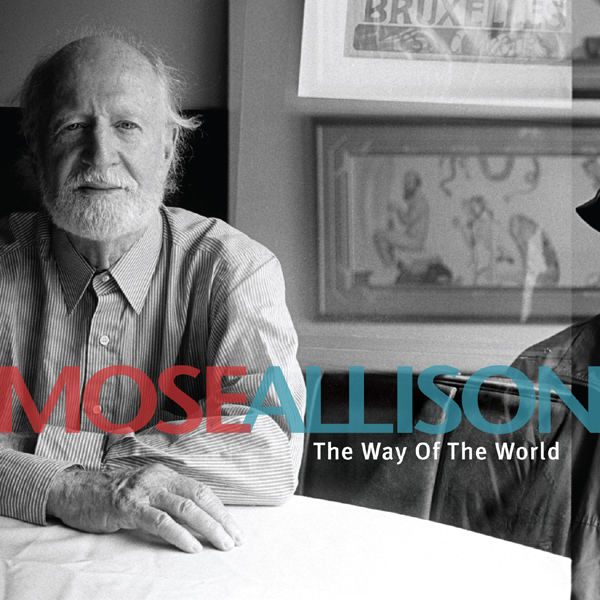
8) Mose Allison: Way of the World (Anti-): “An old man/Don’t get nuthin’ in the world these days.” Well, he didn’t write that, but he wrote the very similar line (and song) The Who made famous at Woodstock and on Live at Leeds. Too many folks slept on his last release, exquisitely produced by Joe Henry (who’s never done a job I haven’t admired), and are un-American for doing so. Mose is all precision on the keys and, as always, brainy on the lyrics, one of the best of which lauds his octogenarian brain–as long as there’s coffee available. A national treasure–give him his props, before the heartbeat stops.
9) Beausoleil: “Bessie’s Blues”/”I’ll Go Crazy”/”You Got to Move,” from From Bamako to Carencro: Not sure anything like this has been done in Cajun music, or any kind of Americana–a cover sequence moving through nuggets originally composed by surprising guiding lights John Coltrane, JB, and Mississippi Fred that doesn’t stumble once. The twin genius axes of Michael (fiddle) and David (guitar) Doucet are at peak levels of invention, passion, and dexterity. I’d try to link it, but, trust me: just buy it.
10) Sisyphus (Secretly Canadian): It’s tempting to dismiss this as sissy fuss, with Sufjan Stevens on hand and Serengeti continuing to threaten to waft away into the indie-sphere. But, at least to my ears, there’s something original and even encouraging in this almost-formula: Stevens (often) provides a plaintive frame for a more substantial and (at least relatively) gritty narrative/inner monologue/confession by ‘Geti. Son Lux lays down the beats, that last word one that gatekeepers would put in quotes. Just gotta say, it gets to me in a near-prophetic way: the ‘burbs and the urbs joining forces to try to communicate a complicated reality.
Listening Journal, Southern Journey, March 29
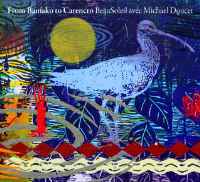
We spent much of the day on the road, heading to Oxford and the premier of the documentary SUB-SIPPI and saying a sorrowful goodbye to the best trip to New Orleans we’d ever taken. Of course, no trip in an Overeem vehicle will be unaccompanied by music, and I must make a fervent pitch to my readers about one rekkid we listened to en route: Beausoleil’s FROM BAMAKO TO CARENCRO. I would argue, and few, I believe, would dispute me, that Beausoleil is and has been the finest Cajun band on the planet for decades. Leader Micheal Doucet is a genius fiddler and a highly underrated and very passionate vocalist…and crafty. Guitarist David Doucet, as I noted a couple of days ago, is such a skilled, ringing, and fluid guitar player he begs comparison to the great Doc Watson. The rest of the band are no slouches. However, with bands this great comes consistency, and haunting consistency is ennui (really, that’s the listener’s fault), and that syndrome may be the reason you don’t hear them talked about much anymore. In the case of FROM BAMAKO TO CARENCRO that is unfortunate. Along with the usual spirited originals and traditional songs one expects from a Beausoleil album, the Doucets engineer several daring and successful experiments: a moving, desert-tinged tribute to their fellow humans in Mali; an audacious and slyly joyful ride through Trane’s “Bessie’s Blues” (jazzers never cover that!); a visit north to Mississippi to convert Fred McDowell’s “You Got to Move” to Cajun funeral music; and, perhaps MOST audacious, an assault on that great LIVE AT THE APOLLO opener, “I’ll Go Crazy.” Even P.J. Proby couldn’t pull THAT off–and I can just imagine how the band’s faithful cut a rug to it in concert. I would link tracks, but they aren’t up on everyone’s free platform, YouTube. Just trust me: this is the best Beausoleil album, and thus the best Cajun album, in years (their last, ALLIGATOR PURSE, was also stellar) and you MUST buy it. That’s an order. Here is the Spotify link for the album, at least.
In Oxford, we heard some great soul music while we were dining at Ajax’s on the square (specifically, Ann Peebles’ “99 Pounds”), and, as I had at Coleman’s BBQ in Senatobia last week, I looked around at the older white diners and wondered what they were thinking and feeling in ’63 and ’64. You never know. But James Meredith’s statue at Ole Miss got vandalized about a month ago, and time takes its time making things go away.
Go see SUB-SIPPI. I was under the influence of medicine and not at my best, but it is a thoughtful and hopeful commentary on the many good things about the state. My favorite segment focused on a black elementary student who had turned to gardening to help him manage his behavior. The screening was at The Lyric Theater, and was preceded by a band performance (The Blues Doctors, and that’s how they sounded–it’s a horrible band name, but the duo were likely both actual physicians) and–the bane of concertgoing, in my not-so-humble opinion–a DJ set. I am not sure what place bad ambient rhythm had at such an event, but, as Nicole often says, it always sounds like porno music, say, from some glossy Japanese urban erotic film. I know this would be a stretch, but how about some music from…MISSISSIPPI? It wouldn’t have to be blues, just local. And don’t tell me the DJ’s constructions were original, and therefore regional; the closest he got was a snatch of Gil Scot Heron–and he was from Kentucky.
Listening Journal, Southern Journey, March 28
Today would have been a wonderful day to report on music. The plan, among other things, like eating at legendary soul food haven Dooky Chase’s and exploring the Irish Channel, was to have included seeing one of our favorite musicians, Alvin Youngblood Hart. Hart was playing in power trio mode at dba’s on Frenchmen; besides being a stellar guitarist and singer, he has a phenomenal musical comfort range: from Charley Patton to Black Oak Arkansas, from Western swing to Beefheart. We could not wait–the perfect capper to a transcendent trip. Not to mention that troubled trombonist/activist/traditional-gospel man about NOLA Glen David Andrews, another favorite of ours we were introduced to through the great documentary SHAKE THE DEVIL OFF! and The True/False Film Festival, was playing at The Three Muses, also on Frenchmen. Woah!
Then, already a little bugged by what I thought were allergies, I came down with a full-blown case of respiratory hacking and general fatigue–not helped by BUCKETS of rain dumped on me in 60-degree weather in the late morning. I ended up back at the hotel, down for a three-hour count while Nicole explored the Oak Street area via trolley.
By 7:45 pm, I just didn’t think I could hack it. But Nicole had nabbed me some ultra-Sudafed, and in a half-hour I felt game at least for a ride-walk out to Frenchmen to eat and stroll. Hart didn’t go on til 11, and Andrews would have already been through his set by the time we got there. Still, it would be a nice “so long” to The City That Care Forgot.
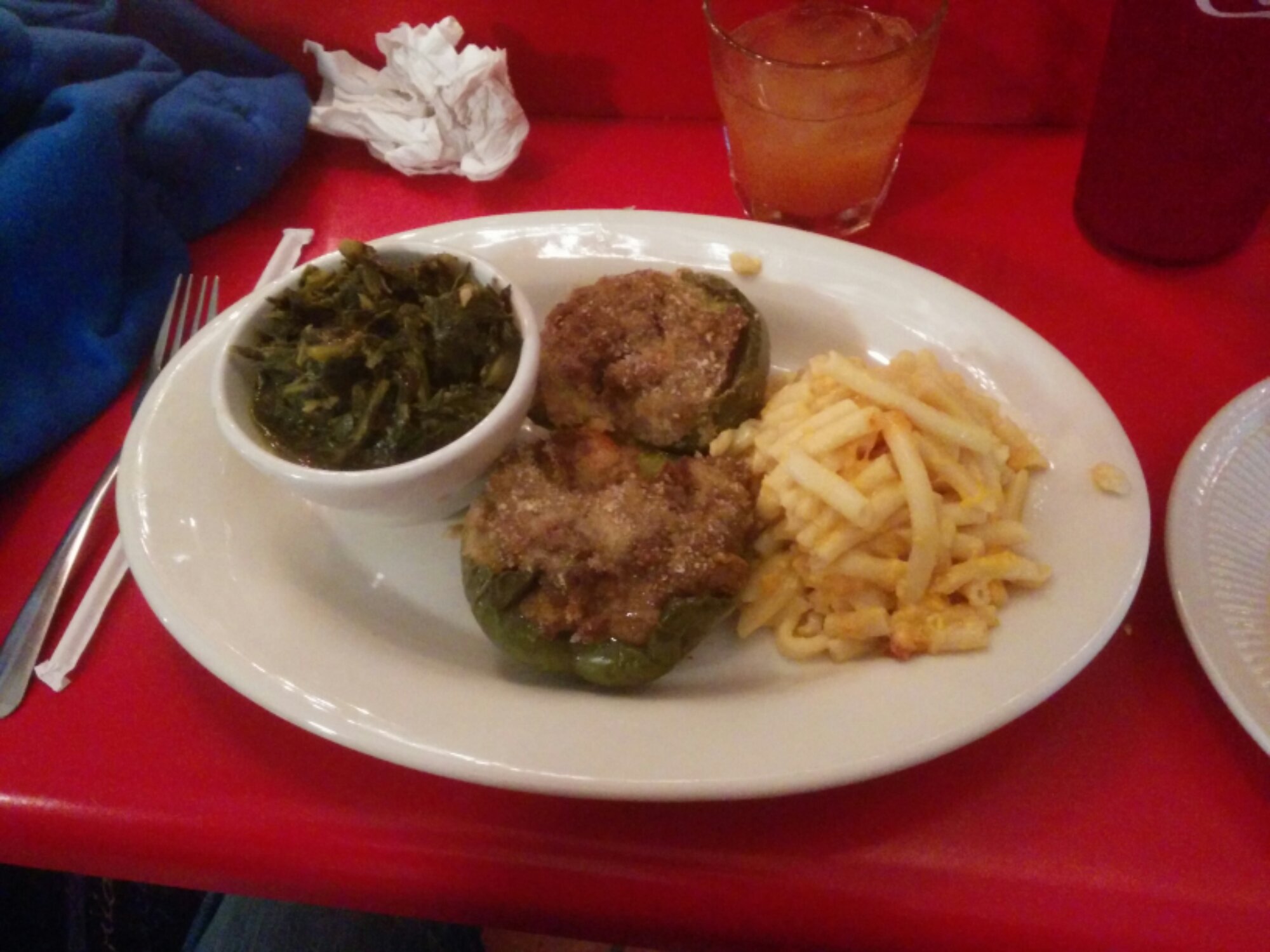
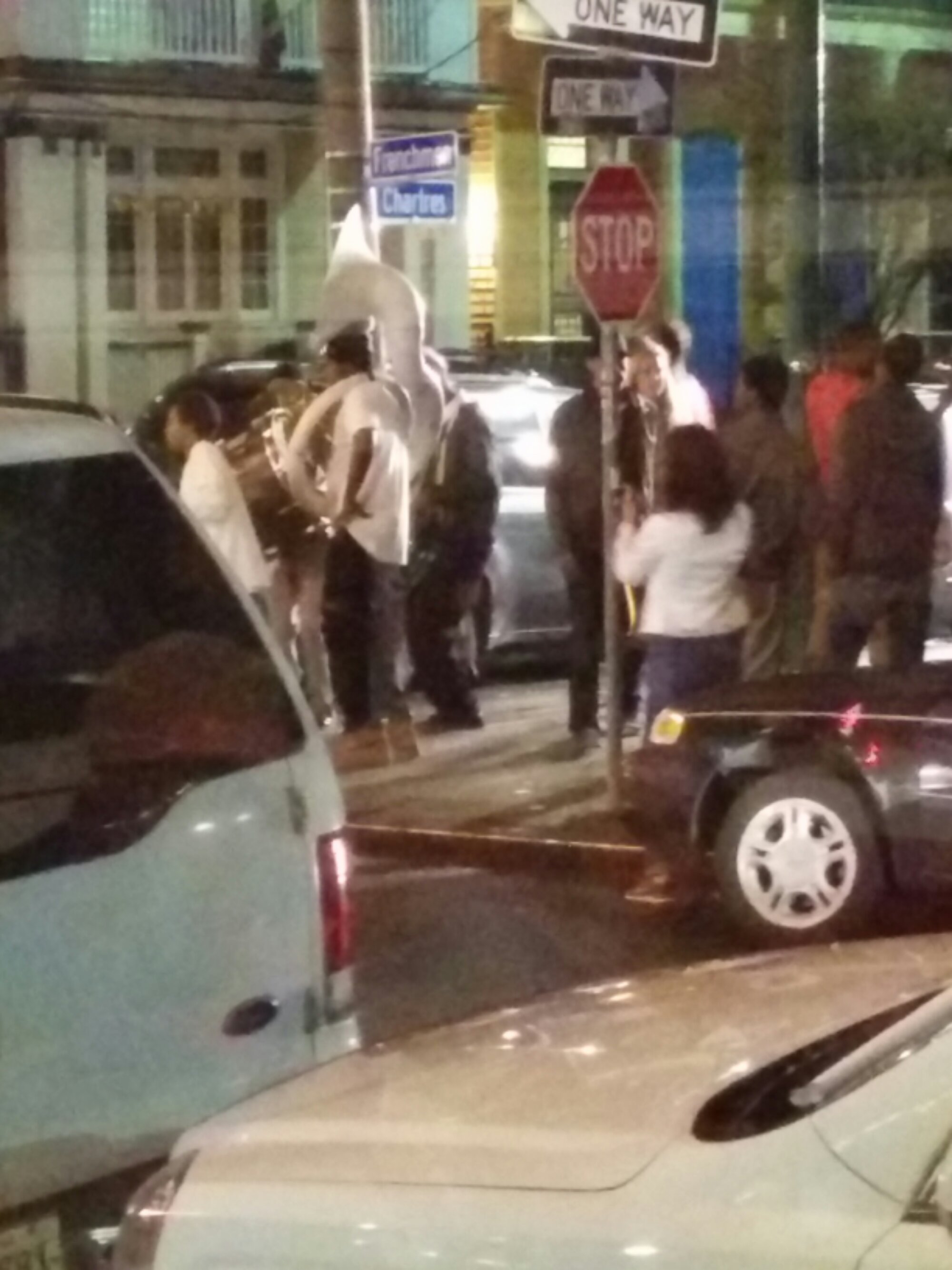
We ate at The Praline Connection, from within which we could hear a great high school brass band blowin’ for tips; “That’s how they ALL get started,” our waitress explained. From our window seat we saw the mix of tourists, bohemians, and musicians (including a solitary, somber Mr. Andrews) that is characteristic of a Marigny Friday file by. The site seemed to me like a MUCH looser, less swinging but more varied version of 1930s KC, with a seeming 15 music venues in a two-block area. After dinner, we walked past several, hearing Washboard Chaz and what looked like his eclectic unit Tin Men rabble-rousing at The Spotted Cat. Really, there’s somethin’ for everyone on Frenchmen Street.
I didn’t have the stamina or health to hang for AYH’s show. We rode two trolleys back to St. Charles, this time the music solely in my head.
Well, I take that back: at The Praline Connection one of the waiters kept singing the chorus of “Gin and Juice”–I think the brass band had just knocked it out. An hour later, waiting for the St. Charles trolley at the corner of Canal and Carondelet, two enterprising young hustlers pulled their ride to the curb and serenaded a gaggle of young blondes with–you guessed it–“Gin and Juice.” Come to think of it, the song does have NOLA written all over it….
Listening Journal, Southern Journey, March 27
Today our daytime adventure was taking the trolley to Canal and walking all the way to the Bywater neighborhood. Not much music was involved, but we were jump-started out of the hotel room by YouTube videos of James Brown’s Japanese miso commercials. I am not making this up.
On the way back from Bywater (by the way, I HIGHLY recommend Elizabeth’s on Chartres), we stopped in The Marigny and, of course, one more trip to Louisiana Music Factory. The owner must think I am insane–why not get everything in one trip?–but I have to let ideas marinate, plus it takes considerable mental discipline to liberate myself from penny-pinching web purchases and do the right thing: support brick and mortar record stores, especially in NOLA. Also, should the reader assume I am independently wealthy, I have no other spending habits. I’d be wearing a burlap sack if I could get away with it, and if it would add money to my music budget. Yes, I know about streaming and don’t care. Here’s the sum of my booty:

In the evening, finally able to listen to Bo Dollis, Jr.’s new Mardi Gras Indian rekkid A NEW KIND OF FUNK (it jes grew outta the OLDEST), we drove out to the greatest music venue in America: The Rock ‘N’ Bowl on Carrollton. OK, that ain’t an exaggeration:
The music is always great–this night, new breed zydeco star Geno Delafose and French Rockin’ Boogie, so open and fun and rocking and sweet he had what I assume was a young mentally disabled relative playing washboard and singing along on stage all night.
The crowd? PACKED…with everyone from kids to octogenarians, every shade of pigmentation, across class lines–and almost EVERYONE dances (including us, and I am from the Tom T. Hall school). And most know HOW to dance; we even saw the hoofin’ star of Louisiana Swamp Stomp once again dancing with every free woman on the floor! And…lots of laughter. LOTS.
You can bowl AND listen to live music, and neither activity disrupts the other.
The bar food beats the typical!
The staff is great–a barmaid even tracked me down through the crowd to return a $20 that was “stuck to” the fiver I handed her.
Did I mention the music? It’s a steady diet of SUBSTANTIAL roots rock. Especially zydeco. Just have to mention that Geno zydeco-ized a Lionel Ritchie song–and made it work!
If you do meet friends down here, it is a guaranteed winner. We met two of my former students who happened to be on vacation, too (they are grown, and dating, so it was a pleasure to buy ’em beers and watch ’em dance). Let me let some pics do the rest:
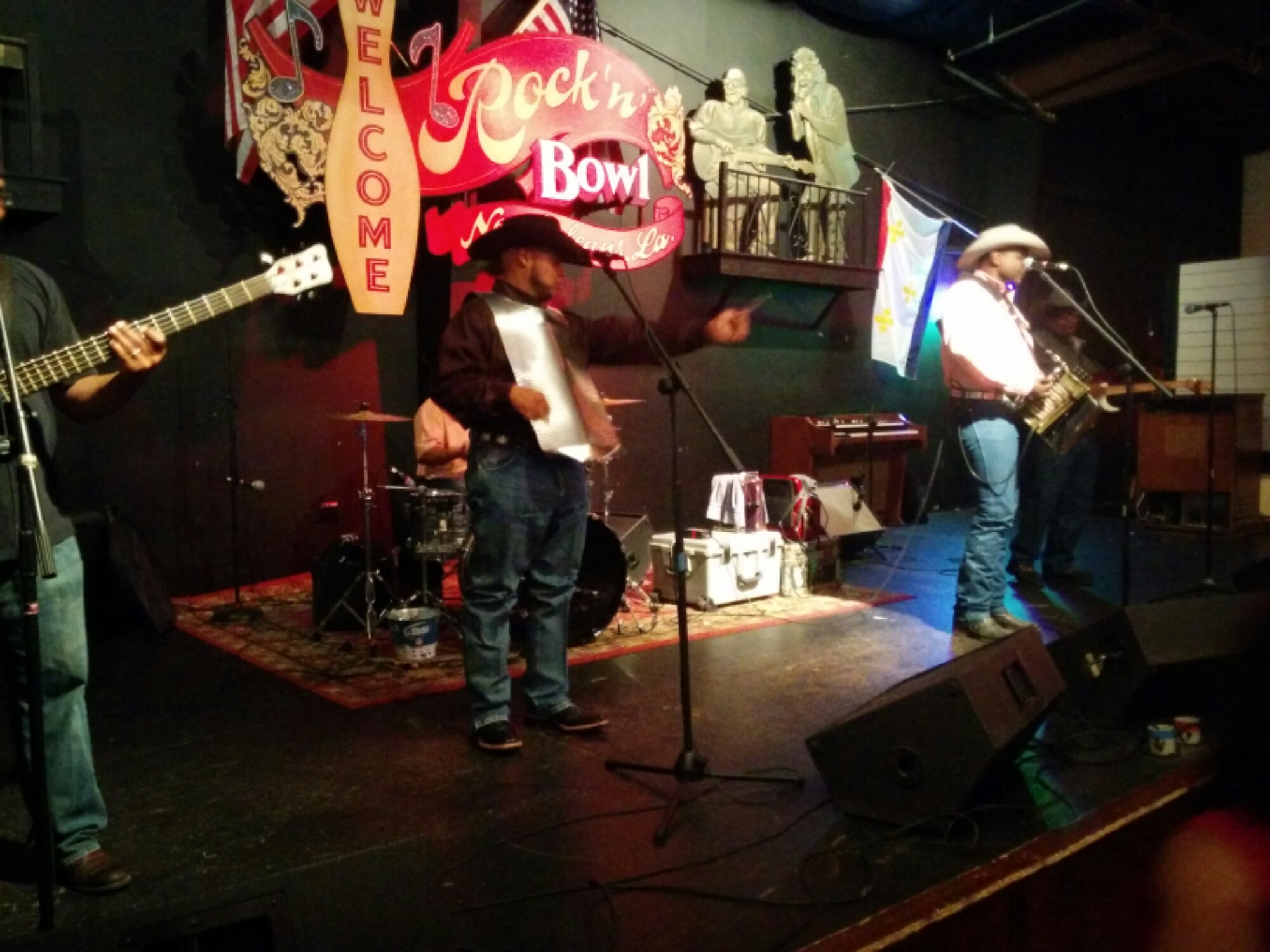

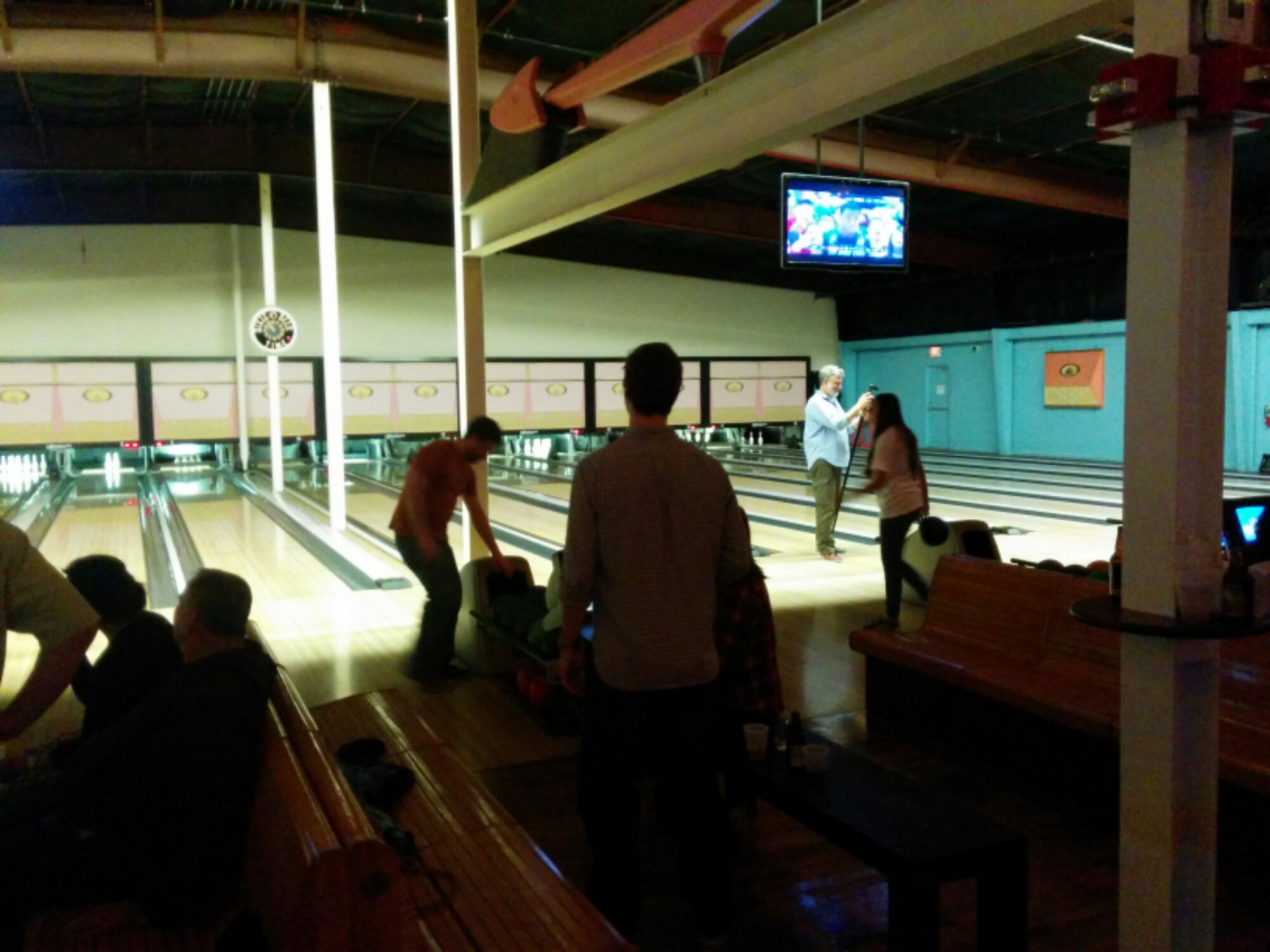
Mid-City Rock ‘N’ Bowl. 3000 South Carrollton, New Orleans. Before you die.
Listening Journal, Southern Journey, March 26
For us, it was a slow music day. To wit:

We sat in Johnny White’s on St. Peters for the second consecutive day, a bar made famous in ONE DEAD IN ATTIC and THE FIVE PEOPLE YOU MEET IN HELL: SURVIVING KATRINA for staying open throughout Katrina and providing multiple sustenances. The place knows the music it likes: Allmans, Stones, Aerosmith. Tough, blues-based white boy rock, and no NOLA stuff…but, when the local news came on, the music went off, and all six of us–the barmaid, possibly the owner, two obvious regulars, and Nicole and I–watched it and DISCUSSED IT. When’s the last time you did that in a bar? We also praised Pope Francis’ stinging of the Bishop of Bling, as well as cupcake ATMs. That’s right.
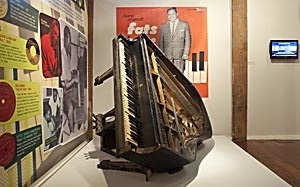
Later, peering out of The Cabildo and watching a street band trombonist play AT a street denizen’s dog and taking in his group’s ragged sound, I realized that two years of listening hard to Rebirth, Hot 8, Lil’ Rascals, Soul Rebels, TBC, and The Stooges have enabled me to discern the difference between street and pro. I love ’em both, but, not being a musician, I feel a homely pride in recognizing such distinctions. Also, the other side of the Louisiana History Museum, separated from The Cabildo by St. Louis Cathedral, holds the Katrina and Mardi Gras exhibits. The Mardi Gras exhibit was interesting, but missing Mardi Gras Indian regalia–you have to go to the Backstreet History Museum and Ronald Lewis’ for that. The Katrina exhibit opened with this moving, music-related image: Fats Domino’s flood-ravaged Steinway.
Finally, at the sillily named Smoothie King Center, we saw the Pelicans beat the Clippers 98-96 behind Tyreke Evans’ bull-in-a-china-closet drives, Darius Miller’s clutch jumpers, The Brow’s six blocks and double-figure boards, and Blake Griffin’s bonked free throws. What’s that have to do with music? Prize-bearing half-time trivia question: Name the performer of this song. (The original version of “Layla” is played.) Dude gives up. Answer flashed on Jumbotron: ERIC CLAPTON!
Wah-WAH.
Oh wait: I did go back to Louisiana Music Factory and buy Bo Dollis‘ kid’s new CD, a DVD of rare performances by Bunk Johnson and other old-time NOLA jazz masters (ahhh…American Music: the label), and Ann Savoy’s rare book on Cajun music.
Listening Journal, Southern Journey, March 25
A little woozy from the high life at the David Doucet show last night, we grabbed a very early coffee at The Avenue Cafe (we are staying at The Avenue Plaza on St. Charles) and embarked for the swamps southwest of NOLA. The Jason Marsalis CD Nicole had snagged yesterday, while not remotely swampy, was the perfect antidote to the fog, Marsalis’ dancing vibe playing slowly bringing us into the clear. I am not a big fan of the family’s music: Wynton’s too “perfect,” Branford not distinctive enough to my ear, Delfeayo–well, I haven’t heard him yet…so, as usual, I am talking out my ass. I DO love the patriarch’s playing (Ellis just doesn’t have enough records), and I find Jason’s playing graceful, inventive, and wry. The record is IN A WORLD OF MALLETS, and it’s on NOLA’s own Basin Street Records, one of my favorite labels. Here’s one of the best songs from the record, live from its CD release party.
During our swamp tour with ZAM’s, I didn’t want to be a doofus of a tourist and chat up our very Cajun guide about “his culture’s music,” but I did float out a Beausoleil reference to not a flicker of recognition. Listened to more of Rhino’s ALLIGATOR STOMP on the way back to the city–Volume 2 is a little corny.
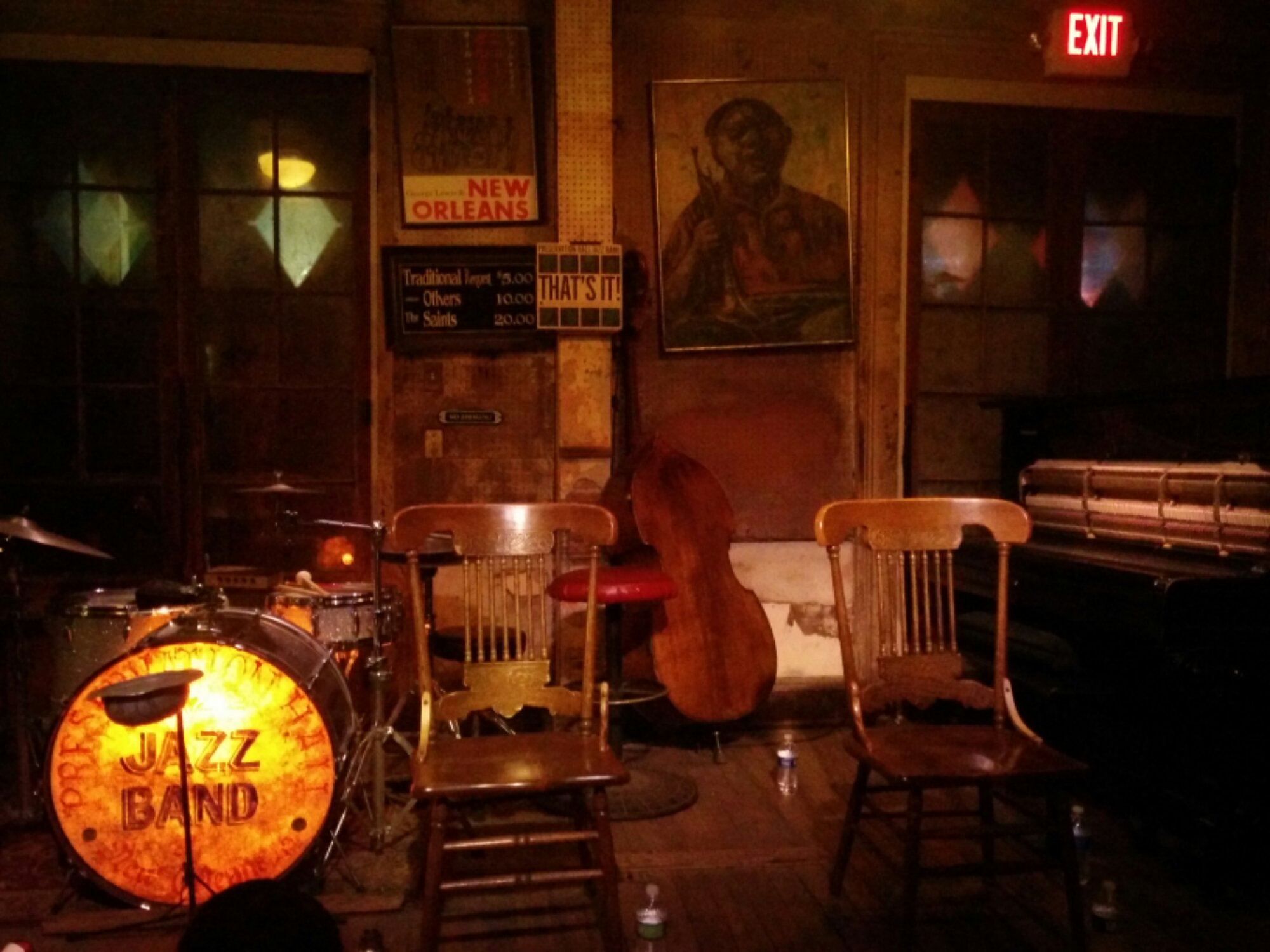

The evening brought an event we had greatly anticipated: a trip to Preservation Hall. Perhaps you think it is merely for the tourists and mouldy figs–not so. It is a must for the true American. You’re packed into an ancient space with 4-5 masters of New Orleans jazz–NOT Dixieland!!!!–both young and old, and will get treated to warm, spirited, knowing, and soulful performances from the fathoms-deep city songbook. It will cost you $20 to request “Saints”; don’t do it! And no photography and recording is allowed, so (sorry) you’ll have to rely on your deteriorating memory. We were very fortunate to get a group led by master drummer Shannon Powell, who is like Baby Dodds made immortal, and gloried in renditions of “Rosetta,” “Darktown Strutter’s Ball” (woah!), and “Creole Love Song” (double woah–haunting and beautiful). It was our second time and we will always go. Tip for the traveler: if you get there early, there will be a loooong line no matter, so get your tics in advance and have drinks across the street on St. Peters at Johnny White’s, the legendary bar that stayed open throughout Katrina. We had mint juleps.
We closed the night revisiting the Palace Cafe on Canal, where we’d eaten thrice on our honeymoon 22 years ago. I hate it when restaurant personnel interrupt your meal with birthday singing and seal-clapping, but a sharply-dressed trio of a capella singers (one a dead ringer for Philippe Wynne of the Spinners) walked in off the street and began serenading diners very beautifully with vocal group classics. We were hoping they would come to our table and do The Jive Five’s “What Time is It?” but no such luck. It was a chilly, windy evening, so we resisted the urge to walk up to dba’s on Frenchmen or take a taxi to The Maple Leaf to brave the packed house that always awaits The Rebirth Brass Band (we had done that before), but if you’re ever here and it’s normally warm, you must go.
Listening Journal, Southern Journey, March 24
We usually wake up to ‘OZ when in NOLA, but got the morning off in the precisely correct spirit with a series of Anita O’Day tunes leading off with “Let Me Off Uptown,” a duet with Roy Eldridge. We were already “uptown,” but we were taking the trolley (one of the simple pleasures of being here), and Anita’s daring duet with a black performer ran parallel with the choices of Hettie Cohen, who chronicles her love affair and life and times with the late LeRoi Jones (Amiri Baraka) in the book I am currently reading, BECOMING HETTIE JONES.
We soon found ourselves on Frenchmen Street in The Marigny, the new location of Louisiana Music Factory, a treasure trove we never miss. I snagged a recent book on NOLA R&B by I HEAR YOU KNOCKIN’ author Jeff Hannusch and a documentary about Mardi Gras Indians, Nicole a new Basin Street Records rekkid by Jason Marsalis, the family’s vibes man. Also, we had to listen to shit music at Pat O’Brien’s (we asked for that), and took the ferry to Algiers, home of great jazzmen like Henry “Red” Allen. The locals at the Dry Dock treated us great.
The real entertainment for the day was a free performance by David Doucet (to my ear, the Cajun Doc Watson), Beausoleil’s guitarist, at the famous Columns Hotel. He and his fiddling partner played a set of traditional Cajun classics including one by the legendary Dennis McGee, as well as some pieces outside the genre, like “Rosalee McFall” and–brilliantly, surprisingly–Dock Boggs’ “Country Blues.” Doucet also hefted an accordian and sounded a LOT like Iry LeJeune. Here’s some footage from a 2013 show in the same locale that conveys some of the show’s brilliance.

The only downside is that I did not have the intelligence to get up and dance like the music and spirit required, even though Nicole beckoned me to and was forced to cut a great rug alone. Perhaps my head was too full of Sazeracs and Old Fashioneds (and my ankles too full of beer), but she deserved my partnership after making my brief bout with rapid heartbeat go away back at the ‘otel with an application of Lee Dorsey. That man is always good for what ails you.
 Living To Listen