Folk-Funk Comes to Hickman High School!

Bobby autographs

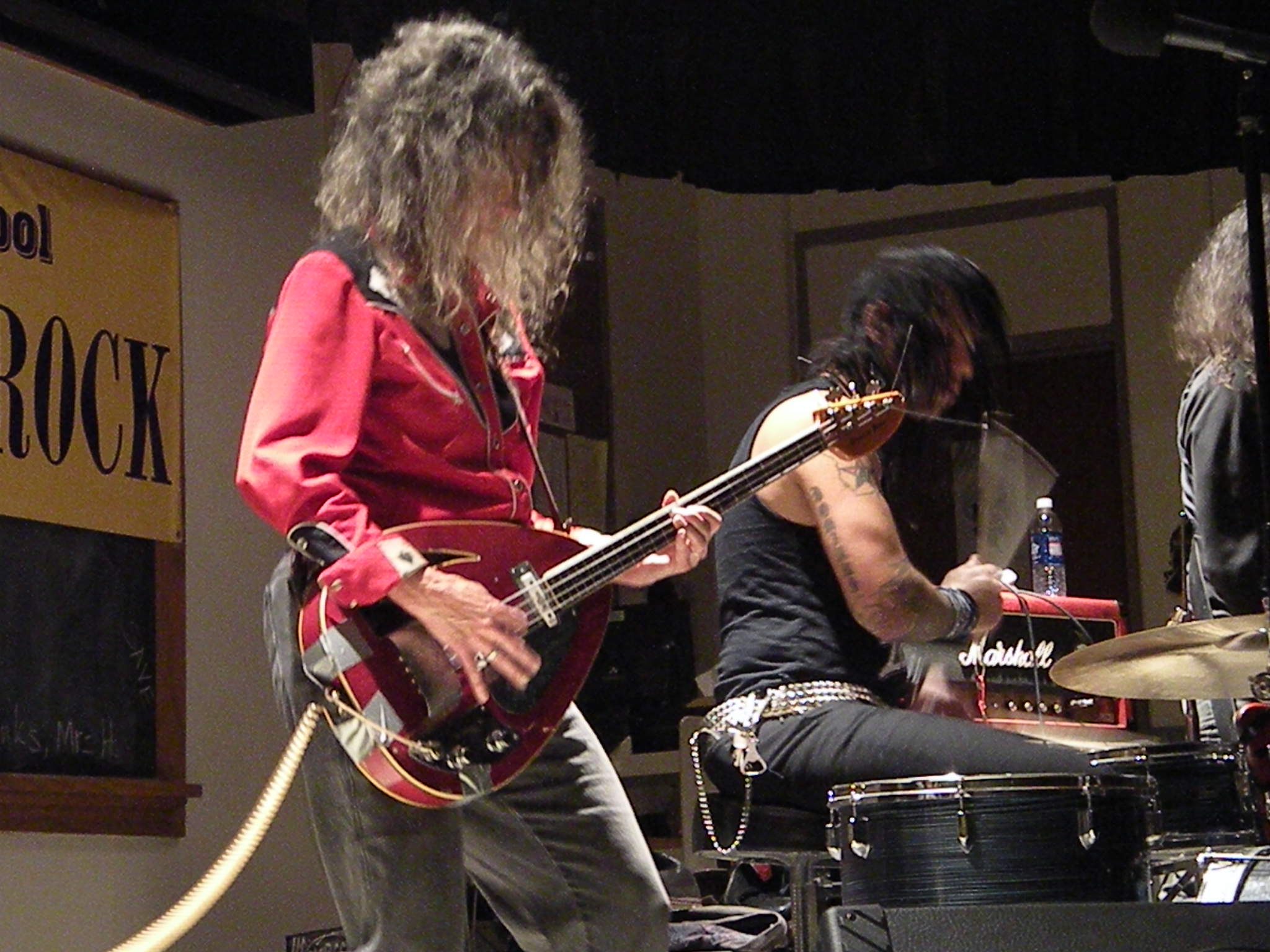
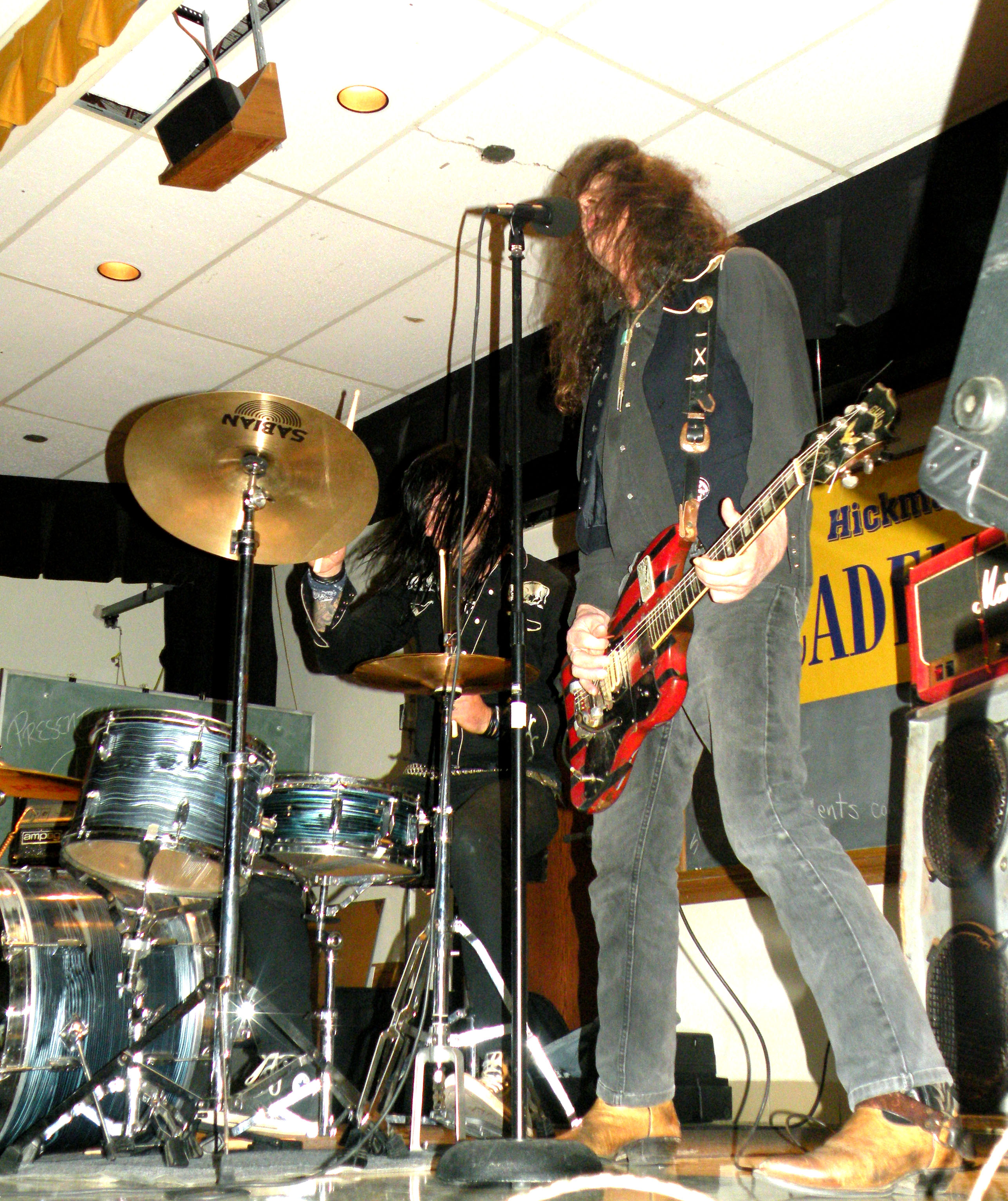
Bobby Rush signs student autographs after his show in Hickman High School’s Little Theater. (Photo by Notley Hawkins)

(This piece is part of a memoir-in-progress about my 30+-years of high school edumacating that may or may not appear some day in completed form.)

Sometimes great things fall into your lap, and you have to be ready for them.

In 2009, my wife and I had just returned from a trip to Memphis, and on the way down and back, we’d listened to a heap of Bobby Rush tracks. Bobby, a native of Homer, Louisiana, is the inventor of what he calls “folk funk”: music too funky for blues, too bluesy for funk, and designed for very down-to-earth people. He has also been incredibly durable. One could argue that not only his recordings but also his performances are more vital now than they were thirty years ago; currently in his eighties as of this writing, he shows no signs of slowing down. We’d barely unpacked when my phone rang. The caller was an associate of the Missouri Arts Council, and she’d gotten my name from an acquaintance who’d mentioned that I’d arranged rock and roll concerts at my high school.

“Would Hickman be interested in hosting a blues artist for a concert next month?”

That would seem to be a no-brainer, but as fans of the graphic novel and film Ghost World know, the wrong band or artist can give an audience the blues rather than relieve it of them. I wasn’t going to be held accountable for a Blueshammer-styled band, nor, I must be honest, a painfully sincere “bloozeman” of any stripe. Thus, I had to put on the brakes.

“Well, it depends upon whom. When we do these things, we like to do ‘em up all the way, and I’d hate to, you know, do up something anti-climactic.”

“Have you heard of Bobby Rush?”

I didn’t know whether to shit twice or die.

“Can you hear me ok?”

“Yeah, sorry, I was just a little overcome there. Hell, yes, we’ll do it! Give me the details!” Usually, I asked for the details before agreeing, but, in this case, I would have been a fool.

“Well,” she said, “It’s free of charge to you and the audience; a grant’s paid for it. Bobby’s got his own band and gear—you’d just need to provide a basic PA and monitors. And we’d like to schedule it for the evening so kids could bring their families if they wanted to. I tried to pitch this to Jefferson City Public Schools, but they wanted nothing to do with it.”

“You snooze, you lose. And this will be a huge loss for them. We’re A-OK on the equipment. And evening is great. But, regarding the kids and their families—is Bobby bringing the girls?”

I am sure this is a question anyone trying to book Rush is going to get asked. Bobby frequently performs with three triple-mega-bootylicious dancers to whom he often makes leering but strangely warm and charming reference throughout his shows, and a) I seriously hoped he was travelling with them, but b) I wasn’t sure the snug stage had room for them, and c) I was not sure a transition from high school performance stage to chitlin’ circuit showcase would be altogether without bumps (take that as you will).

She chuckled. “Oh no, he doesn’t have the girls on this leg.” I breathed a sigh of disappointed relief, as well as applied a mental Bobby Rush-like chuckle of lechery to her phrasing.

The next day, the kids of the Academy of Rock, our music appreciation club, and I revved into PR gear. We made and posted flyers, we networked the hallways and school nooks and crannies, and we set up visits to the American history classes, where we planned to show a brief “teaser” segment on Rush from Richard Pearce’s “The Road to Memphis,” an installment of Martin Scorsese’s The Blues series. Because I have been a serious nut about music since I heard “Then Came You” float out of a swimming pool jukebox, I have always been careful to find a solid justification for connecting any school use of it to curriculum—probably too careful, but I am like a Pentecostal preacher when I get going, and may the Devil take the curriculum. In this case, the justification too had fallen into my lap: it happened to be Black History Month, and, as dubious as I consider the concept (I prefer Black History Year), I was happy to exploit it. I was also happy that, in my long experience at Hickman, I’d seldom seen a major event staged that directly and intentionally appealed to our 25% black population. Not that I could take credit for anything but saying “yes” to the proposal; in fact, that could accurately serve as my epitaph: “He said ‘Yes’ to life.”

We also got word out to the local press—who were underwhelmed as usual, for the most part—and the Columbia music community, which resulted in my fellow music maniac Kevin Walsh and his young pal Chase Thompson showing up to make a film—as yet unreleased, but I have a dub—of Rush’s appearance.

The day of the show seemed to arrive in an instant. We promptly set up the stage and PA—but, for some reason, the monitors, not exactly top of the gear list in complexity of use, were malfunctioning. We tried everything we knew (admittedly, not much), to no avail. At least we had a computer properly jacked into the PA to record the show, which Bobby’d happily agreed to let us do. Still—one of the few things we’d been asked for we couldn’t deliver. I was also nervous about the turnout, as we had no way of knowing how many folks would arrive, since admission was free.

Bobby and his band (also known as the crew—they hauled and set up their own equipment, which is no unremarkable habit, especially for road vets) arrived right on schedule, and, after finding him and introducing myself and my wife Nicole, I cut right to the chase: “Bobby, our monitors are screwed. That’s about all you wanted, and we messed it up.”

“Phil, Bobby Rush got this! You OK! Been on the road for sixty years and ain’t nothin’ like that ever stopped us! You all just sit back and relax and let Bobby Rush take care of business.”

I couldn’t argue with that. Would you have?

We did as we were told and took a seat. The space was an old-style “Little Theater,” capacity 150, with nice track lighting, comfortable seating, and just enough stage for a five-piece band (Bobby had seven). I am assuming it was originally built for student theatrical performances, but, in the ‘Oughts, it was just as frequently a concert venue. As I write, I feel a pang of sadness in not being there to continue using it.

Bobby and his band genially integrated our small crew of students into their own set-up and soundcheck—they’d also quickly jerry-rigged the monitors and had them working—and were thrilled to find that we planned to have one of the kids run sound for the show. This had been our philosophy since the club was formed in 2004: move over and let some students do the popcorn! An element of risk always threatened proceedings as a result, but that’s life, learning happened, and it’s more fun riding on The Wall of Death, anyway.

I had been in a bit of a nervous trance when I suddenly broke it, looked around, and noticed that the house was almost packed. Not only that, but the concertgoers were predominantly black—with a considerable number of parents and grandparents among them. As is my wont, I quickly twisted my joy into worry as I began to recall certain bawdy Rush routines that might be revisited that very eve.

Bobby

I needn’t have worried. Bobby Rush had this. 75 at the time, he must have set the record for pelvic thrusts in one show. The crowd went wild. He told raunchy stories, including one featuring his minister father. The crowd hollered. He plum-picked his sly repertoire: “Uncle Esau,” “I Ain’t Studdin’ Ya,” “I Got Three Problems,” “Henpecked” (“I ain’t henpecked!/I just been pecked by the right hen!”), “Night Fishin’,” “Evil,” “What’s Good for the Goose.” The crowd exploded. He produced a pair of size-75 women’s undies to demonstrate his taste in derrieres. The crowd went bonkers, and the grandmas stood up and shouted amen. He accused our sound man of being a virgin. The crowd—and our soundman—went nuts. He talked about visiting Iraq, about his prison ministry, about struggling up out of the Great Migration to Chicago, about being on damn near every black music scene for fifty years—and about coming through it all to vote for a black president who actually got elected. And the crowd hung, hushed, on his every word, as he delivered a brilliant, deeply personal history lesson we hadn’t even asked for. Even the jerry-rigged sound in that little room was hot as fire and deep as a well, with Rush playing harp like he was possessed by the ghost of Sonny Boy Williamson and snatching a guitar away from a band member to play some razor-sharp solo slide. As I continued to nervously scan what had become a congregation, I was thrilled to notice that the older the person was whom I spied, the wider his (or most definitely her) grin was. The students? They had clearly never seen anything like Bobby Rush before. Our soundman was so mesmerized he forgot to check the recording levels, so our aural document of the show is way into the red.

I know it’s a cliché, but it was, for damn sure, a religious experience. The audience, I think, was more drained than Bobby at show’s end, but not too drained to be shaking their heads in wonderment and giggling with glee. Several of those older folks swung by to tell me, “More of this, please!” The principal who’d drawn event supervision—lucky man!—asked me, “How in hell did this happen, and when’s the next one, ‘cause I’m calling dibs?” Of course, I’d liked to have met those demands with serious supply—but witnessing a bona fide, down and dirty, authentic-but-for-the-booze-smoke-and-BBQ chitlin’ circuit show at a Bible Belt high school, I’m afraid, is a once in a lifetime experience. God, I do love grants and art councils.
Bobby Rush and Us

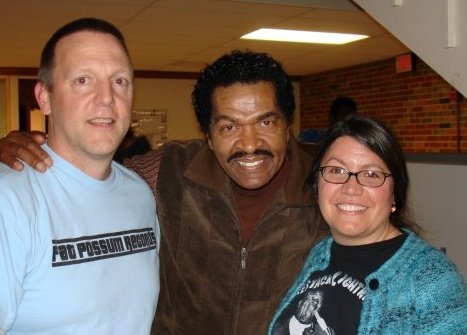
Nicole and I walked Bobby out into the February night, his arms around both of our shoulders. His eyes and jeri curls were shining, but he hadn’t seemed to have broken a sweat. “I want to thank you all for having us,” he offered, humbly. “I don’t know who had more fun, us or them!”

I quickly replied, “No, man, thank you! That show was so good you’d think you were playing for the president! And we’re just a high school in Missouri!”

He shook his head, smiling.

“I told you, Phil…Bobby Rush got this!”

See Columbia photographer Notley Hawkins’ classic shots from the show here, and do yourself a solid and grab Omnivore Records’ stellar four-CD career summation of Rush, Chicken Heads, here!

Midwest Lo-Fi Psycho-delic Attack: A review of Woody Records’ artist sampler CD by Mackenzie Thomas

It’s always tempting for the cooler-than-thou to think that the kids are out of touch with what’s really cool, but I would refer those misguided individuals to Local H’s “All the Kids Are Right,” and its warning line: “They won’t wear your t-shirts now.” Recently, the best thing about Kansas in this day and age, Woody Records, sent a package to Hickman High School’s Academy of Rock, hoping–daring–that some kids would sample the musical merch and find it…good. In fact, it happened. What follows is Hickman 10th grader Mackenzie Thomas’ take on Woody’s CD sampler–she makes the most of an opportunity I dreamed of at her age but had no way of making real (it was ’78–and neither the underground or technology had erupted)–and I think you’ll see a DECENT and fair music writer at work. Enjoy. And visit Woody Records. (The Editor.)

I am quite new to the lo-fi media scene, but the more I keep listening to the Woody Records Compilation disk, the more I begin to like it and understand the hard work put into it. This compilation contains fifteen tracks by various artists from the midwest area who are all a part of Woody Records, a small label out of Kansas. (Check out Woody Records’ Soundcloud page here to sample these artists yourself. – Ed.)

“If A Man Made A Machine” and “Mild Violence” by Fake Fancy, the first two tracks on the album, immediately caught my attention. “If A Man Made A Machine” has a sweet sound to it, and the rhythm moves to the same rate as my heartbeat. The song makes me feel alive. “Mild Violence” is a little heavier, with grooving bass and lyrics that are quick to the point, the singer stating that he has nothing, and no time for anything: “I’ve got nothing, I’ve got nothing, got nothing, but sunshine to keep me wide awake…” After hearing these two tracks, and assuming that a label would put the best of best on a compilation disk, I wouldn’t mind listening to more by Fake Fancy. Their songs seem to be short and sweet, and with fairly understandable lyrics.

It’s really hard for me to wrap my head around why a band would record and release a song where the vocals are so distorted that it’s impossible to understand what the singer is saying. For example, in “Salsa That One,” by Cucumber and the Suntans, the instrumental intro to the song started off nicely, but as soon as the vocals were added in, it became unenjoyable. All I could hear was “Wa, wa, wa ,wa…”– but that could possibly be the actual words to the song. Cucumber and the Suntans, however, redeem themselves with “Lifes,” a short, folksy tune that would be appealing to those listeners who spend their Sundays down at Cooper’s Landing south of Columbia, watching the muddy river flow by, a cold beer in hand and ears tuned into that weekend’s entertainment, usually something along the lines of country/folk/bluegrass/acoustic.

A doom rock/metal band by the name of Merlin takes their music a whole different direction than that of Cucumber and the Suntans. Their 11-minute instrumental track, “Christ Killer,” starts off with acoustic guitar for the first six minutes, then fades into eerie psychedelic rock. After listening to “Christ Killer,” I went on to listen to Merlin’s self-titled album , which consisted of “heavy hours of drinking, smoking, and worshiping the Dark Lord in a beer soaked, incense filled basement to produce our finest release to date. Implementing all the mystical, doomy, psychedelic, evil vibes from everything we’ve put out thus far, we have created a witches’ brew of all the Elements of MERLIN,” according to their Bandcamp page. Throughout their years of playing and making music together, they’ve seemed to maintain the same overall sound in their songs, while still creating new masterpieces each time.

I believe that Woody Records releases this lo-fi material because it’s cheaper on both the artist and the label, but it also sends out a creative vibe that is hard to find in albums by modern rock/pop artists. This album feels more natural because it hasn’t been auto-tuned and doesn’t consist of electronic beats and bass drops. There is definitely something special about lo-fi music–and this album. The Woody Records Compilation would be appealing to anyone who’s really open-minded about music and loves to support local musicians. This disk ranges from punk to electro-indie to psychedelic rock. It has something for everyone!

Mackenzie Thomas review picture

Mackenzie Thomas is a sophomore at David H. Hickman High School in Columbia, Missouri, the bass player in Graveyard Youth, and a member of that school’s Academy of Rock. This is her first professional review, and it’s five times better than my first one. 

When The Pierced Arrows Brought It to The Kids

7012

“…they won’t wear your t-shirts now….”

Local H, “All the Kids Are Right”

Through a good friend, I had heard of Dead Moon in the mid-’90s: “They’re garage rockers, but their lead singer’s about 50 and has been playing since the ’60s.” I had checked out their album Trash and Burn, which was lean, mean, raw, and wiry, with vocals that reminded me of Bon Scott’s, but, at the time, I was being deluged by so much music and stuff-o’-life that the rekkid got lost in the shuffle, even though it spoke directly to things that matter most to me about rock and roll. When they played a club here around the same time, I knew about it–but it was on a weeknight and, being a good-boy teacher for the moment (I was erratic in that area, at best), I skipped it. To what will be, I am sure, my eternal regret.

Fast forward to the mid-‘Oughts. I am sure most owners of record collections numbering 5,000-plus will relate, but, one weekend, sniffing around for something to listen to, I fetched Trash and Burn from where it had been hiding for a decade, slid it into the player, and stood back as it lit our house aflame. Both my wife Nicole and I exclaimed, in spontaneous chorus as old marrieds often do, “Where has this band been all our lives?” With the Internet now at our fingertips, we delved deeper, and found out about a documentary about the group called Unknown Passage: The Dead Moon Story, and immediately ordered a copy.

As will happen, I swear, to anyone who watches this film, we were stunned, then joined in lifetime loyalty to Fred and Toody, “The Coles,” as they are known to cognoscenti. Married for almost 50 years at this writing, successfully applying the DIY ethic years way before it was hip in the rock biz to everything from home improvement to instrument repair to music production and distribution to child-rearing, functioning as pretty-damned-equal partners in singing, playing and writing, these two dyed-in-the-wool rockers not only defined the rock and roll life in a way that didn’t get you looking at your shoes, but also served as a textbook case of true family values. I am not going to describe it; you just order the film, podnah. We have been pushing it on every vulnerable soul for seven years.

Concurrent to this discovery, at the Columbia, Missouri, teaching gig that was subsidizing my record collection, I was experiencing some surprising turns of event with an extracurricular club called The Academy of Rock, which a student of mine and I had founded in 2004. A couple of enterprising students had suggested that we try to convince bands who came through Columbia for shows to stop by our meetings and chat about songwriting, the rock life, and anything else fun. The worst that could happen was being told “No,” so onward we went, and, literally before we knew it, Amsterband (the future Ha Ha Tonka), Cary Hudson (former Blue Mountain and Neckbones), The F-Bombs (a local punk band), and–I had marks all over from pinching myself–eventually, The Drive-By Truckers and The Hold Steady had played–played, not stopped by to chat–in our school’s Little Theater, for free, with deep-ass Q&A, friendly autographing sessions, and invitations to come to their shows with guest-list privileges. So, when Nicole and I discovered that The Pierced Arrows, the Cole project that rose from the ashes of Dead Moon, were playing The Record Bar in Kansas City, we decided to go and maybe strike up enough of an acquaintance to ask them to swing by Hickman.

True to everything we had heard about them, Fred and Toody sat with the rabble through both of their opening bands’ sets, drinking beer, smoking, and obviously engaging with the groups’ music. Between sets, I tip-toed over to Toody, and begin shooting the shit. When I told her about our club and our (by now) tradition of bringing in bands, she enthused, but said, “Well, we’re heading for Europe next week, and we’ll be there for a few months, but, if you give me your phone number, I’ll get in touch with you when we’re back in the States.” Returning to terra firma after a shattering Pierced Arrows set (for the uninitiated, the only real difference between Dead Moon and The Pierced Arrows is slightly heavier guitar and slightly steadier drums) and hitting the prairie pavement back to Columbia, I turned to Nicole and said, “Well, we did get to meet them, we do have Toody’s phone number, and the show kicked ass–but surely after two-three months they’ll forget about us.”

Wrongo. Almost three months to the day of that show, Toody called me out of the clear blue sky and asked, “Hey, we have a day off coming up between Columbus and Kansas City, could we [YES–“could we?”–I shit you not] play at your school then?” I was so gobsmacked that about 10 seconds of silence followed before I Marv-Alberted a “YES!” into the receiver. We quickly agreed on details–we’d pay for their hotel room and food after the appearance, since they’d have to hit the road immediately following for the Kansas City gig–and I proceeded to pinch another red mark onto my arm.

The day before the band was due to play, I was moderating a Socratic seminar for my British literature students in our school’s office conference room when my cellphone began buzzing. I don’t get phone calls much, especially during the day, so I sneaked a look, and saw it was Toody. I put the temporary kibosh on the seminar–do you blame me?–stepped outside, and took the call.

“Phil, we are so, so, so sorry we are late! I think we can set up in ten minutes once we get there [they were 30 minutes outside of town] if you can still make it happen!”

“Toody–it’s not until tomorrow.”

“You’re shitting me! [Turns away from phone, shouts “It’s not ’til tomorrow,” is met by jubilant screams from the rest of the van’s occupants….] Fantastic! We are tired and hungry and need to decompress…but, hey, come by the hotel room and say hi!”

I am not making this up.

Nicole and I swung by to see them, but they were obviously beat, so we just gave ’em some dining recommendations and double-checked the details. We were particularly careful about the latter; when The Hold Steady visited, they arrived an hour after they were supposed to, and at the very moment that, in front of a packed theater, I was running out of steam stalling the crowd with their biographical details–sans soundcheck and sans anxiety, since they drifted in on a cloud of cannabis cologne. Fred assured us they’d be on time for a soundcheck, so we left them to get their rest.

I had arranged to have a substitute take my afternoon classes the next day, and, late that morning, as some Academy of Rock club members and I were setting up the PA in the theater, my phone began buzzing again.

“Hey, Phil, we’re here.”

“But Toody, you didn’t need to be here for another hour-and-a-half!”

“Oh, that’s OK! We want to meet some of the kids and hang out if it’s OK […if it’s OK????].”

“Well, hell, I’ll send a couple of ’em to come get you.”

We spent the next 90 minutes not just sound-checking but actually hanging out and talking about everything under the sun, with Fred giving some of the school’s theater tech kids, who were helping us, tips about rock and roll sound. For example, since he had lost 70% of his hearing by that point [no big deal!], he preferred to have two monitors on each side of him, facing each of his ears. That was just one of the many things the kids learned from him in that very information-rich hour-and-a-half.

The performance? Titanic. Also, easily the loudest in Hickman’s history (the DBTs and Hold Steady had played unplugged–but you don’t unplug Fred Cole). We recorded it, but, unfortunately, we screwed up Fred’s vocal levels; it’s still power-packed and worth a listen, though (see below). The band played all of their then-new album Descending Shadows, plus the best of their previous record, Straight to the Heart.

After the sixty-minute show, they then took student questions, which–if they weren’t already excellent, which most were–they would cannily reconfigure for the best possible responses. I would recap it, but, here, read this Columbia Tribune story about it. The amount of wisdom shared in the nearly three hours they were in the theater was mind-boggling, and, even when the bell rang to dismiss students for the day, they were not yet done.

DSCN7079

I sidled over to Fred, Toody, and their awesome drummer Kelly Halliburton, who matched them word for word, note for note, gesture for gesture in sheer rock-band fan-care, and said, “Well, district rules forbid us from getting gift certificates for visiting ‘educators,’ but here’s $40 to go eat some pizza and drink some beer at the local-favorite pizza joint. Let me draw you up some direct—-“

Fred: “Hey, just bring some of the real big fans and come eat with us.”

“You’re serious?”

“As a heartattack! Just let us have one of the kids to navigate!”

As it happened, one of the kids was already thoroughly inured to the ways of The Coles through our having forced Unknown Passage: The Dead Moon Story on him and his having avidly explored their discography. (Oh yeah: we also took him to the aforementioned Pierced Arrows shows in the guise of our nephew, since it wasn’t all ages and the manager had given us permission–don’t try that one at home, fellow teachers!)  So we sent him along, and, people, I have never seen a student happier. He even got to bum a cig off of Fred!

At the pizza joint, we bought several pizzas, the band knocked back a few pitchers, and we had a total blast. To the end, though, the Coles and Mr. Halliburton were fan-centered. I had expected dinner to be a barrage of questions from the kids about rock and roll history (Fred goes back to the mid-Sixties through his involvement in The Weeds and The Lollipop Shoppe, and knew Janis Joplin well), but, instead, the trio queried the kids about their lives, their tastes in music, their experiences in bands, and…just life.

PizzaPizzaPizza

That kid on my right was a ninth-grader. As I drove him out to his folks’ house, neither of us could keep from shaking our heads in amazement that, along with rocking our asses off, they lived up to their advance notice and more. And as he told me,”I can’t believe they came to my school!”–it wasn’t his yet, but it would be the following year–I realized that it was probably the finest moment I’d ever experienced (could probably hope to experience–and, no, it ain’t been topped yet) as a public school educator. Beyond the educational impact, the encouragement the Coles’ chemistry and commitment gave Nicole and me, who have approached marriage unconventionally in more than a few ways, continues to resonate.

Fred had successful heart surgery earlier this year, and just turned 66 last week. I am sure, however, that he will be back on the road with The Pierced Arrows soon, and, if they come to your town–go. They are about rock and roll, but so much more. Be sure to bring t-shirt money, whether you are a kid or not.

Below: The Pierced Arrows’ performance at Hickman. We used a multiple-mic set up in the room, rather than recording straight from the PA (don’t ask…), and, since our kid at the PA botched the vocal mix and it was so crowded I couldn’t get to him to help, Fred’s vocals are somewhat buried. But you will hear why I got called into the office the next day:

I Recommend an All-Time Desert Island Top 20 (plus a 50-item appendix to prove I am not an old fart) to a Class of 12th Graders

Temporarily deluded that they might want my advice, I put together a list of rekkids I believe every true United States citizen should own for my 12th grade students last week. What follows are a link to a Spotify playlist I put together to further induce them (again, I am deluded: they prefer YouTube), the list of 20 accompanied by annotations aimed at them–as opposed to specialists–and my roughly 2001-2014 old fart repellent Top 50. I am already regretting choices–where’s Neil Young’s Rust Never Sleeps?

1. Bob Dylan (with some help from The Band): The Basement Tapes. In my not so humble opinion, you are not a true United States citizen if you do not own a Dylan album. This one’s special. Having recovered from a possibly faked motorcycle accident in the middle of some freakish fame, Dylan retired into the country with his pals and wrote some ageless songs that conjured the mysteries, absurdities, and tragedies of life. Curiously, few young Dylan fans have tried it.

2. The John Coltrane Quartet: A Love Supreme. For 37 minutes, the most obsessively questing jazz saxophonist of the 1960s communes with his Higher Power. Some of the most powerful spiritual music ever made in this country. If you don’t believe in Higher Powers, simply dig a 37-minute composition in three distinct movements that will set your soul on fire. If you don’t believe in souls, give your ears a present. Note to drummers: Check out Elvin Jones on this recording. You think you don’t like jazz? Try this before you make up your mind.

3. Hank Williams, Sr.: 40 Greatest Hits. The Hillbilly Shakespeare, as he is known by adepts, wrote 50 of the 100 greatest country songs of all-time before spina bifida, quack doctors, the one-two combination of his mama and his ex-wife pounding away at his self-esteem, and his own self-destructive ways sent him to meet Jesus at 29. And he could sing a little bit—especially if you like voices that channel unvarnished yearning, heartbreak, despair, dread, and, on more than a few occasions, joy. If you don’t know him, our educational system has failed you, but surely you know “Hey, Good Lookin’” and “Your Cheatin’ Heart”? Attention students of African descent who might not feel country music has anything to do with them: at Williams’ massively-attended funeral in Montgomery, Alabama, more blacks attended than whites; plus, the man learned his basic stuff from a black musician. Great American music: NEVER SIMPLE.

4. Minutemen: Double Nickels on the Dime. At this point, punk rock peaked in terms of how expansive it could be and still be called punk rock. Then…the slow decline. “Our band could change your life.”

5. Al Green: Greatest Hits (Expanded Edition). Speaking of Reverend Al, and speaking of the world’s greatest singers, he sounds great enough in his mid-‘60s (check out his most recent album, produced by ?Love of the Roots), but when he was ruling the charts in the ‘70s, no one, not even Aretha Franklin, could match his range, command, and pure seductiveness. This version includes a DVD that shows that his voice was not the only weapon in his arsenal; also of interest is one of Memphis’ greatest studio bands, totally in synchronization with even the most sudden improvisatory impulses of the star.

6. Billie Holiday: Lady Day. This two-disc set showcases 1) a singer of limited range but unmatched intelligence and instincts who could alchemically turn song-crap into eternal gold and who utterly changed one somewhat significant guy’s approach to singing (Frank Sinatra, anyone?) by flirting with the beat, usually trailing titillatingly behind it; 2) an assortment of studio bands that represented the greatest jazz musicians of the Thirties, specifically including Lester Young on tenor, who laces accompaniment through Holiday’s vocals like vines through a trellis; 3) many of the greatest pop songs ever produced in this country—ones she didn’t have to transmute.

7. Professor Longhair: Crawfish Fiesta. Having spent five or six of the greatest weeks of my life (including my honeymoon) in New Orleans, and recognizing that its people have the most indestructible spirit in the country, I’d have to have something from the Crescent City with me while lying in the sand. “Fess,” one among many piano “professors” in the New Orleans tradition, invented his own style: a gumbo of boogie woogie, rhumba, blues, and traditional second-line parade rhythms that is sheer intoxication. No one’s yet matched it, and all New Orleans pianists and most of the city’s citizens have pledged infinite fealty to him. He wrote the Mardi Gras theme song. And he is one of the greatest whistlers in music.

8. Sonic Youth: Daydream Nation. The sound of the apocalypse, made primarily by two guys who tune their guitars differently for every song. How’s apocalypse sound? Fun, scary, surprisingly, relentless—like a rollercoaster ride.

9. Bob Wills & the Texas Playboys: The Tiffany Transcriptions, Volume 3–Basin Street Blues. Wills will always be my hero. First, he had the genius to love blues, country, jazz, Native American and Mexican and German folk music, fiddle breakdowns, pop toons—purt-near everything in the American musical lexicon—and play it all with panache, and to think of adding drums to country music (this would lead to rock and roll). Second, the camaraderie he engendered as the leader of his band is intoxicating—the sound of love of music and friendship and playing for the people and really digging American noise, played with expert chemistry, intuition, and—especially—perfect looseness. Third, his measure for whether the band was any good on any given night was whether people danced. Hell, even I can dance to Bob Wills.

10. James Brown: Star Time. Despite his rather inglorious final years and passing, Butane James aka Mr. Dynamite aka The Hardest Working Man in Show Business aka Soul Brother #1 was no joke. Surviving absolutely harsh poverty and abuse—read about it, and weep (I kid you not)—rising above detention homes and early indifference to music, he not only invented funk, became a vital part of the Civil Rights Movement (he single-handedly saved Boston from being at least partially burned to the ground after MLK was murdered), trained a legion of ground-breaking musicians, put on the most exciting show on earth night after night (check out Live at the Apollo, Volume 1 or II), influenced politicians but left and right, but…a big but…there’d be NO rap without his beats. NONE. Pay your respects, children. This is a cheap four-CD box that will never let you down. I tell no lies when it comes to music.

11. M.I.A: Kala. I simply cannot dream of a point in my future where I will not love this album. Incredible beats, imaginative and disruptive sound effects, a somewhat terrifying and exhilarating view of international upheaval, high comedy, sex appeal—and you can dance and think to it at the same time.

12. The Beatles: Beatles for Sale. This is the Beatles on the brink of artsiness and thus pretentiousness—pre-Rubber Soul, pre-Revolver, pre-Sgt. Pepper’s, the run of albums that provoked John Waters to call the band “those honk(ies)…who ruined rock and roll.” To my ear and mind, it is the Beatles at their very best; John Lennon especially is on his game. The sound and songs range from desperate (“I’m a Loser”) to ecstatic (“Eight Days A Week), from celebratory (“Every Little Thing”) to disconsolate (“I Don’t Want to Spoil the Party”)—never artsy or pretentious. Plus, many of the songs are unfamiliar to the youth of America circa 2010.

13. Motorhead: Orgasmatron. At once, a denunciation of war and a musical celebration of its power. Too fast for metal, too heavy for punk, too smart and honest for both genres, Lemmy Kilmister’s hard rock machine has never packed more punch than here.

14. Public Enemy: It Takes a Nation of Millions to Hold Us Back. Rap albums have a short shelf life: what sounded great in 2009 might sound stiff by 2010! The question of which rap album would reward 1,000 playbacks on a deserted island is a tough one, but no one—not even Public Enemy itself—has caught up with the explosive beats and disruptions of this record (at the time, equally popular with black and white listeners), and no single rapper—not even Chuck D himself—has caught up with this MC’s sustained command and invention. For comic relief, there’s Flavor Flav at his sickest.

15. Muddy Waters: Hard Again. As one of the songs here argues, the blues had a baby, and they named it rock and roll. With the amazing Johnny Winters producing and playing flaming slide behind him, the man from whom The Rolling Stones took their name demonstrates authoritatively that age is just a concept, hollering and celebrating manhood as if he’d just turned 21, instead of 63. And NO blues record sounds this great cranked up to 11.

16. Howlin’ Wolf: Howlin’ Wolf/Moanin’ at Midnight. Never was a nickname more appropriate; in fact, one could argue, the nickname isn’t menacing enough to do justice to Chester Burnett’s bone-shattering voice. Combined with Hubert Sumlin’s crazed solos (they gave birth, more or less, to Eric Clapton) and delivering several of the greatest songs in modern blues history, mostly written by Willie Dixon (“The Little Red Rooster,” “Back Door Man”—that’s right, the one The Doors covered—“Goin’ Down Slow,” “Asked Her for Water (She Gave Me Gasoline),” “Killing Floor”)—that voice, once you have heard it, will be impossible to forget.

17. The Ramones Leave Home. 1-2-3-4! The band that stripped rock and roll down to its bare essentials—most of you could learn a Ramones song in a week, even (maybe especially) if you don’t play—was also surprisingly complex in its use of persona and irony, consistently hilarious, and more fun than any American music that doesn’t come from New Orleans.

18. The Coasters: 50 Coastin’ Classics. “Charlie Brown.” “Yakety Yak.” “Along Came Jones.” “Little Egypt.” One by one, the seemingly innocent rhythm and blues hits march out of this collection, usually led by King Curtis’ tenor sax and ace harmonies. Then you notice that some of these hits—“What About Us?” “Run Red Run,” “There’s a Riot Goin’ On,” “Shoppin’ for Clothes”—have code laced into their chants. And they do, thanks to two Jews (Jerry Leiber and Mike Stoller, also authors of “Hound Dog” and “Jailhouse Rock”) dedicated to scripting parables of civil rights for a group of black singers. That is rock and roll.

19. The Best of The Sir Douglas Quintet. Not everyone can invent style. Then again, not everyone writes songs titled “You Can’t Hide That Redneck (Underneath that Hippie Hair”) or keys a psychedelic Summer of Love ballad to the line, “You just cain’t live in Texas/If you don’t have a lot of soul!” Sir Doug (Doug Sahm) honed his chops in San Antonio and had his mind blown in San Francisco, and the result is Tex-Mex (or, as he called it, conjunto) rock and roll: bluesy guitar, punchy horns with border flavor, one helluva flexible beat, soulful but bent singing—and the addictive polka-styled (!) Vox organ playing of Sahm’s sidekick, Augie Meyers. See also Sahm’s Tex-Mex supergroup, The Texas Tornados.

20. Van Morrison: Moondance. Maybe rock’s most perfect “perfect album.” From the singing to the writing to the playing to the arrangements to the production, it seems to emerge from a euphoric dream of the past, and the worst songs—to my ear, “Moondance” and “Crazy Love”—have become standards. And for all that, it’s still eccentric, thanks to an Irish expatriate who gets stoned on a drink of water, dreams about Ray Charles, and promises a revelation to his lover—if she’ll only turn up her radio, into the mystic.

In case you think I’m an old fart…my Top 50 from the last fourteen years of our lives:

1. Bob Dylan: “Love and Theft”
2. Outkast: Stankonia
3. The Dirtbombs: Ultraglide in Black
4. Todd Snider: East Nashville Skyline
5. D’Angelo: Voodoo
6. Detroit Cobras: Mink, Rabbit, or Rat
7. Drive-By Truckers: The Dirty South
8. Lil’ Wayne: Da Drought is Over 3
9. MF Doom and Madlib: Madvillain
10. The Hold Steady: Boys and Girls in America
11. James Carter: Chasin’ the Gypsy
12. Merle Haggard: If I Could Only Fly
13. The Handsome Family: In the Air
14. The Coup: Party Music
15. Ghostface Killah: Fishscale
16. Shaver: The Earth Rolls On
17. The Best Bootlegs Ever
18. Tom Ze: Jogos de Armar
19. Warren Zevon: The Wind
20. Mr. Lif: Emergency Rations
21. Serengeti: Dennehy
22. Johnny Cash: American IV: The Man Comes Around
23. Bettye LaVette: I’ve Got My Own Hell to Raise
24. Balkan Beat Box
25. Gogol Bordello: Super Taranta!
26. Tinariwen: Imidiwan: Companions
27. The Perceptionists: Black Dialogue
28. Art Brut: Bang Bang Rock and Roll
29. Glasvegas
30. Crunk Hits, Vols. 1 & 2
31. Tom Waits: Orphans
32. Arcade Fire: Neon Bible
33. Elizabeth Cook: Welder
34. Girl Talk: Feed the Animals
35. Jay Reatard: Blood Visions
36. Leonard Cohen: Live in London
37. The Baseball Project: Frozen Ropes and Dying Quail
38. Mulatu Astatke/The Heliocentrics: Inspiration Information
39. Girls: Album
40. Jean Grae: Jeanius
41. The Roots: How I Got Over
42. Wussy: Attica!
43. Group Doueh: Zayna Jumma
44. Youssou N’Dour: Egypt
45. Martha Redbone Roots Project: The Garden of Love: Songs of William Blake
46. Hayes Carll: Trouble in Mind
47. Natural Child: 1971
48. Our New Orleans
49. Tyler Keith and The Preacher’s Kids: Romeo Hood
50. Mariem Hassan: El Aaiun Egdat

How I Decided to Become a Teacher (there’s just enough commentary on music herein to justify its being posted here!)

547727_10151082268049344_1600950963_n

I was destined to become a sports statistician. From an early age, I had nurtured an obsession with athletes’ quantifiable achievements, going so far as to design my own charts and take thorough account of every nationally-televised game, hole-punching the results, and keeping them in a binder, the contents of which would reach beyond 1,000 pages by my sophomore year in high school. I even invented players (name, height, weight, age, birthday and birthplace) and created “career statistics” pages for them, complete with annotations (awards won, injuries suffered, league-leading totals by category). As a sophomore and junior, I was the official statistician for our high school football and basketball teams while also playing (and starting) on those teams, and, as a cub reporter for the local paper, my stories on JV contests read like a stock ticker. By the time I accepted a position as the baseball team’s statistician during my freshman year at the University of Arkansas, only a major cataclysm could have disrupted a story arc that would inevitably end with me sitting behind a table at half-court during NBA games, a fantasy of mine that most red-blooded young men my age in 1980 would have hesitated to admit.

Only in retrospect do I understand this, but some minor tremors had already shaken the foundations of my meticulously constructed destiny. For one, an unconventional high school art teacher of mine named Howard South had been so skilled at introducing the world of ideas into his Art 1 and Art 2 classes, and so attentive to my initial flicker of interest in such, that he would regularly (and surreptitiously, making me feel unusually appreciated) drop a slip of paper on my easel tray. I still remember the first one: “ ‘The mass of men lead lives of quiet desperation.’ Thoreau.” I did not know from Thoreau, and the quote befuddled me, but I worked at it until I cracked its code. And, yes, I instinctively applied that to my fantasy of a career in statistics, with some misgivings, but I plowed ahead in denial. For another, I had also become obsessed with the lyrics of Bob Dylan, Johnny Rotten, and Elvis Costello, not inconsiderably due to Mr. South’s pokings at my grey matter. No one I knew shared this obsession, but I was an old hand at singular pursuits already, and, though this fixation seemed to regularly open up weird channels of understanding and delight for me and as a result seem less under my control than numbers, I never questioned it would be compatible with a statistician’s life. Finally, and disturbingly, my senior literature instructor had assigned a provocative college-level book to us, Oscar Wilde’s The Picture of Dorian Gray, then proceeded to throw worksheets at us, tell war stories from his experience in Korea—and not once choose to discuss the implications of the novel. I couldn’t understand how a teacher could leave us in the dark, which he proceeded to do again a month later with that famously simple Shakespearean tragedy, Hamlet. When we studied that play (at present, I have taught it myself at least 10 times), we “learned” by reading it aloud in class, the instructor simply moving down the aisles in assigning parts each day and lifting nary a finger to either correct our blizzard of pronunciation errors or help us interpret the snowdrift of text. I’ll leave it to the reader to imagine the effect of that method on our learning. The test: 50 matching questions, quote-to-speaker. But, to repeat, this trio of quiet rumbles I neither connected to each other, nor considered any threat to the inertia of my career vision.

In some ways, it pains me to recall the coming derailing, destabilizing cataclysms. On one level, my story is one where a university education made all the difference, as the reader will see; however, the difference between a lower middle-class kid and his family being able to finance a university education in 1980 and the same kid’s chances in 2014 are sobering. The incurred debt necessary for our 2014 kid’s transition would, I suspect, put a career in teaching far down on the list of those that would facilitate efficient repayment. How many college students who would be transformative instructors will choose a more financially rewarding profession? The United States needs to provide a free public college education.

But I digress. Visiting the university bookstore with some newfound friends from my dorm, clutching my first-semester course list and a blank check from my parents, and having been required to read three-count’em-three novels my entire junior and senior high school career, I followed behind them up and down the aisles as they dropped the standard five textbooks into their baskets. Meanwhile, I, too, had picked up five textbooks; however, my ACT score had slotted me into an honors freshman comp-and-lit course (I do not remember choosing it, and cannot imagine I would have) and an honors world lit course, for which I was required to buy 29 paperback books—paperbacks were all they seemed to me at the time. I could barely haul my basket to the checkout line, and I thought dark thoughts about what my father would say when he saw the amount of the check (another pittance compared to 2014 dollars). Back in my dorm room, I spread out my new purchases on my bed—they completely covered its surface. I felt a chill, starting in my bowels, shooting up through my chest, out to my fingertips, and into the crevices of my brain: I had finally reached the point where I would be exposed as incapable.* I almost began to cry, until my neighbor Kenny thrust an illicit can of cheap beer into my hand for succor, the first of many that day. Later, alone, I stared blankly at the covers and titles of the paperbacks: The Crying of Lot 49, We, Emma, The Metamorphoses, The Inferno, The Great Gatsby, The Myth of Sisyphus, The Bell Jar, The Odyssey (hey—I KNEW THAT STORY), Song of Roland, Slaughterhouse Five, The Mill on the Floss, and more of which I was totally ignorant. I craned my neck to look at the stack of textbooks: two of them were Norton anthologies with dense text and membrane-thin pages. I remained in a kind of shock until I met with the two literature classes, where I was jolted into a new level of disorientation. In the comp and lit class, I would be required to read a book a week every week of the semester—as well as compose an essay for submission each and every Monday. In the world lit class, I was expected to pass every quiz, though I could throw one out, the problem being that each quiz, covering the entirety of, say, The Inferno, would be only three questions long, and missing more than one would, statistically, result in an “F.” Fortunately, my near-catatonic state following our discussion of those syllabi prevented not only weeping but projectile vomiting and potential contemplation of suicide (something I’d revisit differently in The Myth of Sisyphus).

At first, through fear of failure, indifference to the clock, and instant coffee, I barely survived. Then, a funny thing happened: I begin to really enjoy what I was reading. Gradually, the leap from Dylan/Costello/Rotten to Pynchon/Austen/Zamyatin seemed natural—and mutually reinforcing when it came to my ability to comprehend their output. The now-so-called paperbacks made the papers a breeze; I always had something on my mind from the former to connect to my own experience and knock out the latter. That, too, I enjoyed. And I enjoyed it tantalizingly more than I did writing up a basketball game. My cleft-palated world lit professor strolled in daily, smoking a Chesterfield King and wearing cut-off army fatigues and a Hawaiian shirt, then proceeded to enthrall us (well, at least me) with his dissection of mythological texts. I had never seen anything like him (though Mr. South had sported some bitchin’ sideburns) nor heard anything like him (his passion trumped South’s dry cynicism)—he had the courage to be himself, clearly. I dropped my biology class, very frankly to have more time to read the books and write the essays–because I enjoyed them, not because otherwise I could not have completed them. The fissure had opened, but not split me through.

The next semester, I deliberately took the second-semester section of honors comp and lit, which featured the same diet. By the end of my freshman year, I’d dumped the college baseball team, dumped the journalism major which I erringly assumed I’d need to become a statistician, and dumped “the dream” of being a statistician. I was staring into a void—in some ways, isn’t that the college sophomore experience?—but my eyes were smiling in anticipation rather than bugged in fear.

On another level, my story is very standard: the quest to learn how to do what you love for a living. I thought I had that figured out. I assumed, perhaps correctly (though for reasons which will become obvious I have never sought to know for sure), that a career as a sports statistician would bring decent financial rewards. It seemed specialized, and with specialization comes enhanced value, and with enhanced value comes a decent paycheck. At 19, however, I had not worked out the complete equation with regard to rewards—the idea that desirable rewards existed beyond the monetary realm. In many ways, though I hate to say it, my deficiency in life-math was the result of the stultifying educational culture I’d emerged from after graduating from high school (one Mr. South was not enough), and to a similar extent of the culture in which I’d been raised. My parents were farm-product Depression babies from Kansas who for very good reason wanted my eyes fixed on the bottom line. As I entered my sophomore year, bereft of a major (horrors!), I did not realize how thoroughly my cultural preparation would be upended by three special teachers.

I had chosen to take a folklore class, and the professor, Dr. Bob Cochran, brought in Howlin’ Wolf recordings, spoke fluent Dylanese, and showed films featuring Mardi Gras Indians and Professor Longhair. I thought to myself, “You can teach this stuff?” In addition, he was clearly on fire when he lectured. Numerous times, I left his class to walk down Dickson Street to Record Exchange to buy a record he’d referenced. I still own every one of them—except for one I have replaced twice from having worn it out!

I hated history because my previous teachers had killed the subject, but I was required to complete six credits of it, so I randomly scheduled myself into Dr. Reiser’s Western Civ class. I walked in, noted his advanced aged and somewhat bent form, and headed straight for the back of the classroom, where I could nod out undetected. Within 10 minutes, his utter command of his subject matter, his razor-sharp sarcasm in exploring the failures of human nature in the wendings of history, and his deftness with narrative brought me shame for having made such a choice. For the remainder of that semester, I sat center-front. I never took a note (and his lectures carried voluminous information); I just listened, riveted. I missed two points all semester, but racked up 45 bonus points from essay questions on tests. Simply put, I loved him and I loved the material.

My English lit instructor that year was Mr. Soos (yes: he was working on his doctorate!). An Ichabod Crane-like figure, he assigned perplexing but ultimately inspiring essays. Once, he simply scrawled the word “vacillation” on the board and said, “Personal essay on this topic, 1000 words minimum, due next Monday.” Class in unison: “What does ‘vacillation’ mean?” Soos: “Look it up.” In another essay for his course, I tried to argue that “Layla” by Derek and the Dominoes was the greatest song ever recorded (I winced as I typed that); he volleyed back in comments that were nearly as long as my essay with a counterargument for The Five Satins’ “In the Still of the Night.” Most important, during one class period he was expounding in very exalted fashion upon Wordsworth’s “Lines Composed a few miles above Tintern Abbey,” and brought us to these lines, which he read aloud, voice mildly shaking with passion:

…then, If solitude, or fear, or pain, or grief,

Should be thy portion, with what healing thoughts

Of tender joy wilt thou remember me,

And these my exhortations!

Nor, perchance— If I should be where I no more can hear

Thy voice, nor catch from thy wild eyes these gleams

Of past existence—wilt thou then forget

That on the banks of this delightful stream

We stood together; and that I, so long

A worshipper of Nature, hither came

Unwearied in that service: rather say

With warmer love—oh! with far deeper zeal

Of holier love. Nor wilt thou then forget,

That after many wanderings, many years

Of absence, these steep woods and lofty cliffs,

And this green pastoral landscape, were to me

More dear, both for themselves and for thy sake! –

Human beings writing in reflection, with hope of being read and with hope of entertaining as well as enlightening, often bend reality with imagination to those ends. Readers, this is as it happened. I can still see him towering over us, gesticulating, making the poem comprehensible merely by the power of his reading—and in that moment, the fissure split my old dream, and I clearly remember thinking, “THIS would be honorable to do for a living. Even if I am the only one he is affecting this way, his actions are worthwhile. I am seeing and feeling the world more clearly as a result of this—I’m different on this side of that passage from who I was on the other.” That epiphany was followed by a tumbling together of other connections: my cultural transformation, forged in that freshman-year literary baptism of fire; my abandonment of the empty world of sports statistics (finally, it was bean-counting, barely even mathematics); the necessity of chance (my automatic enrollment in those early classes; my spin-the-bottle choice of the folklore course) in my further enlightenment; the realization of how much was really lost by a classroom of students by my old teacher’s choices in “instructing” Dorian Gray and Hamlet; the almost unimaginable thrill that seemed to me guaranteed to be inherent in spending hours helping students read, hear, and write powerful things, and understand how they connect with LIFE; the grokking of the possibility that I was passionate enough myself about this material that I could effect a change in others—just like Cochran, Reiser, and Soos had done for me—that would lead them to make themselves richer, something that would have been impossible had I achieved my original dream. That was the missing part of the equation. Shortly thereafter, I found my counselor, changed my major to English, and, as they say, you know the rest.

I still awaken every morning to consult ESPN about Kevin Durant’s line in the box score, if he’s playing. I marvel at the analytics that can be squeezed from numbers to more deeply evaluate athletes, and chuckle as I speculate about how my 11-year-old self would have seized upon those. But I have absolutely no regrets about the three decades I have spent in the classroom. As if to goose that statement into being, just before I typed that sentence, I received a Facebook message from a student from two decades ago asking, “Where do I go next from John Coltrane?”

My dark thoughts remain that moments like the ones I have shared—many of them hinging on random choices, but made accessible by a healthier, more just economy—have become less likely to be experienced by current high schoolers, as the dream of college either slips out of their reach or requires a debt-yoke that would steer the passionate toward more lucrative careers. We shall see. It may be that they will have to, need to, turn to blogs to be educated, and to educate. Honestly, I hope not.

*I would later find that this state of being is common for someone who spends his life standing in front of classrooms. Thanks, David!