Listening Journal, Southern Journey, March 23, 2014

Struck out from Como and drove south on 55 to deep accompaniment of Alan Lomax’s late-Fifties/early-Sixties field recordings from the same area (McDowell, the Hemphills, Parchman Farm worksongs, a couple of Tyro church chants). SOUTHERN JOURNEY: 61 HIGHWAY, it’s called. You need to listen to it some day, though it should be called 51 HIGHWAY. As we drove down the pine-lined four-lane, the music threw us back into a crueler time–a wild goat perched under a bridge over the highway reinforced that feeling.

Then we visited that place where, as Sam Phillips once said, “the soul of man never dies”: the world of Chester Arthur Burnett, The Howlin’ Wolf, aided and abetted by Hubert Sumlin on wild guitar, Otis Spann on rolling 88s, and Willie Dixon, on bass and pen & paper. I sang along silently and mimed playing the solos the whole way. Top 10 record: the rockin’ chair cover/MOANIN’ AT MIDNIGHT twofer. You haven’t lived until you’ve heard Wolf overload a mic or Sumlin cut the air with a note.

After we crossed over into Louisiana, it was time for ZYDECO STOMP DOWN (various live tracks, including Nathan and the Zydeco Cha-Chas’ truth-telling “Everything on the Hog”) and ALLIGATOR STOMP, highlighted by Rockin’ Sidney’s paean to his daughter (not his lover) “My Toot-Toot,” Cleveland Crochet’s “Sugar Bee,” and a Cajun cover of Chuck Berry’s “Promised Land.” This was designed to get us primed for the wind-up of Thibodaux, Louisiana’s Swamp Stomp, which we thoroughly enjoyed over beer, jambalaya, fried pickles, and a shrimp po-boy. Saw Cameron DuPuy’s band, which was OK, but the Pine Leaf Boys, mixing some Jerry Lee and George Jones into their Cajun stylings, took the prize. A tall black man in a cowboy hat and shirt with cut-off sleeves danced his Cajun/r&b fusion style with at least 10 different women, including an energetic 70+-year-old white woman. I thought to myself, “Would she have been out there with him in ’64?” Maybe so, but it IS a new world.

IMG_20140323_143701

Zoomed on to New Orleans, listening to ‘OZ along the way (we pledged $10 a month), inched up Rampart Street, which was flooded with deliriously happy people leaving the high school brass band competition at Armstrong Park, parked on Treme (just around the corner from St. Augustine church, from SHAKE THE DEVIL OFF!), and walked against a chilly breeze up to Congo Square to watch The Hot Eight Brass Band, who were smokin’, and augmented by a Mardi Gras Indian.

IMG_20140323_175553

Both of us are a little ailing: Nicole’s got a sore throat, my back’s whacked. We are applying a dose of Sidney Bechet as we fade out in the hotel room….

Listening Diary, Southern Journey, March 22, 2014

20140322-210332.jpg

First leg of Southern journey to NOLA and back, spurred by reading of Greg Kot’s Staple Singers book, listened to Staples’ Vee Jay and Epic recordings, which are to today’s music (pick your genre) as Sophocles is to Neil Simon. You think I exaggerate? Listen to this.

‘Tween Cape Girardeau and Blytheville: Cosimo Matassa-engineered ’62 Atlantic recordings of New Orleans jazz bands frequently at Preservation Hall (Paul Barbarin, Punch Miller, Jim Robinson, The Pierces). Amazingly present recording (Cosimo liked to “crowd it” to excellent effect), fantastic musicianship and LISTENING SKILLS, subtle song selection. Example right hyar.

Just outside of Memphis, decided to try the OTHER END of jazz: septuagenarian free jazz veteran Roscoe Mitchell’s new duet album with Hugh Ragin and the amazing Tyshawn Sorey. It didn’t get far, but it inspired a discussion about what the free crowd really expect from its audience, and what to make of free records where the participants don’t listen to each other.

Some time spent with Todd Snider’s new rekkid, HARDWORKING AMERICANS. It’s really about hardworking American songwriters other than Todd, who sounds hoarse and cashed out. Faron Young’s “Blackland Farmer,” Will Kimbrough and Tommy Womack’s “I Don’t Have a Gun,” and BR549’s “Run a Mile” are the standouts, but Snider seems stuck.

Hitting Highway 55 South to Jackson, we switched to a “Country Blues Legends” folder on the ol’ iPod, with Geeshie Wiley, Robert Wilkins, Tommy McClellan, Victoria Spivey, and many more. Highlight was William Harris’ “Bullfrog Blues”: “Did you ever dream lucky/Wake up cold in hand?” Check it out yourself: http://youtu.be/JNwzCcTRh0w

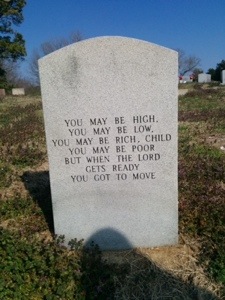
Finally, we wended our way down 51 out of Senatobia (after eating smoked sausage and pork BBQ at Coleman’s BBQ) and, halfway to our destination of Como, MS, pulled a right down a country road, then a left up another until we reached the Hammond Hill Baptist Church cemetery (see above photo), the resting place of Mississippi Fred McDowell, to north Mississippi hill country blues what Robert Johnson is to Delta blues, and covered by the Rolling Stones on STICKY FINGERS. He’s buried next to his wife, but some oblivious fuckers had recently sat by his graveside and made a pile of cigarette butts and trash on her mound. We hadn’t thought to get a blue rose for Fred, so we cleaned up Ester’s grave. A pretty moving experience, standing there on a quiet hill of interred corpses in the obscured Mississippi woods. Afterwards, we drove three miles down the road to Como, Mississippi, entering the town with Napoleon Strickland’s fife and drums powering us. Who is Napoleon Strickland? Well, he’s got a sign on Main Street in Como!

Early Recording by Unsung Memphis Master Demands Your Full Attention!

Selvidge-Cold-Of-The-Morning-CD-and-LP

Sid Selvidge: The Cold of the Morning (Omnivore Reissue)

Mississippi-raised, St. Louis-honed, and Memphis-tested, Selvidge was a true rarity: a white singer who could expertly interpret classic blues (here, “Judge Boushe”and “East St. Louis Blues” via Furry Lewis, the happily nasty “Keep It Clean” from Charley Jordan) without a hint of minstrelsy, a folkie with a great voice who could deliver material without sounding, in the words of Allen Lowe, like he had a napkin folded in his lap, and a catholic music-lover who could shift styles and genres without strain (from “Danny Boy” to “Po’ Laz’rus” to “The Great Atomic Power” is some mileage). Selvidge passed from cancer in 2013, and this recording, along with his Elektra Twice-Told Tales from the early ’90s, is a great way to get caught up. Bonuses: Selvidge’s stellar picking (learned at the foot of Lewis) and a batch of cuts where he’s backed by the eccentric rhythms of Mudboy and the Neutrons. How to explain Sid to the benighted? His baritone is as flexible as George Jones’, and, if you’d agree that Hank and Lefty were at the heart of The Possum’s vocal art, well, Tommy Johnson is the at the core of Selvidge’s. You may have to look that one up. Let’s hope Omnivore reissues the rest of Sid’s Peabody rekkids, which are very, very hard to come by.

Natural Child: Dancin’ with Wolves

NattyC

I’ve been through this before. I’ve become enraptured with the energy, the charisma, the vulnerability, the direct connection with my own doings, the addictive amateurish spirit–which is where we ALL start–of young bands, namely, The Clash and The Replacements, then witnessed their growth as musicians and writers. Really, it’s a privilege, and maybe I perceive it differently because I’m an English teacher who’s always LOOKING for growth, but I have always found myself in conflict with other listeners who seem appalled with such bands simply because “they got good.” Read: they play better, they come to understand the studio, they mull over their lyrics a little, they–horrors!!!–discover more of the universal musical palate. At 52, I’m too experienced listening to music to scream “Sell Out!” just because a band GROWS.

Such is the case with Nashville’s Natural Child. In front, I must confess that I first encountered them in 2010 in Lawrence, Kansas, at the Scion Garagefest, simply because I didn’t know any of the bands on the first tier of shows and chose their venue randomly, and they charmed the shit out of me by presenting themselves as if they were dressed to go on a float trip, playing as if they’d just awakened and thought it was a good idea to rehearse, and communicating insights about white people and cougars and bad lays as if they were talking across the bar to you. In short, they were wonderfully unselfconscious, and just what I needed at the time. Vampire Weekend, sorry, is hard to take.

Since that show, I’ve been fanatically loyal, even harasssing them on Twitter for not being productive enough. Dating from the point of those tweets, they have been workaholics, but I am sure it’s coincidence. And they have proven worthy of my admiration: from their run of early singles (especially “Nobody Wants to party With Me,” “Crack Mountain,” and “Cougar”) through their first full-on albums–1971 and Hard in Heaven–they have hewed to the Doug Sahm Memorial Edict: “If it can’t be written on the back of a Taco Bell sack right after you done done it or thought it, what’s the point?” I am acutely aware of the arguments against this aesthetic, but I just don’t effin’ care, because it’s rock and roll.

Which brings us to the new Natural Child rekkid, Dancin’ with Wolves. For the first time, they sound clean. There’s a steel guitar weaving through the songs.  No longer are they pursuing an odd, bass-led, distinctly East Nashvillean yet punky, weed-informed answer to Johnny Thunders and The Heartbreakers’ LAMF; they are laying back, nodding to New Riders of the Purple Sage (if i were 30, that’d be a deal-breaker), Sir Doug himself, even Big Brother minus Janis (ever heard Be a Brother?). They think they’re going to get more frequently laid because they are country hippies–well, if they really are, well, probably NOT–they lament our temporal state, they nostalgize about drinking and driving, they stand by their surprisingly hip city (if you can block out the image of Jack White), they throw a lifeline back to ol’ Jimmie Rodgers (though one has a right to question whether they could survive an interaction with, say, an actual North Dakotan rounder), they argue their country legitimacy. I believe that litany’s a pretty good argument for the album’s piquancy, though I fear some folks may consider it bland. If you need more persuasion, I’ll proffer this: if you simply browse over to Pitchfork’s review page, skate your eyes across the album cover images, and randomly read a few reviews, you will discern a painful trend toward bending over backwards to establish a plot of musical and–unfortunately, more urgent–existential uniqueness. The cumulative effect is comical. You’ve probably seen websites snarkily cataloguing “The Worst Album Covers of All-Time”? Pitchfork tops those websites monthly with images of new albums! Considered together, it’s just proof of how lost folks can be, and I like Natural Child because they are NOT lost. They know who they are, they aren’t ashamed of getting better, but…OK, here’s the rub…they have no aspirations of ascending to some hip mantle. Remember in Cool Hand Luke when Strother Martin’s gang boss, upon questioning Paul Newman’s Luke, can’t believe “Lucas War Hero” was discharged as a mere private?  I love that moment in the movie, I’ve spent a lot of my professional life trying to apply its implications, and I’ve no doubt that Natural Child subscribe to the same day-by-day approach. Thus, they remain…my heroes.

I wish the lyrics had a few more surprises. I wish there were some dirty guitar. I wish the album were a shade funnier. But the boys have settled into an approach that makes them happy, and that’s contagious. Their lack of ambition is inspiring, considering the milieu they find themselves in, and, if their writing can grow as many moves as their musicianship has–something that, unfortunately, didn’t happen for the Replacements–maybe, someday, someway, they might get a notice in Rolling Stone or Pitchfork. I am confident they are the best band in America with the least notices and, if one considers Dancin’ With Wolves their Hootenanny or Give ’em Enough Rope (I want to be sure you understand that I understand they are operating on a far more casual level than those forerunners, which is the seductive element for me), their best moments lie ahead.

A new poem draft: The Atheist Confronts A LOVE SUPREME

The Atheist Confronts A Love Supreme

It’s just vibrations:

Reeds

Skins

Metal

Catgut

Wood

Wires

Set in motion by

Lips

Tongues

Lungs

Hands

Feet,

In turn, set in motion by

Minds that are not free,

That are run on chemicals

and electricity—

And there is no heart;

The heart is an organ—

And it’s all molecules anyhow.

It may seem spirit-sound

In its volume

movement

dynamics

repetitions

In its prayer-coherence

but

God’s not in it.

No god hears it.

That’s what he thinks.

But in a half-century of

Proselytizing on its merits,

It is not what he says.

This is not subterfuge.

It is stubborn impulse,

Some synapse snap,

That makes him whisper,

“It is spiritual.”

Paul Blackburn, “Listening to Sonny Rollins at The Five Spot”: When Jazz Poetry Works

No one should be surprised to learn that an attempt to parallel the rhythms, inventions, and effects of jazz has fueled a raft of poetry over the years. Just as great jazz is difficult, so is great jazz poetry. Here’s a stellar one that, to my eye and ear, is a spectacular success. It’s called “Listening to Sonny Rollins at The Five Spot,” and it’s written by Paul Blackburn:

THERE WILL be many other nights like
be standing here with someone, some
one
someone
some-one
some
some
some
some
some
some
one
there will be other songs
a-nother fall, another ­ spring, but
there will never be a-noth, noth
anoth
noth
anoth-er
noth-er
noth-er

         Other lips that I may kiss, 
but they won’t thrill me like 
            thrill me like 
                          like yours 
used to 
     dream a million dreams 
but how can they come 
when there

           never be 
a-noth ­ 

Just for fun, play this clip of Rollins playing–what else?–“There Will Never Be Another You.” The venue isn’t The Five Spot, and Rollins is incapable, I think, of duplicating an improvisation,  but I think it might go a long way towards proving Blackburn’s triumph in the above poem.

Note: The song “There Will Never Be Another You” was written in 1942 by Harry Warren (music) and Mack Gordon (lyrics) for the Sonja Henie musical Iceland. I believe I am right in saying that jazz musicians have put the song to more lasting use (try Chet Baker’s, too).

What Happened in Nashville Right After Dylan Dropped BLONDE ON BLONDE On It (Subtitle: I Wonder What Kristofferson Knows)

It’s pretty common knowledge that the studio aces of Columbia’s Nashville Studio A were not ready for Bob Dylan when he arrived there to finish BLONDE ON BLONDE. For one, he was famously not into rehearsing or multiple takes; for another, he did not observe the Golden Mean of the three-minute song; for YET another, he was composing IN the studio, unconcerned about the cost, while the musicians, used to knocking songs out like a stamping machine, sat around, smoke, drank, and played cards. Check this out, from Clinton Heylin’s BEHIND THE SHADES: “On February 15, the session began at 6 p.m., but Dylan simply sat in the studio working on his lyrics, while the musicians played cards, napped, and chatted. Finally, at 4 a.m., Dylan called the musicians in and outlined the structure of the song. Dylan counted off and the musicians fell in, as he attempted his epic composition, ‘Sad Eyed Lady of the Lowlands’. [Drummer] Kenny Buttrey recalled, ‘If you notice that record, that thing after like the second chorus starts building and building like crazy, and everybody’s just peaking it up ’cause we thought, Man, this is it…This is gonna be the last chorus and we’ve gotta put everything into it we can. And he played another harmonica solo and went back down to another verse and the dynamics had to drop back down to a verse kind of feel…After about ten minutes of this thing we’re cracking up at each other, at what we were doing. I mean, we peaked five minutes ago. Where do we go from here?'”

Well, after Dylan was gone, HERE is where producer Bob Johnston, Buttrey, and the rest of the studio cast went:

The Wrong Notes (A poem Thelonious Monk caused)

My truck cab is compact

But built for euphony.

I squeeze in for a ride,

Disc in hand

To fit my feeling,

Slide it in the player:

No place for sound to go

But to besiege me beautifully.

I don’t even know I am driving

Sometimes.

A splendid day.

Sun’s rays,

Monk’s notes,

And a healthy engine

Turn me

Half my age as I

Cruise the main drag.

No beer between my legs

But my fellows are using their

Turn signals

And eschewing phones

Out there.

Hardly does this bliss

Settle when a crabbed image

From our sick spirit

Troubles my sight:

Four rumpled men

With signs and staves

Shouting at girl

Ducking in a clinic door.

I want to blast my horn as I pass.

Backs to the road,

They stand a yard from the curb.

Heart attack, perhaps?

They could be ministering

To the poor

Instead of fouling this child’s day

And mine.

As I ball my fist

Another sound intrudes.

The cab is tight.

It’s Monk,

Hammering out

A dissonant smear

(Like that picket gang)

To break the ear’s ease

In half.

Like the porter’s knock,

To break the spell,

But of pleasure,

Not horror.

Either spell is

Chicanery in our

Quest for truth.

Monk, those notes

Were right.

I drove past

Silent

As one you suspended.