The Violence of Chuck Berry

ChuckBerry2

(The following is an excerpt from a memoir I am writing about my career in public education. Music had a lot to do with it, believe me.)

I have taught many unusual lessons in my career. This one was not only successful (though even the best lessons are only partially so), but its history also incorporated a lot of the best and not a little of the worst of this profession.

I was teaching middle school at the time and was graced with a bunch of seventh graders who were game for anything interesting I proposed. They would go on to make me look great many, many times that year. In this case, their lesson grew out of a screw-up on my part.

Striving to realize our school’s challenging goal of integrating curriculum, our instructional team had tried to design an opening unit focusing on the idea of “culture.” For three weeks, each teacher—math, science, social studies, reading, writing, and special education—would design his or her instruction so that it addressed that common theme, with the unit output being a single assessment of learning, as opposed to five separate tests. Theoretically, it still sounds neat to me—in fact, it drew me away from my previous job just for the chance to try it. In reality, it’s a bitch to pull off. Just trying to talk about it caused my first teaching team to implode.

At this point in my middle school tenure, however, I was surrounded with comrades willing to give the idea a shot. We planned our culture unit very meticulously, and, of course, I, likely the most enthusiastic among us, zipped through my part of the unit quicker than necessary, quite possibly leaving a few students in the dust in the process. So, confronted with an additional three lessons to write before my fellow teachers were finished, I decided to give the young’uns a dose of Missouri culture and rock and roll, as well as an opportunity to be creative.

I have often said, only half-joking, that I teach to subsidize my record collection. But I have always reinvested what I’ve gained from music in the stock of U. S. public schools’ pop culture curriculum (even though that exists only in my mind), and, in this case, I thought it would be valuable for my students to study how one great rock and roll writer reflected his rich and complicated culture. I prepared, with one eye on Fair Use guidelines, a handout highlighting some of Mr. Chuck Berry’s most revealing lyrics (“Brown-Eyed Handsome Man,” “Too Much Monkey Business,” “Sweet Little Sixteen,” and “Back in the U.S.A.” among them), prefaced the lyrics with a quick artist bio, then guided the class through some close-listening of his music. As we proceeded, I led the kids in discussing what we had learned about U. S. culture circa 1955-1964, and advised them in taking a few notes. Then, over the next two periods, we put our shoulders to the wheel of the task: either write a song of your own, reflecting current U. S. culture, in Chuck’s style, or write a song about Chuck’s version of U. S. culture in your own style.

We had a blast, and, I must say, their work was very perceptive, witty, and—what do you know?—indicative of their having learned some valuable things! A couple students even brought guitars and played their songs. What we’d done leaked outside of our classroom (not surprising, in that my classroom was open to the hallways!), and we soon learned that our homeschool communicator’s college roommate had been Chuck’s lawyer at one point—and had his phone number.

One of the kids excitedly blurted, “Hey! Let’s send Chuck some of our songs!” You don’t say no to such a proposition, and soon the ex-roomie lawyer was on the horn to Chuck, asking him if he’d be up for reading some 7th graders’ tribute-songs to his bad self. Almost immediately, we received word back from Berry: send them on! We did a quick read-around, whittled our stack of 150 songs down to the best 30—we didn’t want to swamp ol’ Johnnie B. Goode!—slid them into a “vanilla envelope,” and put ‘em in the post. I didn’t really expect to hear from Chuck again; one of my long-time philosophies regarding ambitious enterprises is to expect absolutely nothing, which intensifies the exultation if things work out.

The next thing that happened was not a working-out.

A week after the culture unit’s conclusion—it worked nicely, but we were never to replicate its success beyond squeezing a birds-and-the-bees discussion into a “plant life cycles” unit—came our school’s “Back to School Night,” a late summer public ed staple during which parents are invited to meet their students’ teachers. These evenings usually prove a bit of a dog-and-pony show on our parts, but they are seldom high intensity, and, though the parents who most need to come don’t (usually they can’t—they are working), we usually at least mildly enjoy the opportunity to communicate to the grown-ups what we’re up to.

I didn’t expect to be called to the principal’s office. Via intercom.

When I stepped into her office, in front of Dr. Brown’s desk sat what I presumed to be a parent. On the parent’s lap lay her daughter’s English folder, open, with the Chuck Berry handout removed and unmistakably on display. I thought, “Oh shit—she’s a journalism professor and she’s got a copyright complaint. I knew I should have picked up those handouts after we finished writing!” I stood at attention, ready to be, perhaps justly, upbraided.

“This man does not have the moral fiber to be teaching my daughter!”

I take copyright seriously, but, well—wasn’t that a bit strong?

But this wasn’t about copyright. I could not have possibly guessed what it was about.

Remember that “quick artist bio”? I know what you’re thinking: no, I did not mention Chuck’s Mann Act scrape and accompanying prison stint, nor his naked photos with equally naked groupies, nor his tax evasion escapade, nor his exploits with video technology. Nor did this mother look those biographical tidbits up. (All idols have feet of clay, anyway.) Her concern was this: I was promoting violence in this unit.
She said that. Yes. And it was in the bio ‘graph I had written, branded into my memory since:“Berry’s machine-gun lyric delivery in songs such as ‘Too Much Monkey Business’ (see below) influenced none other than Bob Dylan, one of this century’s greatest songwriters.” She read that aloud, from the handout, to my principal and me, with supreme confidence and righteous indignation, as if it were irrefutable proof I was a warlock.

Wait—what??

Actually, I think that is exactly what I said. I looked at Dr. Brown—an excellent administrator I had purposely followed over to this particular school, and a human whom I was desperately hoping valued loyalty at the highest level—and stared in disbelief. The mother stood, read the passage aloud again, and punctuated it with this outburst: “It says right here—‘machine-gun lyrics’!!!” (As you can see above, it didn’t quite say that.)

I confess to being a lifelong smartass, but my reply was simply self-defense: “Do you understand figurative language?”

“Don’t try to slither out of this!” At that moment, I was the closest I have ever been to deeply understanding Kafka. And “slither”? Really?

Keeping my far eye pleading with the principal and my near one defiantly on my judge, I patiently explained the point behind the lesson. No sale.

I looked directly at my boss and said, in quizzical defeat, “Well, you could move her daughter to another team.”

The parent exploded. “She’s not going anywhere!”

I was stunned. I reflected for about an eighth of a second and said, to them both, “This is ludicrous. I have sane parents to speak to. Do what you must. I cannot explain more clearly what my valid and very moral intentions were. Goodbye.” Turned on my heel, went back to my class, and pictured two die spinning through the air.

That absolutely wonderful administrator, Dr. Wanda Brown, refused to budge in giving me full support—that’s one of the reasons why she still hangs the moon for me. The parent pulled her daughter from regular classes for homeschooling (I am sure, much to the daughter’s embarrassment), though she continued to send her over to us in the afternoon for French classes (that’s bullshit, if you ask me—you teach her French, lady). In spite of the whackiest—and wackest—parental guidance episode I had ever witnessed in my career, I proceeded to have a better year than Frank Sinatra’s in the song. The story of the Chuck Berry unit, however, had not yet concluded.

Spring. That lovable homeschool communicator rolled into my classroom—he did, in fact, roll—and motioned me over.

“Chuck’s coming to play at a local high school next week. [He lives in Wentzville, Missouri, just down I-70 from Columbia.] He loved the packet of songs, and he’s authorized you to bring over the ten student writers you think would get the most out of hearing and meeting him. I’ll take care of the bus.”
As the generation of teachers prior to mine would have exclaimed, “My goodness!” (That is not what I said; I repeated the title of a well-known Funkadelic title exclamation, but my moral fiber is too strong to repeat it here.) Though selecting the ten students proved an exercise in pure agony, we were soon filing into the choir room of the local high school, where the kids were given a front-row seat—
a mere five feet from the man himself, at that moment swiveling on a stool, his guitar on his lap.
My natural high was so intense, I cannot remember much of Berry’s talk, other than that Chuck gave rap lyrics his seal of approval (good man, and my kids beamed). However, when the afternoon turned to Q&A, I received an electric charge greater than a cattle prod’s when one of my students, Sekou Gaidi (whom I must name for posterity’s sake), stood to ask a question. Sekou, who often underperformed for me despite frequently being the smartest person in the room (including me), had actually been inspired during the Chuck Berry unit and written a killer song. He was also a combination of a cannon packed a shade too loose and Sun Ra (a jazz genius who uttered many a head-scratcher in his day). I admit, as the charge passed through me, that I was holding my breath.

Chuck: “Young man, what would you like to ask?”

Sekou: “I don’t know who in the heck you are”—Unadulterated claptrap! He was laser-focused through the entire three-day lesson!—“but my mom wants you to autograph this book.”

This request was delivered dry as toast, with arm toward the stage, Chuck’s recent autobiography at its fingers’ end as if it were trash recently plucked off the ground. Sekou’s expression? Slot-mouthed.

Three beats of silence. Excuse me while I break to present tense.

Chuck—Chuck Berry—is staring (glaring? I couldn’t tell!) at Sekou, then a pudgy, bespectacled little seventh-grader wearing mauve sweats. I am covering my hands, shaking my head, fairly sure that this is one of Sekou’s jokes, stunned by his unholy audacity if I am correct, and dreading what might rush into the resulting vacuum of silence.

Into the void rush explosive guffaws, straight out of the gut of The King of Rock and Roll. Then out of the audience’s. Then out of mine. My team teacher is laughing so hard she’s tearing up, and my wife Nicole, who’d come along and would later get her own copy autographed, is staring at me in stunned, gaping delight. In fact, I am tearing up a little right now, staring at this screen, mouth agape as I recall it.

Thus properly ends one of the best lessons I ever taught, embedded in the history of which, as with all the best lessons, are other very important lessons. I can only be thankful that the lessons did not come at me with machine-gun-like rapidity.

Folk-Funk Comes to Hickman High School!

Bobby autographs

Bobby Rush signs student autographs after his show in Hickman High School’s Little Theater. (Photo by Notley Hawkins)

(This piece is part of a memoir-in-progress about my 30+-years of high school edumacating that may or may not appear some day in completed form.)

Sometimes great things fall into your lap, and you have to be ready for them.

In 2009, my wife and I had just returned from a trip to Memphis, and on the way down and back, we’d listened to a heap of Bobby Rush tracks. Bobby, a native of Homer, Louisiana, is the inventor of what he calls “folk funk”: music too funky for blues, too bluesy for funk, and designed for very down-to-earth people. He has also been incredibly durable. One could argue that not only his recordings but also his performances are more vital now than they were thirty years ago; currently in his eighties as of this writing, he shows no signs of slowing down. We’d barely unpacked when my phone rang. The caller was an associate of the Missouri Arts Council, and she’d gotten my name from an acquaintance who’d mentioned that I’d arranged rock and roll concerts at my high school.

“Would Hickman be interested in hosting a blues artist for a concert next month?”

That would seem to be a no-brainer, but as fans of the graphic novel and film Ghost World know, the wrong band or artist can give an audience the blues rather than relieve it of them. I wasn’t going to be held accountable for a Blueshammer-styled band, nor, I must be honest, a painfully sincere “bloozeman” of any stripe. Thus, I had to put on the brakes.

“Well, it depends upon whom. When we do these things, we like to do ‘em up all the way, and I’d hate to, you know, do up something anti-climactic.”

“Have you heard of Bobby Rush?”

I didn’t know whether to shit twice or die.

“Can you hear me ok?”

“Yeah, sorry, I was just a little overcome there. Hell, yes, we’ll do it! Give me the details!” Usually, I asked for the details before agreeing, but, in this case, I would have been a fool.

“Well,” she said, “It’s free of charge to you and the audience; a grant’s paid for it. Bobby’s got his own band and gear—you’d just need to provide a basic PA and monitors. And we’d like to schedule it for the evening so kids could bring their families if they wanted to. I tried to pitch this to Jefferson City Public Schools, but they wanted nothing to do with it.”

“You snooze, you lose. And this will be a huge loss for them. We’re A-OK on the equipment. And evening is great. But, regarding the kids and their families—is Bobby bringing the girls?”

I am sure this is a question anyone trying to book Rush is going to get asked. Bobby frequently performs with three triple-mega-bootylicious dancers to whom he often makes leering but strangely warm and charming reference throughout his shows, and a) I seriously hoped he was travelling with them, but b) I wasn’t sure the snug stage had room for them, and c) I was not sure a transition from high school performance stage to chitlin’ circuit showcase would be altogether without bumps (take that as you will).

She chuckled. “Oh no, he doesn’t have the girls on this leg.” I breathed a sigh of disappointed relief, as well as applied a mental Bobby Rush-like chuckle of lechery to her phrasing.

The next day, the kids of the Academy of Rock, our music appreciation club, and I revved into PR gear. We made and posted flyers, we networked the hallways and school nooks and crannies, and we set up visits to the American history classes, where we planned to show a brief “teaser” segment on Rush from Richard Pearce’s “The Road to Memphis,” an installment of Martin Scorsese’s The Blues series. Because I have been a serious nut about music since I heard “Then Came You” float out of a swimming pool jukebox, I have always been careful to find a solid justification for connecting any school use of it to curriculum—probably too careful, but I am like a Pentecostal preacher when I get going, and may the Devil take the curriculum. In this case, the justification too had fallen into my lap: it happened to be Black History Month, and, as dubious as I consider the concept (I prefer Black History Year), I was happy to exploit it. I was also happy that, in my long experience at Hickman, I’d seldom seen a major event staged that directly and intentionally appealed to our 25% black population. Not that I could take credit for anything but saying “yes” to the proposal; in fact, that could accurately serve as my epitaph: “He said ‘Yes’ to life.”

We also got word out to the local press—who were underwhelmed as usual, for the most part—and the Columbia music community, which resulted in my fellow music maniac Kevin Walsh and his young pal Chase Thompson showing up to make a film—as yet unreleased, but I have a dub—of Rush’s appearance.

The day of the show seemed to arrive in an instant. We promptly set up the stage and PA—but, for some reason, the monitors, not exactly top of the gear list in complexity of use, were malfunctioning. We tried everything we knew (admittedly, not much), to no avail. At least we had a computer properly jacked into the PA to record the show, which Bobby’d happily agreed to let us do. Still—one of the few things we’d been asked for we couldn’t deliver. I was also nervous about the turnout, as we had no way of knowing how many folks would arrive, since admission was free.

Bobby and his band (also known as the crew—they hauled and set up their own equipment, which is no unremarkable habit, especially for road vets) arrived right on schedule, and, after finding him and introducing myself and my wife Nicole, I cut right to the chase: “Bobby, our monitors are screwed. That’s about all you wanted, and we messed it up.”

“Phil, Bobby Rush got this! You OK! Been on the road for sixty years and ain’t nothin’ like that ever stopped us! You all just sit back and relax and let Bobby Rush take care of business.”

I couldn’t argue with that. Would you have?

We did as we were told and took a seat. The space was an old-style “Little Theater,” capacity 150, with nice track lighting, comfortable seating, and just enough stage for a five-piece band (Bobby had seven). I am assuming it was originally built for student theatrical performances, but, in the ‘Oughts, it was just as frequently a concert venue. As I write, I feel a pang of sadness in not being there to continue using it.

Bobby and his band genially integrated our small crew of students into their own set-up and soundcheck—they’d also quickly jerry-rigged the monitors and had them working—and were thrilled to find that we planned to have one of the kids run sound for the show. This had been our philosophy since the club was formed in 2004: move over and let some students do the popcorn! An element of risk always threatened proceedings as a result, but that’s life, learning happened, and it’s more fun riding on The Wall of Death, anyway.

I had been in a bit of a nervous trance when I suddenly broke it, looked around, and noticed that the house was almost packed. Not only that, but the concertgoers were predominantly black—with a considerable number of parents and grandparents among them. As is my wont, I quickly twisted my joy into worry as I began to recall certain bawdy Rush routines that might be revisited that very eve.

Bobby

I needn’t have worried. Bobby Rush had this. 75 at the time, he must have set the record for pelvic thrusts in one show. The crowd went wild. He told raunchy stories, including one featuring his minister father. The crowd hollered. He plum-picked his sly repertoire: “Uncle Esau,” “I Ain’t Studdin’ Ya,” “I Got Three Problems,” “Henpecked” (“I ain’t henpecked!/I just been pecked by the right hen!”), “Night Fishin’,” “Evil,” “What’s Good for the Goose.” The crowd exploded. He produced a pair of size-75 women’s undies to demonstrate his taste in derrieres. The crowd went bonkers, and the grandmas stood up and shouted amen. He accused our sound man of being a virgin. The crowd—and our soundman—went nuts. He talked about visiting Iraq, about his prison ministry, about struggling up out of the Great Migration to Chicago, about being on damn near every black music scene for fifty years—and about coming through it all to vote for a black president who actually got elected. And the crowd hung, hushed, on his every word, as he delivered a brilliant, deeply personal history lesson we hadn’t even asked for. Even the jerry-rigged sound in that little room was hot as fire and deep as a well, with Rush playing harp like he was possessed by the ghost of Sonny Boy Williamson and snatching a guitar away from a band member to play some razor-sharp solo slide. As I continued to nervously scan what had become a congregation, I was thrilled to notice that the older the person was whom I spied, the wider his (or most definitely her) grin was. The students? They had clearly never seen anything like Bobby Rush before. Our soundman was so mesmerized he forgot to check the recording levels, so our aural document of the show is way into the red.

I know it’s a cliché, but it was, for damn sure, a religious experience. The audience, I think, was more drained than Bobby at show’s end, but not too drained to be shaking their heads in wonderment and giggling with glee. Several of those older folks swung by to tell me, “More of this, please!” The principal who’d drawn event supervision—lucky man!—asked me, “How in hell did this happen, and when’s the next one, ‘cause I’m calling dibs?” Of course, I’d liked to have met those demands with serious supply—but witnessing a bona fide, down and dirty, authentic-but-for-the-booze-smoke-and-BBQ chitlin’ circuit show at a Bible Belt high school, I’m afraid, is a once in a lifetime experience. God, I do love grants and art councils.

Bobby Rush and Us

Nicole and I walked Bobby out into the February night, his arms around both of our shoulders. His eyes and jeri curls were shining, but he hadn’t seemed to have broken a sweat. “I want to thank you all for having us,” he offered, humbly. “I don’t know who had more fun, us or them!”

I quickly replied, “No, man, thank you! That show was so good you’d think you were playing for the president! And we’re just a high school in Missouri!”

He shook his head, smiling.

“I told you, Phil…Bobby Rush got this!”

See Columbia photographer Notley Hawkins’ classic shots from the show here, and do yourself a solid and grab Omnivore Records’ stellar four-CD career summation of Rush, Chicken Heads, here!

Midwest Lo-Fi Psycho-delic Attack: A review of Woody Records’ artist sampler CD by Mackenzie Thomas

It’s always tempting for the cooler-than-thou to think that the kids are out of touch with what’s really cool, but I would refer those misguided individuals to Local H’s “All the Kids Are Right,” and its warning line: “They won’t wear your t-shirts now.” Recently, the best thing about Kansas in this day and age, Woody Records, sent a package to Hickman High School’s Academy of Rock, hoping–daring–that some kids would sample the musical merch and find it…good. In fact, it happened. What follows is Hickman 10th grader Mackenzie Thomas’ take on Woody’s CD sampler–she makes the most of an opportunity I dreamed of at her age but had no way of making real (it was ’78–and neither the underground or technology had erupted)–and I think you’ll see a DECENT and fair music writer at work. Enjoy. And visit Woody Records. (The Editor.)

I am quite new to the lo-fi media scene, but the more I keep listening to the Woody Records Compilation disk, the more I begin to like it and understand the hard work put into it. This compilation contains fifteen tracks by various artists from the midwest area who are all a part of Woody Records, a small label out of Kansas. (Check out Woody Records’ Soundcloud page here to sample these artists yourself. – Ed.)

“If A Man Made A Machine” and “Mild Violence” by Fake Fancy, the first two tracks on the album, immediately caught my attention. “If A Man Made A Machine” has a sweet sound to it, and the rhythm moves to the same rate as my heartbeat. The song makes me feel alive. “Mild Violence” is a little heavier, with grooving bass and lyrics that are quick to the point, the singer stating that he has nothing, and no time for anything: “I’ve got nothing, I’ve got nothing, got nothing, but sunshine to keep me wide awake…” After hearing these two tracks, and assuming that a label would put the best of best on a compilation disk, I wouldn’t mind listening to more by Fake Fancy. Their songs seem to be short and sweet, and with fairly understandable lyrics.

It’s really hard for me to wrap my head around why a band would record and release a song where the vocals are so distorted that it’s impossible to understand what the singer is saying. For example, in “Salsa That One,” by Cucumber and the Suntans, the instrumental intro to the song started off nicely, but as soon as the vocals were added in, it became unenjoyable. All I could hear was “Wa, wa, wa ,wa…”– but that could possibly be the actual words to the song. Cucumber and the Suntans, however, redeem themselves with “Lifes,” a short, folksy tune that would be appealing to those listeners who spend their Sundays down at Cooper’s Landing south of Columbia, watching the muddy river flow by, a cold beer in hand and ears tuned into that weekend’s entertainment, usually something along the lines of country/folk/bluegrass/acoustic.

A doom rock/metal band by the name of Merlin takes their music a whole different direction than that of Cucumber and the Suntans. Their 11-minute instrumental track, “Christ Killer,” starts off with acoustic guitar for the first six minutes, then fades into eerie psychedelic rock. After listening to “Christ Killer,” I went on to listen to Merlin’s self-titled album , which consisted of “heavy hours of drinking, smoking, and worshiping the Dark Lord in a beer soaked, incense filled basement to produce our finest release to date. Implementing all the mystical, doomy, psychedelic, evil vibes from everything we’ve put out thus far, we have created a witches’ brew of all the Elements of MERLIN,” according to their Bandcamp page. Throughout their years of playing and making music together, they’ve seemed to maintain the same overall sound in their songs, while still creating new masterpieces each time.

I believe that Woody Records releases this lo-fi material because it’s cheaper on both the artist and the label, but it also sends out a creative vibe that is hard to find in albums by modern rock/pop artists. This album feels more natural because it hasn’t been auto-tuned and doesn’t consist of electronic beats and bass drops. There is definitely something special about lo-fi music–and this album. The Woody Records Compilation would be appealing to anyone who’s really open-minded about music and loves to support local musicians. This disk ranges from punk to electro-indie to psychedelic rock. It has something for everyone!

Mackenzie Thomas review picture

Mackenzie Thomas is a sophomore at David H. Hickman High School in Columbia, Missouri, the bass player in Graveyard Youth, and a member of that school’s Academy of Rock. This is her first professional review, and it’s five times better than my first one. 

When The Pierced Arrows Brought It to The Kids

7012

“…they won’t wear your t-shirts now….”

Local H, “All the Kids Are Right”

Through a good friend, I had heard of Dead Moon in the mid-’90s: “They’re garage rockers, but their lead singer’s about 50 and has been playing since the ’60s.” I had checked out their album Trash and Burn, which was lean, mean, raw, and wiry, with vocals that reminded me of Bon Scott’s, but, at the time, I was being deluged by so much music and stuff-o’-life that the rekkid got lost in the shuffle, even though it spoke directly to things that matter most to me about rock and roll. When they played a club here around the same time, I knew about it–but it was on a weeknight and, being a good-boy teacher for the moment (I was erratic in that area, at best), I skipped it. To what will be, I am sure, my eternal regret.

Fast forward to the mid-‘Oughts. I am sure most owners of record collections numbering 5,000-plus will relate, but, one weekend, sniffing around for something to listen to, I fetched Trash and Burn from where it had been hiding for a decade, slid it into the player, and stood back as it lit our house aflame. Both my wife Nicole and I exclaimed, in spontaneous chorus as old marrieds often do, “Where has this band been all our lives?” With the Internet now at our fingertips, we delved deeper, and found out about a documentary about the group called Unknown Passage: The Dead Moon Story, and immediately ordered a copy.

As will happen, I swear, to anyone who watches this film, we were stunned, then joined in lifetime loyalty to Fred and Toody, “The Coles,” as they are known to cognoscenti. Married for almost 50 years at this writing, successfully applying the DIY ethic years way before it was hip in the rock biz to everything from home improvement to instrument repair to music production and distribution to child-rearing, functioning as pretty-damned-equal partners in singing, playing and writing, these two dyed-in-the-wool rockers not only defined the rock and roll life in a way that didn’t get you looking at your shoes, but also served as a textbook case of true family values. I am not going to describe it; you just order the film, podnah. We have been pushing it on every vulnerable soul for seven years.

Concurrent to this discovery, at the Columbia, Missouri, teaching gig that was subsidizing my record collection, I was experiencing some surprising turns of event with an extracurricular club called The Academy of Rock, which a student of mine and I had founded in 2004. A couple of enterprising students had suggested that we try to convince bands who came through Columbia for shows to stop by our meetings and chat about songwriting, the rock life, and anything else fun. The worst that could happen was being told “No,” so onward we went, and, literally before we knew it, Amsterband (the future Ha Ha Tonka), Cary Hudson (former Blue Mountain and Neckbones), The F-Bombs (a local punk band), and–I had marks all over from pinching myself–eventually, The Drive-By Truckers and The Hold Steady had played–played, not stopped by to chat–in our school’s Little Theater, for free, with deep-ass Q&A, friendly autographing sessions, and invitations to come to their shows with guest-list privileges. So, when Nicole and I discovered that The Pierced Arrows, the Cole project that rose from the ashes of Dead Moon, were playing The Record Bar in Kansas City, we decided to go and maybe strike up enough of an acquaintance to ask them to swing by Hickman.

True to everything we had heard about them, Fred and Toody sat with the rabble through both of their opening bands’ sets, drinking beer, smoking, and obviously engaging with the groups’ music. Between sets, I tip-toed over to Toody, and begin shooting the shit. When I told her about our club and our (by now) tradition of bringing in bands, she enthused, but said, “Well, we’re heading for Europe next week, and we’ll be there for a few months, but, if you give me your phone number, I’ll get in touch with you when we’re back in the States.” Returning to terra firma after a shattering Pierced Arrows set (for the uninitiated, the only real difference between Dead Moon and The Pierced Arrows is slightly heavier guitar and slightly steadier drums) and hitting the prairie pavement back to Columbia, I turned to Nicole and said, “Well, we did get to meet them, we do have Toody’s phone number, and the show kicked ass–but surely after two-three months they’ll forget about us.”

Wrongo. Almost three months to the day of that show, Toody called me out of the clear blue sky and asked, “Hey, we have a day off coming up between Columbus and Kansas City, could we [YES–“could we?”–I shit you not] play at your school then?” I was so gobsmacked that about 10 seconds of silence followed before I Marv-Alberted a “YES!” into the receiver. We quickly agreed on details–we’d pay for their hotel room and food after the appearance, since they’d have to hit the road immediately following for the Kansas City gig–and I proceeded to pinch another red mark onto my arm.

The day before the band was due to play, I was moderating a Socratic seminar for my British literature students in our school’s office conference room when my cellphone began buzzing. I don’t get phone calls much, especially during the day, so I sneaked a look, and saw it was Toody. I put the temporary kibosh on the seminar–do you blame me?–stepped outside, and took the call.

“Phil, we are so, so, so sorry we are late! I think we can set up in ten minutes once we get there [they were 30 minutes outside of town] if you can still make it happen!”

“Toody–it’s not until tomorrow.”

“You’re shitting me! [Turns away from phone, shouts “It’s not ’til tomorrow,” is met by jubilant screams from the rest of the van’s occupants….] Fantastic! We are tired and hungry and need to decompress…but, hey, come by the hotel room and say hi!”

I am not making this up.

Nicole and I swung by to see them, but they were obviously beat, so we just gave ’em some dining recommendations and double-checked the details. We were particularly careful about the latter; when The Hold Steady visited, they arrived an hour after they were supposed to, and at the very moment that, in front of a packed theater, I was running out of steam stalling the crowd with their biographical details–sans soundcheck and sans anxiety, since they drifted in on a cloud of cannabis cologne. Fred assured us they’d be on time for a soundcheck, so we left them to get their rest.

I had arranged to have a substitute take my afternoon classes the next day, and, late that morning, as some Academy of Rock club members and I were setting up the PA in the theater, my phone began buzzing again.

“Hey, Phil, we’re here.”

“But Toody, you didn’t need to be here for another hour-and-a-half!”

“Oh, that’s OK! We want to meet some of the kids and hang out if it’s OK […if it’s OK????].”

“Well, hell, I’ll send a couple of ’em to come get you.”

We spent the next 90 minutes not just sound-checking but actually hanging out and talking about everything under the sun, with Fred giving some of the school’s theater tech kids, who were helping us, tips about rock and roll sound. For example, since he had lost 70% of his hearing by that point [no big deal!], he preferred to have two monitors on each side of him, facing each of his ears. That was just one of the many things the kids learned from him in that very information-rich hour-and-a-half.

The performance? Titanic. Also, easily the loudest in Hickman’s history (the DBTs and Hold Steady had played unplugged–but you don’t unplug Fred Cole). We recorded it, but, unfortunately, we screwed up Fred’s vocal levels; it’s still power-packed and worth a listen, though (see below). The band played all of their then-new album Descending Shadows, plus the best of their previous record, Straight to the Heart.

After the sixty-minute show, they then took student questions, which–if they weren’t already excellent, which most were–they would cannily reconfigure for the best possible responses. I would recap it, but, here, read this Columbia Tribune story about it. The amount of wisdom shared in the nearly three hours they were in the theater was mind-boggling, and, even when the bell rang to dismiss students for the day, they were not yet done.

DSCN7079

I sidled over to Fred, Toody, and their awesome drummer Kelly Halliburton, who matched them word for word, note for note, gesture for gesture in sheer rock-band fan-care, and said, “Well, district rules forbid us from getting gift certificates for visiting ‘educators,’ but here’s $40 to go eat some pizza and drink some beer at the local-favorite pizza joint. Let me draw you up some direct—-“

Fred: “Hey, just bring some of the real big fans and come eat with us.”

“You’re serious?”

“As a heartattack! Just let us have one of the kids to navigate!”

As it happened, one of the kids was already thoroughly inured to the ways of The Coles through our having forced Unknown Passage: The Dead Moon Story on him and his having avidly explored their discography. (Oh yeah: we also took him to the aforementioned Pierced Arrows shows in the guise of our nephew, since it wasn’t all ages and the manager had given us permission–don’t try that one at home, fellow teachers!)  So we sent him along, and, people, I have never seen a student happier. He even got to bum a cig off of Fred!

At the pizza joint, we bought several pizzas, the band knocked back a few pitchers, and we had a total blast. To the end, though, the Coles and Mr. Halliburton were fan-centered. I had expected dinner to be a barrage of questions from the kids about rock and roll history (Fred goes back to the mid-Sixties through his involvement in The Weeds and The Lollipop Shoppe, and knew Janis Joplin well), but, instead, the trio queried the kids about their lives, their tastes in music, their experiences in bands, and…just life.

PizzaPizzaPizza

That kid on my right was a ninth-grader. As I drove him out to his folks’ house, neither of us could keep from shaking our heads in amazement that, along with rocking our asses off, they lived up to their advance notice and more. And as he told me,”I can’t believe they came to my school!”–it wasn’t his yet, but it would be the following year–I realized that it was probably the finest moment I’d ever experienced (could probably hope to experience–and, no, it ain’t been topped yet) as a public school educator. Beyond the educational impact, the encouragement the Coles’ chemistry and commitment gave Nicole and me, who have approached marriage unconventionally in more than a few ways, continues to resonate.

Fred had successful heart surgery earlier this year, and just turned 66 last week. I am sure, however, that he will be back on the road with The Pierced Arrows soon, and, if they come to your town–go. They are about rock and roll, but so much more. Be sure to bring t-shirt money, whether you are a kid or not.

Below: The Pierced Arrows’ performance at Hickman. We used a multiple-mic set up in the room, rather than recording straight from the PA (don’t ask…), and, since our kid at the PA botched the vocal mix and it was so crowded I couldn’t get to him to help, Fred’s vocals are somewhat buried. But you will hear why I got called into the office the next day:

Top 10 Great Music-Related Things That Happened to Me This Week

I. My wife Nicole became fully converted to Wussyphilia, via repeat listenings to a folder I put on her iPod including their very lively 2014 release Attica! plus some of their earlier great tracks. Her fave rave–and who can blame her?

2. After all of these years, Greil Marcus’ writing, as knotty, theoretical, and deeply referenced as it can be, is as easy and pleasurable for me to read as drinking a glass of water after mowing the lawn (Hannah Arendt and C.L.R. James, on the other hand, are wonderful, but not easy). While not perfect, his new book, The History of Rock ‘N’ Roll in Ten Songs, intriguingly explores many of his (and my) favorite themes, particularly that our musical and cultural past is always, through the magic of rock and roll, in conversation with our present. He brought about many revelations in my musical thinking, one I am somewhat ashamed to admit. While actively liking “Rehab,” I mostly rolled my eyes at the output and antics of the doomed Amy Winehouse; however, in a chapter focusing on “To Know Him Is to Love Him,” as he glanced off into Shadow Morton and the Shangri-Las, he described a Grammy performance of Winehouse’s that made it impossible for me not to YouTube it. I don’t Grammy, so it was new, shocking, and wonderful to me, and I take back my eye-rolling (I am a huge Shangri-Las fan, and should have recognized her lineage instantly):

3. I started practicing ukelele again. My wife bought me one almost ten years ago for our anniversary, I practiced hard for awhile, but I don’t have a great physical affinity for stringed instruments. I hadn’t gotten it out in awhile, but I muscle-remembered several things. That damned “B” chord formation, though.

4. Some very cool Swedes released a compilation of the great Midwestern rock and roller Charlie Burton‘s awesome, comedic songs. And…it is authorized. And…it has the greatest song ever written about Elvis:

5. It was a long week. Nicole and I ended it with a trip to the amazing, enduring Tony’s Pizza Palace (in Columbia, Missouri) for a pizza, a Greek salad, and a pitcher. We got in the car, relaxed and satisfied, and as we pulled away, Nicole realized she had the car iPod turned down. She turned it up, and I discovered she’d segued from one of my favorite bands to another: Nashville’s Natural Child. As we cruised around a little that night (and the next morning), we were treated to many of their early singles on Infinity Cat, which, though not hallowed by the indie press, were extremely strong in the areas of wit, riffage, cameraderie, and persona (“trio of weed bandits bemusedly working through the obstacles of modern USA”). They have evolved a bit: they’re better players, more relaxed performers, far more well-known on the circuit, and still fun to see live. But there is something about their early drive, humor, and bleary desperation I miss. Here’s one we really loved this morning, a bit of a landmark, really, in the gender politics and sexual documentation of rock and roll:

6. I have recently joined a Facebook group called Expert Witness that is made up of 200+ devoted followers/readers/proteges of the great rockwriter Robert Christgau. Facebook is supposed to be really bad for you in nine different ways, but–it feels like home to me. The conversation is intelligent, useful (since Christgau’s various review columns are defunct–he’s now at Billboard, but I am not sure what he’s really gonna do there), witty, and civil without everyone behaving as if he has a napkin folded in his lap, in Allen Lowe’s great phrase. Case in point: this week, I finally found a cheap copy of sound-bard David Toop’s infamous Sugar & Poison comp, a two-disc modern R&B mix that ambitiously tries to replicate the various hills and valleys in a real-life roll in the hay (for example, in the middle of the groove, the listener might be confronted with financial anxiety (see Dennis Edwards’ track embedded below, my favorite on the collection)). That’s not all it does, and it is fascinating, particularly because no megahits are used (the tracks are mostly excavations!), but, initially, I wasn’t impressed as much as I was expecting to be. I’d read about it almost twenty years ago and my imagination had exponentially swelled. When I posted on the forum about having gotten the CD and been a little underwhelmed, Chicago’s Kevin Bozelka, one of my favorite participants, and I engaged in a Beavis and Butthead-cum-Siskel and Ebert thread-scrum that, despite the multiple double-entendres (and double-nonentendres) led me to a better understanding of the record. Verdict: you must have it. I can’t wait for Nicole to hear it.

7. These reggae greats, blasting from Saturday speakers, motivated me to get school-prep work done and post here: Lee “Scratch” Perry (Who Put the Voodoo ‘Pon Reggae?), Desmond Dekker, Toots and the Maytals, Junior Byles, pre-Marcus Garvey Burning Spear, and ’60s solo Peter Tosh. Thank you, gentlemen. Smoke and see on.

8. I have thoroughly enjoyed two other music tomes this week other than Marcus’: Allen Lowe’s epic, insightful, deeply-researched, contentious, mischievous American Pop: From Minstrels to Mojos and Thomas Brothers’ second volume of his Louis Armstrong critical biography trilogy, Louis Armstrong: Master of Modernism. I like books that indicate hard work and deep love. I highly recommend both, and you should get the nine-disc companion box to Lowe’s history.

9. By simply displaying a photograph of the long-forgotten Indianapolis punk band Panics’ compilation I Wanna Kill My Mom on the above-mentioned Expert Witness Facebook group page and expressing my enthusiasm–how can you not love a band whose goal it must have been (and they did not reach it, part of the charm) to sound exactly like the Sex Pistols trying to learn “Roadrunner” on The Great Rock and Roll Swindle soundtrack?–I got to have a cyberconversation with Chuck Eddy, one of the more eccentric and provocative rockwriters out there. I don’t often agree with him, but he’s fun to read, and he…approved of my purchase. I am unaccountably needy, and so easily made happy.

10. I want to know about Lee Wiley. Always thankful to have a new musical grail after which to quest. Expert Witness eminence grise Cliff Ocheltree, I hope you can help.

Good to My Earhole (and Other Music-Related Phenomena): Last Half of July–and I got my month right!

Feet in Street

“I bet I know how many kids your dad had…”

For those few of you who may have wondered where I’ve been, it’s been to the Land of the Uninspired as well as to the opposite–the American South, specifically New Orleans (again!). I am trying to get the hang of regular blogging; my life-energy is too variously diffused, I think, to write every day, but I am a creature of routine. If I am IN a routine–I mean IN–you can count on me like the sunrise. But if what I am involved in has an irregular pulse, I am likely to fade. So I am fighting this. I would also like to clarify that this is a music blog that, really, is aimed at people like me (life-energy variously diffused) who don’t have time to be music-obsessed (though I find time because I am helpless). So, for example, if I mention Mr. Quintron, to whom many would now react with a gargantu-yawn…well, I am not writing at you. OK, enough. My life does revolve around music, so here’s what has happened since I last made contact.

1. I saw Johnny Winter with a colleague whose mother taught him English in high school in Beaumont, Texas, and who had Johnny’s brother Edgar (I am sure you have heard of him) as a–wait for it!–but it should not be a surprise!–Sunday school teacher. My buddy got to say hi at an otherwise depressing meet-and-greet (where to hold one these days? in a store specializing in video games!), then we went to the show, where either the sound guys at the venue-that-shall-not-be-named fucked up the mix, or the mix was designed to disguise Johnny’s age-and-illness-related struggles. It was not a bad show, but you couldn’t tell what Johnny was singing (“Bill Haley preaching Armageddon,” Lester Bangs once wrote of his performance on 1969’s Second Winter), and you had to watch his fingers (we were in the balcony) to tell if he was soloing. Barely a week later, he was a gone dead (silver) train. Did he matter? Listen to this:

Also, below, is a great picture of my friend, looking perfectly Sunday-school-defiant, standing in front of the teenaged Edgar “Frankenstein” Winter:

Sunday school

2. I adore Western Swing–Bob Wills’ 1946-7 version of the Texas Playboys is as close as I think that products of Western civilization have ever gotten to fully realized–and, if you don’t count the late, ineffably great Canuck Ray Condo and his Ricochets, I had never seen or danced to such a band live. It materialized that I got a chance to see Asleep at the Wheel, to my mind the world’s best and maybe last Western Swing band. Well, they only had one fiddle, they didn’t play a song from their great early records The Wheel and Comin’ At Ya, and they didn’t play either of their classic Kinky Friedman covers, which are important since a) Kinky cannot sing, and b) he is a cowboy-hatted Jewish Texas country-singer, crime fictionalist, animal-lover and channeler of Mark Twain. ASSIGNMENT: look up Asleep at the Wheel’s beautiful run at “Before All Hell Breaks Loose,” in which Kinky advises resigning from the human race, and “Homo Erectus,” in which Kinky gets wood for a teacher. They played OK, but we didn’t dance. That’s the measure.

3. We did not make a second visit to Fred and Annie Mae McDowell’s grave on Tate-Panola County Road between Senatobia and Como in Mississippi. We had hoped to make a practice of keeping them clean–on our first visit, Annie Mae’s grave was littered with butts and other detritus–but we realized only three months had transpired since our first visit. We are going to make it practice, but instead we went to the Como, Mississippi, library and saw some great North Mississippi Hill Country photos on the wall. If you’re ever in Como, stay in the Como Inn and go to their library.

4. Nicole, my wife, who is gamely, heroically, and intelligently struggling with the recent passing of her mother (and, really, she has no other) from brain cancer, loves New Orleans even more than I do–and people, I was born to love it–so we booked about a week at the highly recommended Frenchmen Hotel in the heart of the Marigny on Frenchmen Street, which, if you don’t know, is where you end up if you keep walking east past the French Market and out of the Quarter. I had a nice conversation with Jan Ramsey, the editor of Off Beat!, the guide to avoiding tourist shit and having fun local-style (it’s free in NOLA, but we pay to subscribe here in Misery), whose office is above the great Louisiana Music Factory, which was right next door to our hotel, and she was concerned with our experience on Frenchmen Street: “Was it just a touristy extension of the Quarter?” is what her concern was. Yeah, tourists find their way there, BUT, first, Frenchmen Street and the Marigny is the bohemian version of the Quarter (think about that), and it is virtually all music venues that are devoted to local acts, which, in New Orleans, deliver.

5. When in New Orleans, you must see and hear music. Every genre is represented, and not as a passing-through thing. We had a series of literally (in other words, I am not writing figuratively) mesmerizing live experiences:

Ellis Marsalis, one of the city’s first modernists, slyly guiding us through a mixture of Tin Pan Alley, bebop, post-bop, and modernistic pieces at Snug Harbor (go! go!), with his youngest Jason drumming and exchanging wry looks and strangely autistic rhythmic responses throughout.

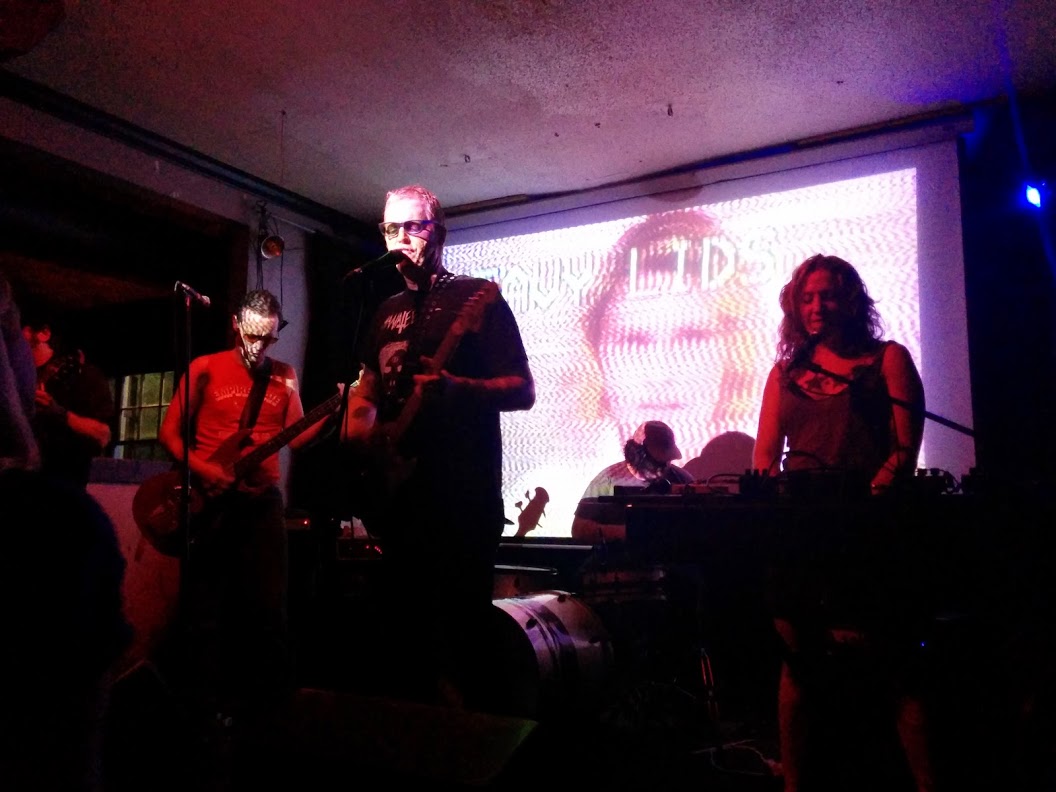
Heavy Lids

Heavy Lids (above)

Siberia, an old-school punk dive that we revelled in–no summer scarves, no beards, no preciousness, lots of smoking!–featured an amazing four-band bill: Planchettes and Heavy Lids, who must be among the best punk bands in New Orleans, the  former anorexic teenage sex-god trash, the latter a casually fierce, “I don’t give a shit” unit with a great Mr. Quintron-produced 45 which we found at the stern but awesome Domino Sound, supporting the Nashville duo of Pujol, who must be the shortest band in rock and roll history but whose guitar tone drilled a hole through my brain, and–honestly, we didn’t know they were going to be in NOLA–Natural Child, whose new album Dancin’ with Wolves is their worst (they’re tryin’ to go country–why?) but who remain totally unpretentious, fun, and offer the best t-shirts in indie-dom. I count myself as easily in their Top 10 biggest fans, but they don’t give a shit–as it should be! We went in dreading enduring the huge bill, and left elated at how consistently exciting and fun the band–and, largely, the crowd–was. Props to a dude I met there named Ronin, who immediately made us feel welcome (my ancient Husker Du shirt helped).

John Boutte plays almost every Saturday night at dba’s on Frenchmen. The lay(wo)men would know him as the singer of the theme to HBO’s Treme. While not quite Sam Cooke risen to walk amongst us (as some claim), the little sprite has a very similar, though drier, delivery, and–honestly–better taste. We had suffered through douchebags standing directly behind us talking about their BMWs and cocktails when we’d seen him at Tipitina’s in NOLA in March, but dba’s insists on decorum during Boutte’s sets, and it made all the difference. He swung smoothly from anti-war song to Tin Pan Alley standard to trad-jazz NOLA to Iris DeMent’s “My Life” and Paul Simon’s “American Tune,” backed by acoustic guitar, piano, trombone, sax, and his own tambos. The man really would be a star if he chose to step out of the Crescent City, which he has no plans of doing. Respek.

We were, unaccountably, on a Marsalis kick. I find Wynton’s musical politics a sad and misguided distraction, but the family can play, and we bought tickets to see the trumpeter lead the Lincoln Center jazz orchestra at the beautiful Saenger Theater in a benefit for the Tipitina’s Foundation, which gets instruments in the hands of NOLA youth. I expected a dry performance, but the set list was inspired (nice onscure Brubeck and Silver, plus some Marsalis originals), and Wynton, really getting off on his mute and vocalizations, came off as a true and proud and funky son of the city. Two nights later, we found ourselves at the Royal Sonesta, watching Jason Marsalis’ vibes group nail a bunch of Monk tunes and being blown away by Justin Faulkner, one of the best young jazz drummers (along with New Orleans’ own Joe Dyson) that I’ve seen–look for him in the upcoming film about Buddy Bolden. He is the son of Art Blakey and Roy Haynes, if that means anything to you.

Records: four blew me away. Two 45s: a limited edition split-single where local boho-community booster-weirdo-organist Quintron does nouveaux-zydeco Keith Frank’s awesome and inspirational “Haterz” on the “B,” and Cajun heroes Steve Riley and the Mamou Playboys do Quintron’s addictive “Chatterbox” on the “A”; and a great 1971 single by eccentric Lousiana bluesman/ex-con Robert Pete Williams, where, on the “A,” he says goodbye to Slim Harpo with stinging and unusual slide-playing, and, on the “B,” addresses our involvement in “Viet Nam.” I casually snapped it up for $10, only to find it was going for $30-40 in the collectors’ market. That shit makes no difference unless the music wails–which, here, it does. One LP I scarfed up collected the great NOLA trumpeter Henry “Red” Allen’s accompaniments of ’30s blues singers. Allen wasn’t Satchmo, but he had plenty of subtle and ecstatic moves. Finally, I got a 300-copies-only cassette comp of the best of the aforementioned Mr. Quintron, which, to my ears, is a) perfectly selected, and b) perfectly timed, since I just bought a new Denon dual cassette deck for $25 on eBay.

Finally, I met a small passel of locals at the Envie Cafe on Decatur–one of which had previosuly just been a cyberfriend, but who, in physical space, was even more interesting: a former stud wrestler, a master geneologist, and stellar record collector (I suspect him of being former CIA). He introduced me to his morning band of caffeinated reprobates, and I learned very, very much–about James Booker, Wynton Marsalis, Algiers Point, 504 Records, much, much more.

If you ain’t been, you really ought to go.

6. There are only two records that matter this year: Wussy’s Attica!, which is passionate and mysterious as rock and roll has not been for a long time, and Allen Lowe’s Mulatto Radio: Field Recordings 1-4. I’d like to say one thing about the latter (well, maybe more than one): read Lowe’s great book American Pop: From Minstrels to Mojos, which explains better than anything our tangled musical legacy, listen to the nine-disc audio companion, then load up his new four-disc set, lean forward, and revel in how he and his mutating jazz units (featuring players like Matthew Shipp, J. D. Allen, Lewis Porter, and the raw, ebullient-toned Lowe himself, on alto sax) try with all their might to live up to that legacy. All that’s missing, Allen, is a fiddle. Props are also extended to Bo Dollis, Jr’s A New Kind of Funk and the Jenny Lewis single “Just One of the Guys,” which transcends the too-polished album it’s attached to with real live commentary about being a rock and roll woman.

Good to My Earhole: 2,119-Mile Texas Trip

As is my habit, I set up a 400-song folder of Texas songs on our car’s iPod. In addition, I packed the audiobook of John Waters’ CARSICK, knowing it would be riddled with the cracked songs that are like illicit delicacies to The Prince of Puke. Here were our standout musical moments:

Jimmie Dale Gilmore: “Reunion” (with Lucinda Williams), “Just a Wave,” “Bhagavan Decreed” (with The Flatlanders)

We have long been familiar with this one-of-a-kind Texan, who fuses Eastern religion with the honky tonk upstairs, and Marty Balin (!) with Hank Williams Sr. But as many of you surely know, in close quarters and on long drives, songs you thought you knew cold unfold in new ways, or simply splash cold water in your face to remind you how great they are. Respectively, Jimmie a) tells his departing lover (via death? break-up?) that the Cosmos does not allow for true parting; b) is told by a departing lover that, however strong his love is, it is only a few cubic feet of what she needs and wants from the other waves (I emphasize the plural) in the ocean; d) reminds the profligate apple of his eye that “the highest place is under ground.” Sui generis, baby, sui generis.

Lightnin’ Hopkins: “Needed Time”

Have heard it a million times, always figured it was the original “Kumbaya” before it got clumsily Africanized by uncomprehending Christian Caucasians, then got pulled up short by what I think has been a mishearing on my part: “Now is a needed time.” Always thought it was “Now that I’ve needed time.” Just a slight adjustment makes it more desperate, more humbly pleading, more communal–even more of a masterpiece, one among many created by ol’ Sam. I could be wrong, but, sorry, folks, from here on I will choose to be.

Various Artists: John Waters’ CARSICK (unofficial soundtrack not yet available, but buy the book directly from Atomic Books, please!)

Waters has a killer record collection–I have seen part of it–and it makes an impact on everything he films and writes. The tunes in Carsick mostly energize the “Good Ride” and “Bad Ride” fantasies that precede his true tale of Baltimore-to-Frisco hitchhiking, and, after dutifully listening carefully and tracking all the songs on YouTube (not all are available there, a tribute to Waters’ eye for the obscure), I was dismayed to find the entire track listing helpfully supplied by the author at the end of the hard copy. It ain’t Texas music, but it kept us sane driving through that endless state:

Soundtrack

Note: the book itself is excellent–among the many things it is (which includes severely aberrant), it is a warm testament to the decency and good cheer of the random citizen of the Yew Ess Ay! I shit you not!

Blind Willie Johnson: “God Moves On the Water,” “Take Your Stand”

The great intinerant country gospel singer whose “grain of voice” makes Howlin’ Wolf’s sound like Michael Buble (well, I am exaggerating a little) probably/maybe hailed from Marlin, Texas. I will let the scholars wrestle, but, upon traveling through Marlin, we could hear his wail whipping around the little town–and it’s 2014, not 1930.

Joe King Carrasco and the Crowns: “Let’s Get Pretty,” “Buena”

As Nicole and I forayed into Austin with fearsome one-man-band and fellow WordPress blogger John Schooley to dig in the local crates, I expressed enthusiasm about finding a particular vinyl copy of one of Joe’s early albums. Without missing a beat, John responded, “You can find it in any dumpster in Austin.” Ouch. Well, along with the B-52’s and maybe Quintron and Miss Pussycat, the Crowns were among the last of the great, great, great rock and roll party bands (just for example, their catalog of prime big-beat hedonism is a lot deeper than the Fleshtones–and they recorded with Michael Jackson!), they are eternally honored in my heart, and–NOPE, didn’t find what I was looking for in a dumpster OR at End of An Ear OR Antone’s (though I did find an autographed copy of their killer Hannibal label record at the latter, but then lapsed into a Lockhart BBQ hangover and forgot to grab it, buying instead a Johnny Bush-Willie Nelson duet album I already owned). Resist this:

Ornette Coleman Quartet: “Ramblin'”

Goodbye, RIP, Charlie. He, one of jazz’s greatest bassists, was from Missouri and Iowa, Ornette from Fort Worth. As a tribute to his life that just ended, listen carefully to these euphonious musical radicals play the honkin’ Texas blues as freely as the sky spreads, and listen to the late Mr. Haden insert a little Elmore James into the mix.

Rosie Flores: “Cryin’ Over You”

While in Austin, we also visited the teen-incey Ginny’s Little (I Mean Really Little) Longhorn Saloon, where we saw an old musical friend holding forth on The Fourth: Ms. Flores. As we entered, she was kind of slogging through a version of Dave Alvin’s “Fourth of July,” then she took a break. After we (and she, quite likely) tipped a few cold bottles of Lone Star, she returned to the stage invigorated. Just a tiny thing, with reading glasses on and a music stand in front of her, cute as a goddam bug, she ripped into this old song of hers, and raised even the jaundiced eyebrows of our host with a sizzling solo. As soon as I got home to Columbia (a week and a day later), I had her first record on the turntable. If you’re in Austin on a Friday night and she’s got the bill, proceed post haste to the above locale. The crowd will be there for a decent reason, the beer is cold and cheap, and you can dance to her! In the meantime, dig this corny but sweet official video for the above.

The Sir Douglas Quintet: “Texas Me”

For us at least, no trip to Texas could be complete without a goodly helping of the music of Doug Sahm’s deceptively talented fake-Brit-Invasion group. Sahm (the ur-Willie), abetted by his fellow South Texans and Tejanos, could do damn near anything classified as American music, such as here–blithely and cooly melding loud fiddle, horns, piano triplets, and soul singing. If you ain’t already, GET FAMILIAR with the ways of Sahm.

Rock In Real Life: Hot Day in Velma

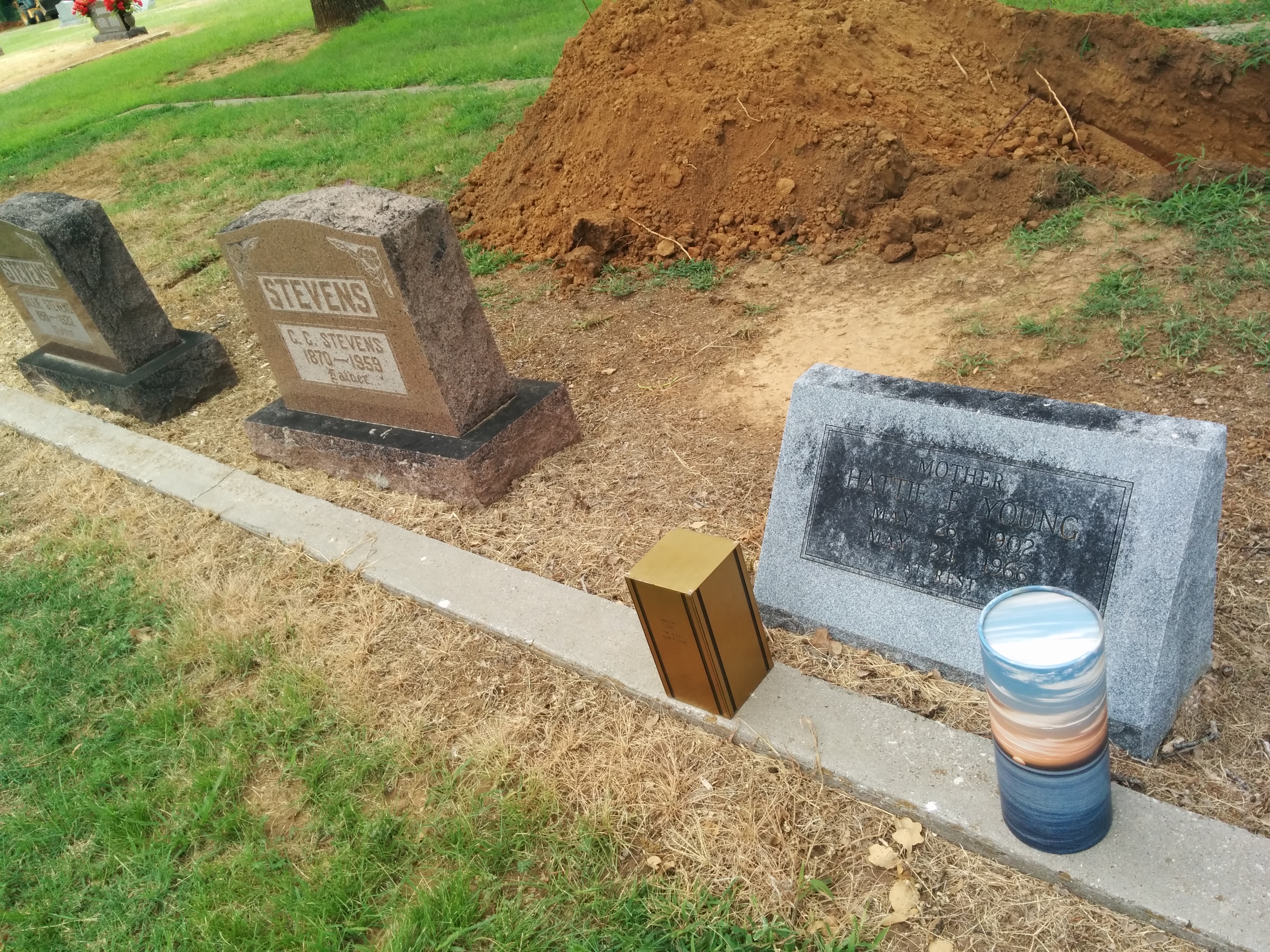
July 9th was a hot, dry day in the little Oklahoma town of Velma. My wife Nicole and I had come there to inter the ashes of her mother, Lynda Evers, who passed away from brain cancer last December, and of her grandmother, who died of leukemia in 1992, in the grave of her great-grandmother Hattie Young, which was located in the old Velma cemetery. Velma’s situated between Ada and Duncan in the southeastern portion of the state; no relatives were near, nor did we know anyone who could attend or assist with any service we might desire, so, as it so often was during Lynda’s battle, it was just us. To a great degree in our quarter century together, that’s how we have preferred it, but it had special meaning in this situation. At our hotel in Ada, we sketched out what we felt was a meaningful service.

After a local had dug out a spot in which we could lay the two urns, we drove to the old cemetery. Nicole read a poem by Emily Bronte, entitled “Encouragement.” It had come to her by an odd path, the kind of path we are used to in public education. I had assigned one of our mutual students Ms. Bronte as a British poet to research and study–particularly her poems. The student, needing help with the project, came to Nicole with one of the few Bronte poems she was comfortable with, as a starting point. Nicole wasn’t familiar with the poem, but, as she was battling through the grieving process at the time, it had powerful, beautiful and terrible resonance with her as she read it:

I do not weep; I would not weep;
Our mother needs no tears:
Dry thine eyes, too; ’tis vain to keep
This causeless grief for years.

What though her brow be changed and cold,
Her sweet eyes closed for ever?
What though the stone–the darksome mould
Our mortal bodies sever?

What though her hand smooth ne’er again
Those silken locks of thine?
Nor, through long hours of future pain,
Her kind face o’er thee shine?

Remember still, she is not dead;
She sees us, sister, now;
Laid, where her angel spirit fled,
‘Mid heath and frozen snow.

And from that world of heavenly light
Will she not always bend
To guide us in our lifetime’s night,
And guard us to the end?

Thou knowest she will; and thou mayst mourn
That WE are left below:
But not that she can ne’er return
To share our earthly woe. (1846)

After Nicole carefully recited the poem, I read a modified passage from The Book of Common Prayer, which an Episcopal pastor in Columbia had read from as Lynda passed. We carefully lowered the urns into the grave, then I walked over to the car (parked about ten yards from the site), started it, dialed the USBed iPad to the following song, turned up the volume, and left the passenger side door open so the music could flow across the otherwise isolated burial ground.

No doubt, there is something about Shaver’s hard-won (and hard-lost) worldview that fit not only the moment, but the sixteen months (from Lynda’s diagnosis) that led up to it. Neither Nicole and I are certain about what lies beyond earthly life, but the feeling Billy Joe bull’s-eyes in his song made it our near-unspoken choice for the ceremony’s last words. The version we played was not the one from the video above; it was a live version (from the classic Unshaven: Live At Smith’s Olde Bar) that ended with applause, which, given the solemnity of the occasion, may seem to have been inappropriate, but, considering the path of Lynda’s life out of this isolated Oklahoma geography to coast-to-coast nursing of the less fortunate for thirty-plus years, and to Ireland, it was perfect.

urns

A Memory Stirred by Carl Wilson’s Celine Dion 33 1/3 Book

Image


Funny thing about this book. I was at the library picking up a hold (Song of the Shank–more on that next month, probably) and, as usual, couldn’t help looking at the new music nonfiction. Unfortunately, I’d forgotten my glasses, and my arms were only long enough for me to make out “Alex Ross,” “Brilliant,” and the title. Those sounded promising, so, I thought, why not add it to the stack? Upon arriving home and putting on my specs, I was initially dismayed to discover it was an expanded 33 1/3 entry about Celine Dion. Those things are so numerous, it’s hard to keep up with them–and, to my lights, they are seldom very good. I also noticed a Jonathan Lethem blurb, and, I’m sorry, but right now, “those guys” are not floating my boat much. Nonetheless, I chose to sample it. Not many hours later, I had finished it, and, truly, every music nut–and, especially, every music writer–should be required to read it. Wilson wasn’t a Dion fan when he took on the project (and still not much of one after); his idea was to use his distaste for Dion to examine what taste really is, and the results of his inquiry are sometimes rattling. Personally, as in Emerson’s old quote, I found many of my own past musings marched much more eloquently than I ever thought ’em back across my eyeline. The revelations Wilson makes are too numerous to go into fully here, but two fascinated me so much that, in the hours after I finished it, I began to reflect on some of the music “taste collisions” of my past. We all have bands that speak so directly to us that our responses are deeply emotional, that we can’t really think of them at a critical distance (right now, for me, that’s the Cincinnati, Ohio, band Wussy). Often, that speaking doesn’t necessarily relate to the benchmarks of high art, much less the simpler idea of good taste. Wilson, delving into both the significance of Dion’s Quebecois past to her Canadian fans and also the needs she might be fulfilling in her listeners in the wider world, writes wonderfully about how this phenomenon complicates critical assessment and discussion. Second, the author enters a long thought-tunnel concerning kitsch, and exits wondering, with great justification, whether there’s something troubling about cultural gatekeepers disparaging artists who traffic in, shall we say, broad emotions. Why, for example, should it be more critically valid to lionize artists who shine a light on the darker corners of living than to exalt those who choose to magnify the glow of the brighter ones? Now, honestly, how many of us have paused and thought that, caught short by a corny wedding song we’d never be caught dead housing in our media players?

These questions took me back to a moment in my late teens that I have often recalled. Having just finished my first year of college, where two new friends hipped me to many punk bands, notably The Ramones and Black Flag, I had returned home for the summer to work in a factory and save up some dough. Even though I had graduated from high school with “decent” taste–I was deeply obsessed with Bob Dylan, Jimi Hendrix, Neil Young, Bruce Springsteen, and Elvis Costello–I was ill-prepared (and completely, totally ready) for the worldviews of X, the Germs, Gang of Four, the Clash, and the Sex Pistols, the latter two to whom I’d listened but not “got” prior to my college exposure. I knew good and well that, returning to the small southwest Missouri town where my parents lived, I would be spending the social segment of my leisure time tolerating the music of others. Such snobs we can be when we are wet behind the ears.

One weekend night, a carload of fellow factory workers, city pool rats and I headed across the state line into Kansas, where we could legally drink 3.2 beer (main attraction), ogle and even dance with women (second by a slim margin), and bask in the glow of .38 Special, Loverboy, Head East–must I go on? This particular evening, the rest of my party had had an exhilarating time; I, on the other hand, had spent most of the evening playing the wall, grimacing during mega-Midwestern-blasts like “Hold On Loosely,” and thinking about the Minor Threat/Bad Brains mix tape I’d just gotten in the mail from one of my college buddies, who, lucky for him, went home to California and was seeing L.A. punk bands live. I was a mope, and couldn’t wait to get back home. No wonder no chick wanted to dance with me.

On the way back, we were all quiet, most in a bit of a “j mood.” The car stereo was loud. The music fed their fantasies; it discouraged mine. Journey. Escape. My head was right next to one of the back speakers, and, with each Steve Perry vocal skyscrape, I took a deep swig of piss water and gnashed my teeth. An hour’s ride full of this, equivalent roughly to having an old filling drilled out without anesthesia. Casually at first, I looked around at my comrades, most of whom were reclined almost fully, their eyes closed, grinning blissfully (the driver was not among these, to our immense good fortune) and occasionally nodding to key phrases. An unsettling thought hit me: against the backdrop of a hometown they didn’t have much refuge from–I was the only college student among them–which offered little career fulfillment beyond industrial work, little social fulfillment beyond the bars, bowling alleys, pool, and, well, forays across the state line, and precious little diversity of culture and opinion, the–yes–soaring, Utopian music of Journey was simply and powerfully beautiful. In a flash, I realized, “The subjects of Springsteen songs don’t listen to Springsteen songs; they’re Steve Perry and Neil Schon fans!” Thinking from a writing student’s perspective, I thought, for a minute, “But…it’s so generic!” Well, it’s that just-right generic quality that allows for projecting one’s reality, no matter how constrained, upon the song’s magnificent scene, right?

You have to understand, Journey was everywhere in ’81–especially on the municipal pool jukebox on our days off and even more especially on those weekend Kansas clubs’ sound systems. This wasn’t a decade or so later, when the band’s reputation underwent some overdue reconsideration, when “Don’t Stop Believin'” closed down The Sopranos. Journey could not be escaped, which made the aesthetically deft escapism in their music easy to miss. For me, at least, this uncomplicated band was very complicated. My mind finished its convolutions at the approximate moment that “Open Arms” drifted (if loud music can be said to drift) from the car stereo speakers, and by that time, I had made peace with Journey’s music–in fact, I felt a little shamefaced that I had to furrow my brow to appreciate it, that I had to condescend before I could appreciate the other guys’ appreciation, but at least I found myself enjoying “Open Arms” for the first time. Of course, I didn’t share this tableau with my buddies when I returned to school, but it did help me avoid being a jerk when I started teaching and got into music gab with my students. I still don’t own even a Journey greatest hits album, but I can hear their finest achievements with startling clarity in my memory, and the feeling is warm, and good.

If, like me, you’ve experienced such a moment, you really need to read Carl Wilson’s Let’s Talk About Love–or, then again, maybe you don’t. It’s all in really hearing the soaring.


Rock in Real Life: Vignettes Proving Why It Matters

Image

June 21, 2014: Wussy Night

My wife and I have had a difficult last year and a half. Her mother was diagnosed with brain cancer in February of 2013, and the two of us, with some hospice and much colleague support, were in charge of her care until she passed away December 8, 2013, and lived with her in her duplex for the final three months, plus one in the aftermath. Though we have had about seven months to “recover,” grief takes its time, the intensity of our situation was unusual, and Nicole was an only child, her mother’s only sibling having passed in October, and her maternal grandparents had died long ago. We try a lot to loosen the grip of memory and pain: meditating, communing with nature, reading, cranking the stereo, drinking, going on trips, socializing, just heading out the front door and improvising. Sometimes it works; sometimes it doesn’t. Weekends are often the hardest.

Tonight, after having a strong margarita apiece at our favorite Mexican restaurant, we headed into town for food and who-knew-what, storm clouds threatening, and the Cincinnati, Ohio, band Wussy blasting from the car stereo. I had delayed playing the band for her; honestly, their name is not the greatest, and Nicole, as she should be, is a tough critic, especially when it comes to modern rock. But this band is special. Their noise–rough, passionate, often wild–matches their lyrics–searching, exclaiming, questioning, battling, reflecting–matches their singing–human, disharmonic, desperate, urgent–and I knew if the moment was right, she would fall under their spell. As we drove under alternating sunshine and dark-blue billows, she was able to take in some of their best songs (I’d carefully assembled the car iPod playlist): “Teenage Wasteland,” “Airborne,” “To the Lightning,” “Beautiful,” “North Sea Girls.” Though I have been thoroughly indoctrinated into this band’s method of expression, I even found myself caught off guard, getting a surprise “erection of the heart” (Lester Bang’s phrase about Elvis) while being swept away by the perfect chaos of “To the Lightning”‘s guitar and lyrical attack. This band is for real, in their prime, and should not be missed, whether you cloister yourself and just listen to tracks, hit the clubs, or just go out driving with the windows down and the stereo blasting.

Lisa Walker and Chuck Cleaver are one of the most believable couples in pop music history, at least from the point of view of the average listener. George and Tammy? too contrived (I mean the songs, but, I could almost mean their relationship), though their vocals made their tunes work. Exene and John: too arty, too boho, too sensationalistic. Fred and Toody: maybe not enough balance or specificity–they hang my moon, so I must tip light. But these two sell the idea that their songs are about working through the difficult dilemmas in life, with no loss of the god/devil in the details. After we listened to most of the playlist–and after stopping for food and hitting a couple bars–Nicole turned to me and said, “I like ’em.” If you’re still on the outside, and you use Spotify, try this replica of our evening’s soundtrack:

Image

June 22, 2014: Hangover Cure/Singing and Picking Spell Cast by Sinatra and Jobim

After the pure rush of Wussy’s music, beautiful weather (it never did rain–but the clouds vying with the sun were magnificent), great conversations on the streets (former school secretary and hubby, former student musician with new country aspirations) and in the pubs (jazz rap with bartender: Monk, Ella, Louis) of Columbia, we closed out at a new Logboat brewery that’s opened up in town, and spent a quiet, cool, beautiful evening huddling, talking, and plotting our next adventure. Grief must be aggressively confronted, almost daily. We came home full of great beer and a underlayer of tequila, walked the dog about a mile, watched a little of the original British Shameless, and went off to meet Morpheus. Unsurprisingly, when we awoke, we were groggy, and midmorning, trying to match some music with my state, I put on the complete Reprise sessions of Antonio Carlos Jobim and Frank Sinatra. Weird project: bossa nova was pretty much over by the time Ol’ Blues Eyes got the idea; also, the prospect of our greatest male singer of saloon songs and Tin Pan Alley gems taking on the sexy weirdness of Brazilian harmonies and rhythm, especially given that Sinatra’s magnificent voice was beginning to abrade a shade, seemed dubious. However, I’d already heard one track, “Insensatez,” that sort of knocked me out, so as I collapsed onto the couch, put the earbuds in, and scrolled to that playlist, I thought that the ease of the style and Frank’s crooning would be perfect for an hour’s catnap. Well, they were perfect–so perfect I could not sleep. Three things: obviously–and as was his habit–Sinatra had studied Jobim’s tunes, and thought deeply about them. Second, he’d consciously toggled from his very masculine and authoritative approach to a lyric over to, certainly, a more submissive and possibly more effeminate rendering (I don’t use that term pejoratively–I think it’s a striking trademark of bossa nova and samba singing). Third, the engineering is such that, along with hearing all the nuances of Jobim’s guitar-playing, you can hear Sinatra thinking, breathing, playing with sibilance–even (horrors!) giving in. It’s truly a masterpiece of risk-taking from a guy who’d already conquered the pop world several different times and still was thinking in terms of gambits, and the desire to be an even greater master. Honestly, this may be the great man’s last great album.

Once the rekkid was over–so was my torpor; in fact, I am sitting up, writing this, aren’t I? Pour a drink this evening, and if you have some contemplative time, activate this playlist–and adjust the volume so you can truly savor the aural details.