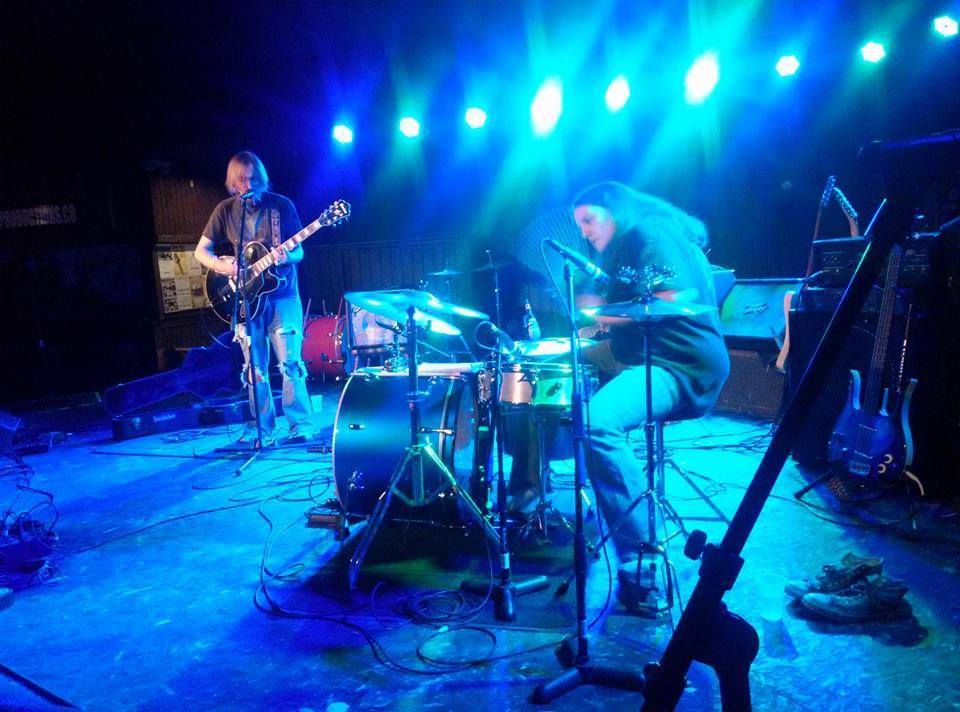
“I Will Not Stop Til They Bury Me”: A Talk with American Music Scholar, Composer, and Musician Allen Lowe

Allen Lowe is certainly one of the most prolific, deep-digging, and insightful scholars of American music ever. His groundbreaking book (and accompanying nine-CD set) American Pop: From Minstrel to Mojo on Record 1893-1956 set the standard for traveling the crooked path of songs that led to the rock and roll revolution, and the works that followed, among them Really The Blues: A Horizontal Chronicle of the Vertical Blues, 1893-1959, That Devilin’ Tune: A Jazz History 1900-1950, God Didn’t Like It: Electric Hillbillies, Singing Preachers, and the Beginning of Rock and Roll, 1950-1970, and “Turn Me Loose White Man”Or: Appropriating Culture: How to Listen to American Music 1900-1960, demonstrated that one journey up the path was not enough to get one’s head around our music (a few of those books reinforcing that belief with 36-CD sets). However, many of those who’ve read or at least heard of the those books are dimly aware, if at all, that Lowe has also been a composer and player of considerable power for nearly 35 years, often playing with some of the most forward-thinking instrumentalists in jazz and regularly navigating in notes and harmonic collaboration the same territory his books did in words. His song titles often “speak” to his scholarship; his compositions often serve as commentary on contemporary (and original) jazz. A struggle with cancer sidelined Lowe for much of the last few years, but recently he exploded back onto the scene with a three-disc set, In the Dark, Volume 1, which seems to lovingly survey, in swinging, grimily funky, and woozily emotional style delivered with a crack band, a range of large-ish group approaches to jazz composition; a single-disc set, America: The Rough Cut, on which Lowe is backed by a smaller group (plus one beauty of a piece from 2014 featuring the late trombonist Roswell Rudd) and which earns its title partly due to the unpredictable, explosive, and inventive guitar of Ray Suhy, as well as Lowe’s most fiery playing (he also plucks guitar plangently on two cuts, including his second wrestling match with Blind Willie Johnson’s “Dark Was the Night, Cold Was the Ground). As the title of one of the album’s songs implies, Lowe’s response to staring mortality in the eyes, at least by virtue of the quality of this new work, is “Eh, Death.” Lowe’s albums are available via his website and Bandcamp, and, unsurprisingly, he’s also just published a collection of his critical observations, Letter To Esperanza: Or: The Goyim Will Not Replace Me – Looking for Tenure in all the Wrong Places.

This interview was conducted through a series of emails. I have edited Mr. Lowe’s answers to my follow-up questions into the original transcript in the most logical possible fashion.

Phil Overeem: The health travails you have been battling have taken you to the wall (and fortunately not through it), and you’ve documented many of them on social media. In the notes to one of your two new releases, you mention that, somehow, those struggles have resulted in music that’s on another level from anything you’ve composed and played before. Having followed your work for quite a few years, I can hear what you’re talking about. Why, and how, do you think that happened?

Allen Lowe: Tough question – desperation, focus, fear, and the help of a lot of incredible musicians who just came to my rescue. It’s hard to know what leads to that kind of inspiration, and material reasons tend to just sound like a rationale for something you cannot explain. But even when I was unable to play I was always playing and composing, in my head. And also, I gotta admit, I was and am motivated by general frustration with the poor state of jazz composition, which led me to write these things as essentially an answer to the industry, about what I think the music can and should be.

PO:  Another social media-related question: I think it’s fair to say that you regularly engage in battle on Facebook with other music aficionados about theories of the development of American popular music. Is this something that’s helped you as a theorist yourself, do you wish you’d never gotten sucked in, or is your experience somewhere in between. I have to say, some of the conversations are as interesting as your books, and those set a high bar. In fact, it seems the job of any writer who is looking at the development of our music should be seeking to complicate rather than simplify the narrative, yet even current young writers seemingly committed to revealing the truth in fiery terms seem to steer clear of or dismiss complication.

AL: I enjoy the give and take, and I take inspiration from the high-level intellectual goals and battles of the old New York intellectuals of the 1930s on: Harold Rosenberg, Irving Howe, Richard Gilman, Theodore Solatoroff, Stanley Kauffmann, Isaac Rosenfeld, Susan Sontag, Diana Trilling, Delmore Schwartz – largely, but not solely, a group of dedicated and intellectually-heightened Jewish intellectuals whose work was probably nurtured by the in-grown alienation of American Jews in general, who were perpetually kept at arm’s length by much of the official world. I have suffered that same kind of otherness, twenty years of complete isolation in Maine, where I was treated like a freak and an outsider. As for public debate, I enjoy the give and take, though I am aware that when one opposes certain kinds of received wisdom it pisses people off, and they regularly take it personally because it questions some of their more sacredly-held opinions and beliefs. I try to avoid the personal stuff, and on my own Facebook timeline I think it stays pretty civilized. And I have to say I have met some of the smartest people I have ever known through social media interactions.

And yes, there are times I get sucked in obsessively to arguments, feel like I have to answer that Midnight comment; and there is one particular guy on Facebook who likes to remind me that I am an old white guy who everybody of color should ignore and avoid, and he does so offensively and with nasty intent. Though the great thing is that he thinks he is a person of color but, as I pointed out to him, his ethnicity is Aryan, which makes him as white as me. Sometimes Google is a good thing.

PO: Something that fascinates me, as someone who reads and listens to your work, is how your compositions (and wry song titles) speak to or from your arguments about American music. Sometimes I think I hear it clearly; sometimes I can’t find it; often, I realize I shouldn’t be expecting your compositions to do that. Are your compositions ever extensions or articulations of your viewpoint, and if so, how often? Not to make this seem like an essay question, but could you talk about a composition of yours you feel most successfully achieves that?

AL: Oh, pretty much everything I write is a form of debate and argument with somebody (sometimes myself). There is a polemical aspect to what I do musically, though at the end of the day it isn’t worth shi* if the music isn’t good, if my playing isn’t good, if it is not well recorded and smartly presented. Too much of the contemporary artistic world of all genres, in my opinion, is better at writing rationales for the work they do than at actually producing the work. Look what wins grants – all sorts of high-falutin’ intellectual presentations on worthy social goals followed by crappy work in every discipline. As I pointed out recently, by these granting standards Samuel Beckett, Charlie Parker, Bud Powell, Jean Genet and maybe even Shakespeare would not have received foundation funding for lack of the kind of social linkage that gets money. And don’t get me started on diversity – the more diverse we get, the more everyone looks and sounds alike, forced as they are to fit into acceptable socially-woke categories. Republicans love this shit, it plays into all the myths about Progressive shortcuts and stereotypes. And then there is age discrimination, which is a constant. For recent compositions: “Elvis Don’t You Weep,” “Castles in the Sand,” “Ralphie’s Theme” – all make my point about the integration of historical knowledge, historical necessity and aesthetics, about the need to face all of old American music head on. Honestly, just about everything on both projects is a point of formal and musical advocacy. Just to add, my compositions are all about triadic harmony, which I feel is the soul of jazz but is really not well understood in the context of jazz history and American standard song form. Almost no one writes anymore with a real understanding of old-line song form except, I say immodestly, for me and a few others. And I think the free-jazz world has gotten lazy and sloppy, painting itself into a musical corner. I admire the concept of open improvising and we use it a lot on those recordings, but we use it structurally and in complicated ways. I am proud of the compliment that the late jazz historian Larry Gushee paid me when hearing some of my prior recordings: “You have re-invented free jazz.”

PO: Just for clarification’s sake, I’m not too familiar with the grant-writing process for arts projects, so could you elaborate on that? And I think I’m following you on the “diversity in the arts” paradox, but could you clarify that, too?

AL: I won’t name names, but they know who they are. But seriously, anyone who has ever written a piece on Climate Change or Minstrelsy (there was one obscenely awful project on minstrelsy that got a grant a few years back, or on diversity (today’s favorite fake buzz word) ought to be removed from the practice of music. We need a Hippocratic oath for music; don’t do any harm, Every socially-linked piece and grant supporting it does irreparable harm to the music, so you can see we are in big trouble. Want an  example? Try the recent thing written by the pianist Chris Smythe called Smoke Gets in Your Eyes which is about….you guessed it – wild fires and the damage they do. Now that is very controversial – I know a lot of people support wild fires, like to set ’em, like to run through them, like to dance in circles around them as their homes burn down.

Ok, the whole diversity bullshit – I favor affirmative action, I favor reparations for African Americans. What I don’t favor is the racialist ideal which, instead of looking for balance and redress of racial grievances by seeking out quality, simply considers every artist of color to be a great artist without critical discernment. Some is good, some is crap, but they are all accepted if they meet gender standards or satisfy a desire to have everyone look different than they used to look, though ironically now they all look all the same. The arts people who most specifically call for diversity don’t really want diversity – they want to be looking into a mirror, where every artist looks like them, and any art or art form that does not conform to their expectations is excluded, often, as well, by age. I have worked too long and too hard to bow to this kind of trendiness, which tends to support forgettable creations and mediocre expression. This is not diversity, it is uniformity and conformity. It is an excuse for artistic inaction, as though by “making a statement” we have already done our job.

PO: Your saxophone playing on America: The Rough Cut and In the Dark is the most eloquent, allusive, and powerful I’ve ever heard from you. Its controlled intensity is very consistent across all four discs. This relates back to my first question in some ways, but what physical frustrations related to your condition did you have to overcome as a horn player, and in any way did the time off give you the time to make mental adjustments to your attack?

AL: Well, it took me a while to get those recorded takes right, and I confess I did some overdubbing to re-do certain solos because in some of the earlier sessions my embouchure sort of fell apart (which goes back to the 2019 high-intensity radiation which destroyed my jaw muscles and embouchure, which I had to rebuild). I am ok, thanks to a good mouthpiece and a mouthpiece maker who did a lot of amazing work on it. But it is not just that – when I retired in 2016 it was really the first time in a 40-year career I was able to focus on my playing without a difficult day job and raising kids. Things were going extremely well until I first got sick in 2019, which knocked me out of the box for about a year, but then I just said to hell with it, I am going to do this again even if it kills me. But yes, there is an emotional element of desperation in my current playing due to a fear of imminent death, though this is no longer a likelihood (I am cancer free now). But I remember Pee Wee Russell’s admonition to “play every solo like it’s your last,” and that is my working technique. Plus, learning and re-learning harmony, which is at the basis of almost everything I do, and I should mention the constant inspiration of Bud Powell, who occupies a permanent space in my head. I am not a great technician but I think I play with feeling. Add to all this that I am old and regularly a bit dizzy (see below; a post-Chemo effect). But I wrote two books and mastered 30 CDs while I was sick, and I just push on; there is nothing that makes me feel better than composing and playing. And when I play I feel like it is a great flow of consciousness. There is no better reason to do something; it has a purity and sound that cannot be matched by anything else in my life.

PO: Ray Suhy, the primary guitarist on Rough Cut, and Lewis Porter, the keyboard player on In the Dark, have long been major contributors to your music, yet remain very underrated in jazz conversation (as far as I’ve been involved in it). Both musicians are at their best on the two albums, and Porter especially does some amazing things on synthesizer (evoking Augie Meyers’ work with Doug Sahm was not something I was expecting, but should have been)—if you’re the mind and soul of the music, he seems the heart. Could you talk a bit about how they are particularly suited to your musical vision?

AL: I love those guys, personally and musically. They are also the absolute best in the world on their instruments, in my opinion (one thing I have realized while working with these musicians is that the best players now are NOT the ones who regularly appear in clubs, in polls, and in reviews). Yeah, nothing of my work would be half as good without them – but please let us also mention Rob Landis, Aaron Johnson, Brian Simontacchi, Ken Peplowski, Alex Tremblay, Lisa Parrott.

Back to the original question: both Ray and Lewis (and all I mentioned above) understand my method of composing and playing, which is a type of extended harmonic exploration in tandem with a lot of personal freedom to create improvisations at will. I don’t tell them what to play, I just give general guidance, and everything they do works better than anything I would suggest, anyway. They always surprise and delight me – Lewis does some synth things on In the Dark, which are astoundingly inventive, and Ray is a post-blues and rock and roll delight on America: the Rough Cut. I am the luckiest guy in the world to have run into all of these musicians; they saved my life in more ways than one. (And by the way I think Aaron Johnson is the greatest saxophonist alive).

PO: When you described how you ask your fellow musicians to play your compositions with you, that sounded A LOT like Mingus’ method. How could he not be an influence, but I must ask to see to what extent.

AL: Oh, I am sure, yes, Mingus, materially and subliminally. I tend to think I am too dumb musically to competently copy anyone else but myself. Duke Ellington has a way of writing – like it’s one long sentence – which I love, and he is a combination of conventional and quirky, and his voicings are just beyond profound; Monk of course, and Bud Powell is one of the greatest jazz composers, and when I play or compose I hear him in my head. As a composer I am torn between classic triads and extended form, integrating various kinds of improvisation into the form. My biggest difficulty is that I so rarely work, which makes it harder to get a band to perform in an organized way, but these players are so brilliant that they make it sound like that.

PO: I recently read an anthology of Stanley Crouch’s uncollected work—I am among the few music junkies I know who liked the first (and sadly the last) volume of his Parker biography, and I do not admire his vitriol (it dishonors his mind) and forcefully reject his seeming condemnation of what I’ll call “free innovation”—and frequently found parallels in his best moments with contentions I’ve heard you make. You may have addressed this in one of your books I haven’t gotten to yet—and possibly in one of your social media scrums—but where do you stand on Crouch, Murray, and Ellison (not that I mean to conflate their viewpoints into one)?

AL: I admire all of them intellectually (well, I gotta say I don’t find Murray to be that great, which is a very unpopular opinion), and I particularly love Ellison, the one novel and his essays, but really all of them fail when it comes to the entire concept, philosophy, and range of “modernism.” I define modernism, per Richard Gilman and Alain Robbe Grillet, as the need to constantly renew art forms, to reject old gestures and forms in favor of either new gestures and forms; or to alter those gestures and forms into fresh and radically new approaches. Their kind of cultural conservatism – and Murray is the most conservative, followed closely by Crouch and then Ellison – is death to music and jazz in particular. Now some people today think I am too culturally conservative because of my disagreements with the latter-day school of Free Jazz, but I am not. I am just bored, bored with Free Jazz’s self-referential postures, its repeat of the same-old-same-old ways of improvising, the laziness of just getting up and faking it – it is just too damned easy to play that way. I was able to do it when I was a teenager, but I moved away from it because I knew it was too easy (and there is an interview with the great saxophonist Archie Shepp in which he talks about his health problems and how at one point he was playing poorly but people could not tell the difference “because this is Free Jazz.” Yes, he really said that). I am in favor of complete artistic freedom, but that does not mean we can’t make personal artistic judgements. But Albert Murray thought the 1950s Basie band was too radical, and he put down Genet and all of modern expression in a really dumbass way (in his book The Omni Americans) and, honestly, I am tired of his views on The Blues. I love the blues, have written a book on it, but it has become a One-Size-Fits-All aesthetic crutch to describe or criticize too broad a range of music.

And I have to admit I still look to the first and second generation of post-bop modernists – Sonny Rollins, John Coltrane, Paul Bley, Ornette Coleman, Shipp, Eric Dolphy, Sonny Simmons, Gil Evans, Johnny Carisi – for inspiration. I feel like we have not adequately explored the implications and possibilities of their music but at least I have tried, unlike most of my contemporaries – because, really, it takes too much time for most jazz musicians, who just want to play and who lose perspective on the art form itself.

PO: I had a feeling your feelings about the current state of free jazz would come up (“painted itself into a corner”) made think of the limitations of the solely impressionistic approach of many current free players). I have listened to quite a bit of it over the years, and I’m probably a bit more tolerant than you, but mostly agree that SOME form—some composition, even if only in fragments that would probably have to be discussed by the musicians beforehand—has to be present for me to really enjoy it. I haven’t heard too many performances that have “become” compositions as they were played, though I know, just for example, that Ellington and Strayhorn were adept at hearing phrases played by Ellington’s soloists in one composition and later turning them into a wholly different one. Are there other players you know of and listen to today–excluding yourself, because I agree with that wonderful compliment you were given–that ARE composing satisfactorily (to your ears) while allowing a considerable amount of freedom?

AL: Probably: is Anthony Davis still active? Threadgill is great, Roscoe Mitchell when he really writes it out. But I have to admit I tend to turn to the oldies – Speckled Red, Cow Cow Davenport, Clarence Lofton. Their ways of playing inspire me compositionally. The way old insane gospel tunes are performed as in a state of delirium – that inspires me as a composer. I love that kind of anarchy – and I love the way Albert Ayler composed and performed.

PO: Thinking back to that Archie Shepp anecdote, as much as you’ve covered most of the history of American music in your books, you must know of some stories (whether about individual players, bands, periods, etc.) that need to be told in book form. Are there any you hope to write, or hope someone else will write?

AL: I have to say that I am basically done – with this last book, being tired (and retired) in general. I am feeling much better, but I don’t think I will ever really be back to where I was before the cancer. Books take too much energy, and Turn Me Loose White Man feels like my intellectual eulogy. As for others – I don’t know. I find most music books to drone on and on. I still turn back to the old favorites – Francis Davis, Dan Morgenstern, Max Harrison. And for criticism on other fronts, Richard Gilman (who has effected me more profoundly than anyone else), Stanley Kauffman, and Susan Sontag. From now on, my energies will go into the saxophone,composition, performing, and recording.

PO:  Truly, very few music academics of your stature have created even a fraction of the quality music you have—I can barely think of any (Porter, for sure, in his Coltrane book and on-line presence; Crouch—but did he even play enough to prove himself; have you heard Ishmael Reed’s new piano record?) who have played, period. With that in mind, how would you like to be considered, 25-30 years down the line? I don’t mean to bring mortality up at a point where you probably haven’t been thinking about it as much, but there’s nothing like a legacy of writing and recorded music to establish a kind of immortality.

AL: Yeah, I have not heard a lot of academics who impress me musically, though there are probably a lot I haven’t heard at all, and I do think things are improving on that end. I mean, people like Gerald Cleaver are now teaching, and there are more like him. And, of course, Lewis Porter is not only a brilliant historian but my favorite pianist.

I do think about legacy, but in a very concrete way; I honestly tend to think that when I am dead my followers will fold their tents and leave and forget about me. One book described me years ago as having a “cult” following, and I wish this were true, as I would like to experience that kind of slavish and uncritical dedication from people who would wash my feet and serve me grapes if I ask. I actually have more of a following for my book and history projects, I think, which is fine; I actually made a decent amount of cash on Turn Me Loose White Man.

PO: Once in the past, I spoke with you on the phone about the prospects of bringing you to mid-Missouri to speak and/or play as part of a music series here. This is certainly related to a couple of my previous questions, but have you received offers for combined playing and speaking appearances? I would think you’d be irresistible, and you’d be hard to cancel because you’re…complicated. Is that something you’d be interested in doing in the first place?

AL: I would love to do that but have only done it maybe once (a friend of mine hired me); I can print you out a collection of my unanswered emails. Put end to end, they would probably reach from here to the farthest university Jazz Studies program. I may try it again, but I am a bit exhausted these days from constant rejection.

PO: On America: The Rough Cut and In the Dark, I think I am hearing different stylistic allusions from song to song to other horn players. Who are the players who have most influenced your own style? And…whose music in particular helped you through your health struggles? I know you suffered long periods of insomnia; reading about them, I imagined music in the background keeping you company. As well, and if my recollection is right, reading was sometimes complicated if not impossible for you. Were there books that helped you endure?

AL: Oh, that’s a complicated one. Players: Coleman Hawkins, Sonny Rollins, Bird, Dave Schildkraut, Eric Dolphy, Pete Brown, Louis Armstrong, Jabbo Smith, Bud Powell, Bud Powell, Bud Powell –James P. Johnson, Donald Lambert, Aaron Johnson (soloing after he plays is like getting into a barrel to cross Niagara Falls); Wardell Gray, Al Haig – well the list could go on. But truthfully I am a bit of an idiot savant of improvising, I don’t really imitate anyone else because I can’t. I actually did not listen to a lot of music when I was so damned sick, except in my head. I am addicted to 1920s COGIC gospel, which is incredible, insane music; and really early jazz, pre- 1930; those six months I stayed awake I was too delirious to focus, so instead I wandered in circles in the dark and ate a lot of food (gained twenty pounds, which I have since lost). But I heard it, as I said, in my head. I love and am inspired by what are called Songsters, black singers of the old, old days who did not sing the blues but instead sang folk-type ditties, minstrel tunes, and other oddities. That old music is so old it’s new, and the old screaming gospel is where I got a lot of my ideas for America: The Rough Cut; it is blues and pre-blues and parallel to blues, but the damn blues, as I said above, has become a crutch for critics who don’t know anything else. I also love white hillbilly music, like Harmonica Frank and Doc Walsh, the rougher the better. I put a lot of that into Turn Me Loose White Man. But the racially-altering gospel music is the free-est music I know, technically and emotionally, and where I (at least subliminally) developed my ideas on “free” improvisation, which is really a form of emotional liberation put in check by the constant fear – or chill, as Mingus said – of death and hell. Book-wise – I still can only read on my Kindle, as my eyes are still troubled. I like books on the Mafia, but more personal are stories by Bruno Schulz, criticism by Richard Gilman and Stanley Kauffman, poems and prose by Pessoa, Vachel Lindsay. My eyes still hurt, and it’s a struggle. Not much of this was a true comfort, but reading Richard Gilman, who was the smartest guy I ever knew (I studied with him briefly) makes me feel, if only temporarily, that all is right with the world. For a few hours I stop worrying that my cancer will come back and kill me like some kind of stealth-music critic.

PO: I enjoy your sense of humor (in the song titles and in your writing) and feel like I hear it not only in your playing but sometimes in the structure and mode of your compositions. Am I imagining things?

AL: My wife thinks I have the sense of humor of a 12-year-old, though maybe a very mature 12- year-old. You are hearing correctly; I try to take things lightly. What else can I do? When I was certain I was going to die imminently I figured I had better prepare for what seemed like the inevitable, and so I just started to contemplate it all and try to accommodate the certainty of losing consciousness permanently; I got nowhere. I had nothing. I thought nothing, I felt nothing but more fear and uncertainty, so I just gave it up. Better to watch Marx Brothers movies and think of bad-taste things to write. There’s a Mary Lou Williams tune called “Little Joe From Chicago,” so I wrote one called “Little Jew From Connecticut.”

As for humor in my horn, I don’t know. It probably seeps in, though not in any larger-picture sense, at least that I am aware of, but I do like to think that my lack of maturity bleeds through in places.

PO: I cannot imagine you without a project in the offing, though after releasing four discs of music and a kind of memoir, you may be resting. However…are you already working on something new?

AL: Yeah, I got a bunch of stuff in the works. Depends on my health and energy level. I am still feeling post-Chemo effects, and they wear me down. I go through periods like recently when I have little appetite (and I still have that Chemo-metallic taste in my mouth on occasion, and have neuropathic dizziness; don’t believe what they tell you about Chemo leaving your body after 30 days. I am two years on from my last chemo – I had it twice – and it is still in my body and in my head – though it was the radiation that almost killed me, but that’s a whole other story which has led to about 6 surgeries in the last year to reconstruct the damage done to my face).

But back to the question, yes, I have to keep recording. I will not stop until they bury me. I am a bit fed up with jazz’s official complacency, the bad composing, the Free Jazz b.s., and I feel I have to take an aesthetic stand. I feel like I am the only one who does what I do, for better or worse. Right now I want to to do a session that is “about” Bud Powell, another “about” Julius Hemphill. Not tributes, but “inspired by.”

PO: No one has covered the growth of American music, song-by-song, genre-by-genre, decade-by-decade, as you have. What I am very fascinated to learn are the artists who have most moved and intrigued you SINCE, oh, say, 1977, and especially RIGHT NOW. Does your work keep you from getting to more recent developments?

AL: I am hopelessly out of date, but I find the really old music to be more inspired and inspiring than most of the new, in all genres. I prefer the old ways of recording, the old sonic clashes of instruments, the old analog feel of expression (which digital can recapture if you have the will to do it). It is a little bizarre that I cannot name much music after 1970; I almost always go back and further back, to early black music, early white music, jazz of the 1950s, bebop, country and hillbilly music; these are sounds that soothe my soul.

PO: You mentioned raising kids. What are they listening to? Do you talk to them about music, and have you talked them into learning to play? Also, what’s your wife’s taste in music like?

AL: My kids are pop music fans, no jazz really. My wife likes jazz, particularly singers. She tends to think my current work is a little too far out.

PO: This probably qualifies as a nag, since I kind of already asked this in a way, but what’s the most recent record you’ve listened to that you really enjoyed? I remember popping into a social media thread of yours and recommending Ricky Ford’s The Wailing Sounds of Ricky Ford—Paul’s Scene, which I hope you sampled (not that I’m hoping that’s the answer to the question).

AL: I listen to so little current music, except in snippets on bandcamp and youtube. Very little holds my interest; there’s Randy Sandke’s Inside Out, which I love, Jeppe Zeeperg, a Danish pianist who is brilliant. Anything with Lewis Porter and Ray Suhy and Aaron Johnson.

PO: On that note, let’s end on a “historical dig” question—there’s no one better to ask it of. Are you aware of the guitarist, historian and author of a new Merle Travis bio, Deke Dickerson? He wrote some Bear Family liners awhile back. In the new Travis bio, diving into Travis’ influences and touching on Ike Everly and Arnold Schultz, Deke posits one Kennedy Jones as the first thumb-picking guitarist in Muehlenberg County (as opposed to Schultz) and thus an overlooked influence on Travis and many others. Deke mentions that the only known recording Jones made was on King with Texas Ruby and Curly Fox. Thoughts on this?

AL:Is he playing the electric or the acoustic? [PO’s note: According to Dickerson, he’s the one who’s plugged in.] The electric is very interesting, in that kind of playing I always think the lineage is Blind Blake, Ike Everly, Merle Travis and – damn, what’s the name of the other guy? He never made any formal recordings, there’s a bio of him – Mose Rager (there are some clips on youtube, or used to be)! That kind of guitar playing is fascinating to me, it feeds into one side of the rock and roll equation, Elvis and Scotty Moore – as opposed to the more shrill, single line approach of James Burton, Roy Buchanan, etc. A lot of people don’t seem to be able to hear this, especially the Blind Blake origins, but to me it is obvious.

PO: Allen, I know you’ve got projects to attend to, so thank you so much for your time, writing, music, effusiveness, humor—and physical indomitability!

AL: I think I am pretty domitable (as opposed to indomitable). The thing about hitting a certain age, especially when it has been preceded by all the physical problems I have had, is that you have a feeling you are just treading water while your body prepares to self-destruct. I try to imagine the moment at which life finally slips away, and though I’ve got some idea of how it will feel – I’ve been put under 15 times in the last four years  –  I refuse to believe it is going to happen; sometimes delusional thinking is the best defense -so I carry on, as though there are no lasting consequences to the passage of time.

Archival Interview: John Schooley, Uncompromising Texas Guit-Slinger (rescued from the ruins of The First Church of Holy Rock and Roll, November 1st, 2018)

Schooley Rouses the Rabble at the Sympathy Showcase
John Schooley: Hard Feelings, Hard Thoughts
      
    I know no one more straight-razor serious about proper rock noise than John Schooley, the driving force behind Austin’s premiere garage outifit, the Hard Feelings. Straight outta the nothing of Niangua, Missouri, he helped craft the greatest band Columbia, Missouri’s ever known, the Revelators, who musically mugged the Oblivians at the Down Under Bar at their first-ever gig and waxed We Told You Not to Cross Us (click for our review) for Crypt Records, a raging slab of venom topped only by Ike Turner and the Bottlerockets (barely) in the annals of state rawk history. After the Revelators unfortunately self-destructed, Schooley packed his six-string and headed to the Lone Star State, where his new band’s Sympathy for the Record Industry release, Fought Back and Lost, chewed through Garage Nation like a pissed-off wolverine. The band’s sophomore release is imminent.
Schooley pulls no punches. Nevertheless–or should we say, consequently–the Reverend decided to wade into an interview situation last month, armed only with an inquisitive mind and the desire to bring some excitement to the congregation…..
You’ve been at “the rock and roll thing” for a long time for somebody so
young. What first lit that fire in you, and how have you kept it lit?
Well, actually, I always thought I got a late start. I was always interested in music, but I didn’t have much access to it. I grew up in an isolated, rural community (Niangua, MO, pop. 450, Sa-lute!) I had wanted to play guitar for awhile, but my folks didn’t wanna drive me somewhere to take lessons (the next biggest town being 15-20 miles away) so I didn’t start until I turned 16. I never got a chance to play with anybody else until I was in college, I just practiced in my bedroom. I always figured most people were in bands in high school, but there was really nobody to play with.
So the Revelators was the first band I was in. I had been playing long enough by then that I kinda knew what I was doing, and I had been doing it in isolation for so long I didn’t have anybody who tainted my “vision”, (ha ha). And actually, my One Man Band 7″ on Goner was the first record I ever did, it came out awhile before the first Revelators single. So the die was cast, so to speak. I was doomed from the beginning!
It helped that the Revelators enjoyed some moderate success right off the bat, so that was encouraging. Since we did put out a record, and get to tour, I wasn’t ready to quit when the other guys did. I was just getting warmed up.
What distinguishes the Hard Feelings, your current band, with the plethora
of other so-called garage rockers out there?
We mean it!
Ha! To elaborate a little, it seems like there are lots of bands out there right now that are jumping on the “rock” bandwagon. Some of these bands are loud, some of them are fast, some of them play hard. Some even play loud, hard and fast. This is enough to fool the average dumbass into thinking he is watching a rock n’ roll band. And he is, but it’s a BAD one. I think what separates us from these other wankers is
1. We actually have SONGS. Bands used to have these long ago, now they mostly have gimmicks or a formula or sumthin’. I think every song on the album is good, no filler.
2. Good guitar riffs. Repeating the same thing twice does not make it a RIFF. A riff is something that makes the song!
3. Some distinctive musicianship. I like to think I have my own guitar sound. Trey’s one of the best drummers around. And when you hear the new album with Will’s playing on it, you will be impressed. We aren’t afraid to actually play our instruments
and, finally (and perhaps most importantly)
4. We have ROOTS. Most bands sound like they never listened to anything past a few years ago, so you get a third or fourth generation interpretation (of something that usually sucked to begin with!). And most people don’t know anything about music older than when they first started buying records, so both band and audience are in pretty shallow waters. We bypass the puddle of contemporary historical blindness to explore the lost rivers of American musical experience, from blues, country, and soul to unknown garage and punk rock. (We also like AC/DC).
You’ve always been pretty eloquent about what you do and what you like, so let me play devil’s advocate for awhile. One theory about garage rock is that it’s seeking after that “amateur epiphany” that you hear in so many ’60s groups (like, say, the Monks or the Sonics or the Music Machine), but that, in being self-conscious about something that lacked self-consciousness to begin with, it’s a doomed pursuit. What’s your take?
Well, I’d hardly say the Monks lacked self-consciousness at all! They very much knew what they were doing and the sound they were creating. I feel the same way. I’d be pretty pissed if anybody described my guitar playin’ as “amateurish”. I think this kind of attitude is what you get from people who think, say, Eric Clapton is a great guitar player. Their assumption is that technical competence makes for acceptable music.
I don’t know anyone in a so-called punk or garage rock outfit who is “holding back” so as to appear more amateur. It’s not like I can play like Yngie Malmsteen at home and I’m dumbing it down on stage. It has to do with a whole different attitude towards music, that drive and passion take precedence over the technical aspects. Some may just have a hard time accepting that we mean for it to sound that way.
The Sonics, Monks, all those bands knew what they were doing, they didn’t just stumble across their sound blindly. Their sound was a reaction against the bland pop of the day, a rejection of the status quo, or maybe it just made ’em fuckin’ happy. I think people seem to have a hard time accepting that you can make music that is simple, direct, and brutal like that and still be a thoughtful, intelligent person. People either seem to assume that it must take an idiot to do it and are interested in a sort of freak show way, or that it takes some sort of genius and are all misty-eyed and reverent. It’s really neither one. Incredible music can be made by normal people. Iggy, Jerry Lee Lewis, Bo Diddley, Hazil Adkins, Cap’n Beefheart, all the “greats” attain a sort of hero status. But it’s really a cop out ‘cuz if you think that way, then there’s no way YOU could do anything as worthwhile ‘cuz you are either 1.) a mere mortal or 2.) simply not “crazy enough” to be able to do something like that. The reality is that Iggy, Jerry Lee, and you and me all put our pants on one leg at a time like everybody else. That’s not to diminish what they’ve done, or to ignore the fact that they were some pretty forceful and fucked-up personalities. But in order to recognize that YOU have something to contribute, as well, you have to get past all that fan-boy baggage.
But I think what so-called modern “garage rock” has in common with it’s 60’s forebears is that the people makin’ it, at least those that don’t suck, are really doing it for their own amusement. I hope they all know enough to know they aren’t gonna be rock stars and be rich! It’s more like a modern folk music, moved from the front porch to the punk rock bar. It’s the same concept of making music for yourself and yer friends, but you can get more people drunk and turn the amps up louder.
How ’bout the possibility that striving for the perfectly raw sound reduces“raw” to a cliché?
Well, I can agree with that on some level. On the one hand, there can be alotta charm in recordings with less than perfect fidelity (Back From the Grave comps, etc.). One of the reasons we’re into punk and blues and rootsy musics is that we want to avoid the artificial polish of mainstream pop. (Or even mainstream so-called “roots” music- Keb Mo may be blues to some folks, but it sounds like pop to me. Yech.) On the other hand, I hear some bands that maybe are shooting for that Back From the Grave ideal and instead they make something that just sounds shitty.
Cost can be a factor. I mean, why is it “authentic” if a band 30 years ago made a shitty sounding record, but one this week does it and it’s clichéd? I’d love to go into a real expensive studio and take a week to record an album. I think we sound raw to begin with, you’d just get a much better recording of what we really sound like, our “rawness.” But that’s not an option money-wise for us, and for most bands in the “garage-rock/punk” world. I mean, every 7″ I’ve ever done has been recorded for free, either in somebodys basement home studio or on a boom-box or something. So it’s authentic, in that we were trying to get it to sound as good as we could with the shit we had available to us.
I like the Mummies, the Gories, Billy Childish, and these folks seem to make it work (and my One Man Band singles both really sound like shit). But generally I wanna hear everything that’s going on. Alotta the time a “raw” sound can just be covering up a bands lack of ability! I think our album is raw, but you can still hear everything. It’s the performance itself that’s raw. So sometimes it works, sometimes it doesn’t.
What about the caveat that lots of the trademarks of garage (misogyny, stoopid lyrics) are indicative of modern guys pretending to know less than they actually do?
Once again, you may have a point, but I also disagree a little. I’m a fan of some of yer singer-songwriter types or some folks who are known for their lyrics (Dylan, Merle Haggard, Elvis Costello, Townes Vand Zandt, etc.), but I still like plenty of rawk with what some may deem “stoopid” words. The thing is, it ain’t poetry, it’s rock n’ roll! “Louie Louie” is not supposed to read like fucking Leaves of Grass on the printed page!
Here’s an exercise: take any great rock n’ roll song and write down the lyrics (if you can understand ’em). Fer example, take “All Day and All Night,” by the Kinks, which I don’t think anybody can argue is a great song:
Girl, I want to be with you in the daytime
Girl, I want to be with you all of the time
The only time I feel allright is by your side
Girl I want to be with you
All day and all of the night
Notice the lack of resemblance to Emily Dickinson! The words are worthless if you take ’em off by themselves, they’ve gotta have the riff, the beat, the screamin’ to go along with ’em. Not to say that some lyrics don’t hold up without all that, but the point is they DON’T HAVE TO, and even that they AIN’T SUPPOSED TO. Most of yer so-called “poetic” rock lyrics, usually liked by English majors or folks who want to appear smarter or more sensitive because they listen to A, B, and C, are crap! We’re talking about Jim Morrison and Morrissey, here!
Anyway, rock n’ roll is supposed to be visceral, dynamic, of the moment, an experience. Lyrics are just a part of it. Hearing Iggy sing “Nineteen sixty-nine okay, all across the U.S.A.” with the Stooges is not the same as seeing the words on the page. Not that rock can’t be intellectual, but it can be over-intellectualized. I generally find it’s yer so-called “rock critics” who need to have some “intelligent” lyrics so they have something to write about. And some indie-rock wankers need these to prove how smart they are to themselves and their friends.
And yeah, I like alotta songs with misogynist lyrics. If it works in the context of the song, it works, and some women will sing along with it and some will be offended. So be it. You gotta have a sense of humor about some of this shit, after all! Besides, hip-hop has pretty much taken the honor of being “most misogynist music” at this point. Most rap records make “Under My Thumb” or whatever might have been considered sexist at the time sound downright quaint.
Now, all that being said, I don’t really think my lyrics are misogynist or stupid at all. There are a lot of bottom-feeder bands out there whose “lyrical themes” center around drugs, sex, and clichéd aspects of rock n’ roll. Are these people genuinely as stoopid as they make themselves out to be? Well, maybe they are that stupid or maybe they are just playing to the audiences expectations.
I think it comes down to two things: image vs. music. Some people are into Johnny Thunders ‘cuz he wrote good songs, some people are into him ‘cuz he was a junkie fuckup who died, they’re into this rock n’ roll martyr image. I’m into music more than image, so I want a well-written song. The thing is, you can still write a good song about getting drunk, or being horny, or whatever tired “rock n’ roll” kinda topic that comes to mind, ‘cuz these things are still part of the human experience. It just takes some talent!
I know you’re a harsh task-master, and probably even more so with yourself. When you’re playing or recording, what does it take to produce something you yourself can live with?
Actually, I like things to be loose, I don’t care if you can hear the mistakes as long as the feeling is there. I’ve never had a lot of time in the studio, it’s always been a git-in-&-git-out-quick situation, so I usually have to settle for getting through the song without fucking up too bad. That makes a good take: not TOO MANY fuck-ups.
Live, I like it when bands are sloppy. I don’t think The Hard Feelings are usually that sloppy, but we can be. I assure you, depending on the beer intake, the potential is there! I think the key is that you practice enough that you have shit down, and then you just cut loose and try to have fun with it live. I don’t sweat the small stuff.
I know that, economically speaking, the music you make isn’t a going concern. Being a veteran of two of the coolest garage rock labels (Crypt and Sympathy), were you able to turn much of a profit and, if not—if making a simple living doesn’t keep you going, what does?
A profit? (Insert laughter here) I’m always surprised when some delusional folks think we make any money! I could’ve gotten the same return on my “investment” if I took all my money, pissed on it, and then doused it in kerosene and set it ablaze. I’ve never turned anywhere near a profit being in a band. You get some money here and there, but compared to all you spend in the long run you are way in the hole. Really, I try not to think about it that much!
Crypt made some pretense of giving you a royalty statement, but the Revelators never sold enough to actually get anything. With Sympathy, we never signed anything, it was strictly a handshake deal, and Long Gone John doesn’t even bother with the pretense of giving you a royalty statement. If he reprints the record, he’ll send us some more copies, and that’s all we can expect to see from it in the future. I’d say on our record Long Gone covered the advance he gave us, and he may have actually made a profit on top of that. So somebody is making something, at least. And Long Gone is pretty generous with the money he gives you up front, unlike a lotta other labels, so I got no complaints.
With most small labels, and I’m talking about the ones small enough to be in our ballpark, all you get (if you are lucky) is enough dough to cover the recording expenses and maybe a pittance on top of that. And they put out your record and give you some copies. They print (maybe) a couple thousand copies of the record. So you aren’t gonna see any royalties, ‘cuz they may recoup the expenses (i.e.: the pittance mentioned above) but after that there won’t be much left. You make some money selling yer records off the stage, usually enough to buy gas to get to the next town and get some tacos.
That’s it. And that’s with Crypt and Sympathy, the “big” labels. Most don’t even give bands that much. Most small labels also go out of business on a pretty regular basis ‘cuz nobody buys their releases!
So, it’s pretty obvious that it AIN’T about the money. The way I look at it, most of the bands I love were never very popular and never made any money. I mean, some, like the Stones or CCR were big, but overall we’re talking about bands that nobody cared about then, and nobody knows about now. I’m grateful that these folks bothered putting out records, because their music means a lot to me, even if I never got to meet them and tell them that. I guess I’m just doing it assuming there are people like me out there who will find it and dig it. So this will sound lame, but it’s for the fans! I’m a rock n’ roll fan, and I’m making music for people like me and my friends!
And, it’s also a chance to do something creative that will maybe outlast you. A good rock n’ roll album lasts forever. I was reading the liner notes to that recent Saints compilation on Raven and the writer was talking about seeing one of the Saints’ first shows at a Communist party function. Think about that: The Berlin wall has fallen, Communism is dead in it’s homeland, but people are still listening to the Saints! And ask Chris Bailey and Ed Kuepper if they ever made any dough. Or guys from a lotta my favorite bands. Ask John Felice. Or Jeff Connoly.
When the Revelators first started out, I asked Steve Mace if Untamed Youth ever made any dough and he just laughed, too! He pretty much said we were doomed, and I remember his words quite clearly: “You’ll never make shit playing garage rock. It’s all for the glory!”
Were you pleased with the reception of your first record, Fought Back and
Lost?
Well, everybody who’s heard it seems to like it, but of course I’d like it to reach a wider audience. I think we are hindered by our lack of a gimmick. No matching outfits, no fire breathing, no black chick lead singer, not Scandinavian. It’s a problem for some, ‘cuz there’s nothing ‘cept the music.
With no gimmick and a maybe a record that’s a little subtle that you have to take time to get into, no reviewer is gonna care! That’s why you should never trust record reviews – they get them for free, listen to ’em once, and they prob’ly have a big stack of ’em to go through. So of course what sticks out is the gimmicky shit. With us, there’s nothing to write about, just three guys in jeans and t-shirts. There’s no angle! We’re a pretty straightforward rock n’ roll band, so there’s not “snob appeal”. We do reference alotta things (country, soul, r&b, blues, rootsy shit etc. that indie-rock types avoid like the plague) but I think that the average rock critic or punk zine writer isn’t familiar enough with that stuff to appreciate it. We are both too lowbrow and too highbrow at the same time!
But I say put “Fought Back and Lost” up against any so-called garage rock, punk rock, or indie-rock release to come out in the past couple years and it will totally slay and lay waste to it! It is a good record, I feel pretty confident. So even though we’ll probably never be any more popular than we are right now, I’m satisfied.
What inspires your songwriting? Do you start with music first or lyrics?
A little of both. Usually, it’s the guitar riff first, and then I’ll come up with a melody line. Then I’ll just sing with that melody and see what words fit. Sometimes it springs forth fully formed, sometimes we’ll play a song live for quite awhile before I actually finish writing the lyrics. I’ll have an idea, a topic, for the song and then just see what I can come up with. Most of the clubs we play have shitty PA’s, so live you can’t hear the vocals anyway. So that gives me a chance to play with things and see what works. Usually a “hook” will come to mind, and I just have to fill in the blanks.
Is there a song you’ve written in particular where you’ve really hit the
ball with the fat of the bat, so the speak?
On the Hard Feelings album I really like “We Need Another Vietnam”. I got the idea from a Bart Simpson quote, and I think it’s just hilarious. A very broad indictment of the youth of America, who deserve it. It seems to be a popular live number, it’s our usual set closer. I never get tired of playing it.
I also liked “Roger Peterson’s Blues” ‘cuz it was an attempt at a “story song,” at least in my mind. And it was written from the perspective of someone else, which made it an interesting exercise. I was reading a book about Buddy Holly and there was a bit about Roger P., who piloted the plane Holly, Valens, and the rest died on. I thought it was really interesting, and sad, that this guy was a footnote in history. He got called outta bed on a cold shitty day to go to work, died, and his death was totally overshadowed by the death of his passengers. And it added an extra tinge of tragedy that it was probably his fault, too.
Who are the guitarists who’ve most inspired you?
Link Wray is the main one. Before I heard him I was a bedroom wanker, practiced a lot of scales. I was mostly into classic rock. I was just getting into rockabilly, like Cliff Gallup and Scotty Moore, and somebody told me I should check out Link. I bought Missing Links Vol. 3 on Norton, on LP ‘cuz that’s the only way it was available and it was the only one I could find. I didn’t even have a turntable. When I finally played it, I started it on side two and played “Growlin’ Guts” ‘cuz I liked the song title. Immediately I knew I’d never practice a scale again! It was really a revelation, it was so easy you could figure out how to play it as you heard it, but it was so ballsy and so much fun. It was how guitar was supposed to sound. It was more punk than punk. I was hooked.
My other big influence is probably Hound Dog Taylor. He’s like the Link Wray of slide guitar! Quoth Hound Dog: “When I die, they’ll say ‘He couldn’t play shit, but he sure made it sound good!'” That says it all right there. And in keeping with that spirit, I’ve never sat down and tried to “learn” a Hound Dog song. I have all the records, but I can’t do like a note-for-note “guitar in the style of Hound Dog Taylor” impersonation. I also learned a lot from R.L. Burnside when I toured with him, and that helped my slide playing immensely.
And though I play some leads, I really think of myself more as a rhythm player. I guess from my Revelator days when I had to fill up all the space. So Malcolm Young is a big one, ‘cuz he is the best rhythm guitar player in the world. And R.L. plays great rhythm guitar, he can really lock into a simple groove that could just go on forever.
So those are the big ones, but I’m a (reformed) guitar nerd, and a record collector nerd, so I’ve listened to A LOT of guitar players. Bukka White is a big one as far as slide. Grady Martin’s playing on Johnny Horton’s early records kicks my ass. Travis Wammack. Johnny Ramone. Paul Burlison. Ike Turner. Danny Gatton. Billy Gibbons (the solo on “Just Got Paid” is what made me wanna play slide in the first place!). Angus Young. Ed Kuepper. Lots of players.
I know you’ve had some interesting touring experiences here and abroad, with both the Revelators and the Hard Feelings. What have been some of the highlights of your life on the road, and, as someone who has to work for a living…how do you do it?
Getting to tour Europe was the biggest thrill, it was also the first real tour the Revelators had ever done. Crypt paid our way. We were with the Oblivians, a band I really liked, and so we got to see Europe and see the Oblivians every night.
The sights and smells of Europe! I remember in Rome we played this hippie punk squat, and couldn’t find a bathroom that didn’t make us nauseous. We had to go out in this vacant lot/field to take a dump! Making shit like a bear in the middle of Rome. We played in front of probably 1000 people at that show. We got to see Paris, Germany, we went to about 10 countries in two months.
The tour really made me a lot more aware politically, after seeing Sweden and Holland and all the countries with more socialist economic systems. It was eye-opening to see how much better the average person lived there than in America. The quality of the floors we were sleeping on were much improved. Then we came back to the U.S.A. and did a miserable month and a half tour. That pretty much broke up the band.
I’d love to get to Europe with the Hard Feelings, but we’d have to buy our own tickets over there and then hope we made enough from the shows to make that back. We can’t really afford to lay out that much cash with no guarantee right now.
The Hard Feelings have done some brief U.S. tours, we’ve hit the west coast a couple times. I know, having lived there, that I can avoid the mid-west and the Revelators toured the east coast and nobody cared, so the west coast looked like the best option. We’ve been decently received. We played the Vegas Shakedown, and we played to more people at that one show than at all the shows on our tours combined!
We haven’t done any extended tours like the Revelators did, ‘cuz that seems to be just a good way to drive yer band into the ground. It’s a catch-22, ‘cuz you can’t reach more people if you don’t tour, but if you tour too much your band breaks up or you get burned out. You can’t make any money doing it unless that’s all you do. Otherwise, you have to quit your job so you can lose money for a couple weeks.
I’ve tried to keep our tours short, so we can keep our jobs. We use our vacation days, ask for time off, fake family emergencies, etc. Touring for an unknown band these days is trench warfare. You can stick your head out to fight a little, then dive back in the trenches where it’s safe. Or maybe guerrilla warfare is a better metaphor. If you launch some big campaign to take over North America you’ll be defeated. You have to sneak around, do a little damage by skirmishing here and there, and then get back home to lay low. We are an underground band, and always will be, so guerrilla warfare is our only option.
I know you probably don’t wanna talk about this, but what’s the chances we’ll ever see the 2nd Revelators record? (EDITOR’S NOTE: We’ve seen it, and it is GREAT!!!)
Tim Warren claims it’ll come out this year, probably September. I wrote some liner notes for it. There is even an ad for it in the new Gearhead. But he about went broke doing these new Pagans reissues, if those don’t sell the Revelators album won’t get released. So if you wanna see the 2nd Revelators LP, you better buy Shit Street and the Pink Album!
Your one-man band singles are the cat’s ass (click to see our review of the latest one). I’m lucky to have ’em both–how can the curious but unlucky obtain ’em? Any more in the future?
The Goner one is out of print (and going for thousands on E-bay). The new one you can get from Goner’s web site or from Ball Records directly (PO Box 152,Gardiner, ME 04345).
I’ve been messing around with the one man band shit a lot lately, since I moved out of an apartment and into a house. Now I can be as loud as I want. I’ve added a snare drum, and I play a little harmonica as well. I should have enough material for an LP pretty soon. That should annoy lotsa folks. I figure the one man band is the only way I’d ever be able to make any money touring, and it would probably be more popular ‘cuz all the records (by necessity) would all sound the same! I’m pretty much reached the conclusion that too much variety just confuses people. They want every song to sound the same, or they don’t know what to think. The one man band could be my cash cow!
You’re a pretty voracious reader and record-collector. What’ve been some books and records that’ve been keeping you alive recently?
Just finished Noodling For Flatheads by Burkhard Bilger. The concept sounds shakey (New York writer travels the south in search of “lost” southern traditions) but he’s good and pulls it off. Great essays on cock fighting, squirrel brain eating, catching catfish with your bare hands, and a marble game called Rolley Hole. I’d recommend it.
I picked up a few AVI re-issues of various artists (Wynn Stewart, the Hightower Brothers) that I was missing. Anything that AVI re-issed is good, and they’re all out of print, too. Sometimes you can find ’em as cutouts or markdowns. Whoever it was at MCA that deleted all these records (when MCA bought AVI) should be hunted down in the street.
Also recently picked up a cd comp of Moon Mullican called “Moon Over Mullican” that’s his more rock n’ roll songs. It’s pretty incredible.
But mostly I’ve been listening to Bo Diddley and Jerry Lee Lewis, ‘cuz I finally nabbed the out-of-print Charly box sets for both those artists. I like the Bo one better as far as sequence, ‘cuz it’s more or less chronological, whereas the Jerry Lee one is grouped into various categories by cd (all his country covers on one, all his r&b covers on another, etc.). But both of ’em are killer and it’s such an overload of music to have all at once that it’s hard to take it all in.
Your championing of unsung rock and roll bands have led me to some great listening experiences. Any bands you’ve played with or been exposed to you feel are worthy of better exposure?
Just saw Tyler Keith and the Preacher’s kids. Their record is great and they killed live. It’s Tyler from the Neckbones’ new band. It sounds like the Neckbones, but without the Soul-Asylum sounding tunes. Tyler always wrote the most trashy songs, and was the craziest on-stage. And now it’s all his show. They are brilliant, but I’m afraid nobody is gonna care because they are on an “americana” label (Black Dog) and I don’t think the people who’d like it are gonna hear it. And the Neckbones never got any breaks, they never sold many records and I thought they were a great band. The Revelators played with them some, both bands were active around the same time, and I think more people know about the Revelators than the Neckbones. (That should give you some perspective: lesser known than the Revelators!) So “featuring ex-Neckbone Tyler Keith” isn’t gonna be much of a selling point for most. But they rock.
The Deadly Snakes record was one of my favorites from the last couple years. Talk about records that sound like shit! But it works, and I saw ’em and they rocked mightily. I’d like to see ’em getting the kind of attention that the White Stripes are getting.
The Country Teasers just came through town again not too long ago, and I always enjoy seeing ’em. They’re the other white guy band on Fat Possum that didn’t sell diddley-squat, but I dig ’em.
Jon Wayne just played here, too, and it was one of the better live shows I’ve seen for awhile. Talk about a totally underground band. I’ve never seen anybody review them, never even seen ’em mentioned in print. But the place was packed, and everybody knew the songs, so word got out somehow. Very drunken show, very funny, lotsa fun.
I’ve heard mixed reviews about what it’s like to be a musician living in Austin. How’s it for you?
Well, I for me it’s great, especially compared to Missouri. People actually go out to see music here, there is a healthy scene as far as bands and clubs. Emo’s has improved a lot in the past few years, the guy who does the booking there now really knows his shit. Also, a friend of mine who used to book the Bates Motel is opening his own club (Beerland!) and it should be a great place to play.
And there are quite a few good local bands around town and in nearby cities.When we tour, I always hope we’ll play with some cool band I’ve never heard, but usually it’s an endless parade of lame combos. I haven’t seen any town that can sport as many cool rock n’ roll bands as Austin. I hear Detroit has quite a few, but it’s too fucking cold up there, so I haven’t seen for myself. Texas has a fine roster: The Crack Pipes, Damn Times, Titz, Big Foot Chester, Deadites, Sons of Hercules, Gospel Swingers, Boozers, Teen Cool, Ignorance Park, lots of bands that can provide a good evenings entertainment are from around here. Also, there’s Sweatbox, a great studio that’s pretty cheap. Bands come from all over to record there. As far as making money, it stinks, but I never made any money in Missouri and at least we can attract a crowd here.
My friend D.B. Harris is a honky-tonk country singer here, and it’s harder for him ‘cuz he has to pay his band every night (he uses some of the same players as Dale Watson). Austin also has a good honky-tonk scene but it’s pretty competitive. The “professional musician” types might have a hard go here, but if you give up the idea of ever making any dough (like I have) you can have a good time.
Austin is changing, the tech boom hit it like it hit San Francisco and raised rents and the standard of living. I’m hoping the music scene will survive, but it has been tainted by lots of yuppie bullshit (if you ever hear the name Bob Schnieder, RUN!!!). Luckily we exist so far from the mainstream that we don’t have to worry about Dell and Intel tech-yuppie types flooding our shows. The scene we’re a part of has survived and I hope it will continue to do so.
What’s the current activity on the Hard Feelings’ radar screen?
We’ve got a new single coming out on Dropkick, the Onya’s label out of Australia. It’s got an original on the a-side and a Flamin’ Groovies cover (“High Flyin’ Baby”) on the flip.
We’ll record the new album this summer. Will is real anxious to get an LP out with his bass playing on it, ‘cuz at this point he’s been in the band longer than Andy was but it’s still Andy’s picture on the cover of the only record.
I want the new album to be shorter, probably only ten songs, ‘cuz I think the first one suffered by being too long. All the songs were good, but people’s attention span starts to wander after too many songs, so I think some of the tunes get overlooked. I’d also like to be able to spend a little more time on the production.
I can’t really describe it in too much detail, ‘cuz of course we haven’t recorded it yet. But we’ve got lots of new songs, some in a familiar vein and some a little different. At least in that they have more chords or are shooting for a different mood or whatever. Not a radical departure, but I’d like to think we have a distinctive sound as a band and so anything we do is going to sound like The Hard Feelings. When the White Stripes were in town, I asked Jack White about his next record, ‘cuz Long Gone had said it wouldn’t have any slide guitar or blues songs on it. He said yeah, that was the case, ‘cuz he didn’t wanna repeat himself, didn’t wanna make the same record twice, etc. I told him we were plowing the same tired ground with our next record! There’s something to be said for originality, but there is something to be said for consistency as well.
How would you describe the Hard Feelings’ mission in the rock and roll universe?
The Hard Feelings are a real rock n’ roll band. Our music is not for poseurs, squares, or lames. We will not dumb it down to make it more accessible, we will not fatten it up with pretensions to make it seem more intellectual. We play music which is rooted in country, blues, punk and other forms of American roots music, but we never try to outright copy or imitate those who came before us. We play rock n’ roll for those who like rock n’ roll. Our mission is to annoy as many folks who don’t as possible!
What are your Top Ten Desert Island Discs (as of today)?
I dunno, I’ve listened to all of these so much I’d probably get sick of ’em if stranded with ’em, but here goes I guess if you’re looking for an “all time favorites” kinda list…
Saints – Wild About You (Ha! This is really cheating ‘cuz this collection
has their first three albums on it).
Link Wray – Mr. Guitar (Norton collection)
Bob Dylan – Blonde on Blonde
Hound Dog Taylor and the Houserockers – s/t
AC/DC – Live at Atlantic Studios
Bo Diddley – Any of the Chess albums
Jerry Lee Lewis – Live at the Star Club
Slim Harpo – Hip Shakin’ (AVI collection)
Captain Beefheart – Safe as Milk
Heartbreakers – L.A.M.F.
Ahh, I hate this kinda shit! No room for the Oblivians (Popular Favorites) or Tennessee Ernie Ford (Ol’ Rockin’ Ern)! Or George Jones! Soloman Burke! Jerry McCain! My desert island would have to have a large record library.

Archival Interview: Charlie Burton, Iconic Midwestern Rocker and First-Class Wit (retrieved from the remains of “The First Church of Holy Rock and Roll, November 1st, 2018)

Charlie Burton: 12 Steps to Heaven
Don’t fight the band that needs ya!
(click to see Charlie’s web page)


Yep…CB at SxSW
Charlie Burton is the greatest rock and roll songwriter in the center section of our great land. After toiling in the wastelands of Nebraska for nearly 20 years, cracking whip on bands like the Cut-Outs and the Hiccups, he’s now residing in Austin, running not only a record store but a damned fine roots-rock unit, the 12-Steppers. Their first album, Rustic Fixer-Upper, on Bulldog/SOB Records, excellently showcases Burton’s creative wiles, and the 1999 release One Man’s Trash: The Charlie Burton Story (1977-1999) will neatly catch up anybody who doesn’t know who the fuck he is….which is too damn many of us. (See the Rev’s recent feature on Charlie by clicking here.)
Recently, Charlie took some time to answer a few questions.
Are you a folk singer?
No.
How’d you get interested in music in the first place?
I grew up in a house where music was very important: my father was a record collector (classical and folk mostly) and he was a real literal Pioneer in FM radio: he started a commercial (meaning he had to sell advertising), classical FM station in 1957 in Lincoln. Nebraska, and sold Granco FM receivers at cost outta our garage to create a market for the station; nobody listened to FM at that time; there was no public radio or college radio. My sister was an accomplished pianist and I won an AM transistor radio when I was 12, in 1963–a good year for AM radio. You could still hear Wolfman Jack on the “Big X…XERF” playing Howlin’ Wolf while you were falling to sleep with the transistor radio at your ear. It sounded like the terrifying voice from Hell. I was both drawn to it and scared by it. Need I point out that music was extry-good in the mid-60’s when I was a teen??? And seeing Bob Dylan (on THAT tour) in March of 1966 when he played Lincoln’s Pershing Municipal Auditorium really did a number on mah haid!!!
Where’d your world-famous sense of humor come from?
Sense of humor… Yeah, I guess I’m kind of a quipster. Dunno where it came from. Some of my favorite records as a Husker Youth included Peter Sellers comedy records on the Angel label; I always liked the track “Balham: Gateway To The South.” which I seem to recall reading in a back issue of MOJO was THE favorite track of its producer, George Martin, who could have also picked many others, don’tcha think???
Were you good at book-larnin’?
I was good in English, yeah. I remember that we had to write our own obituaries in one class and I wrote “See the candle, burn out quick, no more wax, no more wick.” Then I forgot it, and wrote and handed in some total mediocre shit. Twelve years later, I remembered the line and it became a lyric in one of my most requested numbers, “Breathe For Me, Presley.”
Is there such a thing, do you think, as Midwestern rock and roll? You got the Skeletons, Freedy Johnston, Bottlerockets, and…hey, wasn’t Axl a Plains child?
Of course there is such a thing as Midwestern Rock and Roll, but I would cite such practitioners as Iggy, The MC5, Lonnie Mack, the SOMA label outta MPLS, and the aforementioned folk singer from Minnesota as being more of my Midwestern Rock and Roll Soul Brethren (at least in my dreams) than the artistes you mention. Also let’s not forget the great Nebraska rockers like Carl Cherry, Sparkle Moore, Lou and Red Berry. But then, Philbert, you have a Show-Me State bias. I was talking to my old friend Peter Jespersen, he of Twin-Tone and Replacements fame, the other day, about being Midwestern, and he ‘lowed as how it has something to do with being polite, and I would have to agree.
How’d you keep a band together for nigh-on 20 years without raking in the big bucks?
The bands stayed together with minimal/gradual personnel changes because, I think, we all believed in what we were doing. It’s really that simple.
Any highlights from the Cut-Outs’ life on the road?
Highlights? Hmmm… there was one night at the Rodeo Bar in NYC when I remember going over to Phil Shoemaker, the geetar player, and looking at him and saying, “Geeziz, we sound great tonight, and making eye contact with him and just knowing we really did sound great. And it was always a thrill and an honor to play on the same bill with the Replacements when that happened. There were lotsa fun nites at The Lifticket in Benson. I always liked the feeling of driving home after a good gig and maybe stopping at this all-nite BBQ joint in Omaha.
You’re now located in Austin, which many folks in my parts consider the Mecca of American music.  Have you found relocating there to strike your fancy?
Well, as Sonny Boy Williamson the Number once said, “Don’t start me talkin’ I jes’ might tell everything I know!!!” Let’s just say that as a Mecca of American Music, Austin may be somewhat over-rated.
Tell us a little about the genesis, progress, and future of the 12-Steppers.
The Texas Twelve Steppers are what I call the people I play with here in Austin; they are a pool of some of the finest musicians in Austin and there are many fine musicians in Austin, yew betcha!!! They play subject to availability, in other words if there is a higher-paying gig with someone other than myself when I get a gig they can…and will!!!… take it. Hence the pool. Progress??? Progressive!!! Future??? Unknown!!!!
Has the resurgence of interest in roots rock and roll had any impact at all on your, uh, career?
Resurgence in roots rock and roll??? Impact on my career??? Geeziz, if this has been a resurgence then I AM screwed!!!
How hard is it to write “funny”?  How do you normally go about writing your songs?
Y’know, I don’t really try to write “funny.” I just approach an idea the way I approach it and I usually don’t like songs where the songwriter tries to make a Big Statement About Life. I try to deal with what’s left.
Describe the typical Charlie Burton fan.
Men: Well hung and intelligent. Women: Beautiful and intelligent.
Based on the evidence of some of your songs, you gotta be a major record collector. Do you have any “Holy Grail” records you’ve yet to find?
I am an avid rekkid collector and have uncountable LP’s, 45’s and CDs, many of which are totally rare and which my fellow collector friends will never own. As far as any “holy grail,” for which I still search, there really is (are) none simply because I am well aware of the countless great “sides” that await discovery by us one and all and regret that there is not time enough in life to listen to them all. Sigh. I do love the Thrill of the Hunt For Music. In fact I shall now impart to you my current 25 fave listening items. They include both all-time faves which I never even bother to file away, and current acquisitions.
In no apparent order:
1) Vernon Oxford–Let Me Sing You A Song. (Westside).
A new release and a dream come true for me, reissuing on a single CD all of  this great hard-core honky-tonk singer’s classic 1966 recordings for RCA. Minor (major) Quibble: They shoulda used the original LP cover.
2) I work at a CD store and gazed longingly at the Frank Sinatra “Capitol Years” UK box for about a year before I finally traded in a buncha shit, including all my US remastered Frank-on-Capitol stuff, to acquire this SHOEBOX o’ DISCS. Gulp!!! Well, it’s the BEST DECISION I HAVE EVER MADE!!! Simply astonishing sound–I mean I’m no audiophile,–BELIEVE ME–but if you “dig” Frank on Capitol …YEOW!!!
3) Los Shakers, “Por Favor!” (Big Beat) Another dream come true for me, an entire CD of the best of Los Shakers, the Uruguayan Beatles. I stumbled on Los Shakers when I got a reissue on Raven of their “Break It All” LP and wuz ah evvah HOOKED!!! Cynics will cite similarities to the Rutles, and, okay, there is something of the pastiche about ’em, but I just love these guys. You will too.
4) Iggy & The Stooges “Raw Power” The greatest Hard Rock LP of all time. The remixed-by-Iggy-version is best, but I will part with my original with the last grip o’ mah dyin’ digits.
5) Percy Mayfield “My Jug & I” Why hasn’t anyone reissued this PULVERIZING AND INFLUENTIAL LP (on Ray Charles’ Tangerine Label, with backing by RC & band)on CD???
6)Johnny Bush, Texas Legends Vol. II–(Texas Legends) These are earlier recordings than Vol. I which covers his RCA period, which I adore also, but there is something so SOULFUL AND MAJESTIC AND SPECIAL about the STOP recordings of Johnny Bush, ca. ’68 when the Country Caruso was at the absolute height of his honky-tonk power. Totally over-the-top and totally devastating music.
7) Elvis 60’s Box From Memphis to Nashville. “Elvis is Back” and “From Elvis In
Memphis” with the hugely under-rated no-sountrack studio recordings in between. My favorite period o’ the King.
8) MC5 –“Back in the USA”
9) Elvis Costello “Get Happy!!!” (Ryko) I like Elvis Costello and this is my favorite by him.
10) Bob Dylan — Royal Albert Hall CD’s (SONY)
11) “Otis!” Otis Redding Box on Rhino. He was so great.
12) Buddy Holly Complete LP’s. Hopefully someday soon all the legal shit will get hashed out so there will be a CD update with stuff currently only available on bootlegs added. It’s a National Crime that you can’t get it at this time.
13) George Jones – Live at Dancetown USA– (Ace) I love George Jones and have been looking for this for a while. It’s great.
14) Dave Godin’s Deep Soul Treasures Vols. 1 & 2 (Kent) These are great “northern soul” compilations for which I tend to be a total sucker. There’s a new Volume on the horizon for which I have high hopes.
15) French Accordion Music 1913-1941 (Vol. I) and 1925-1942 (Vol II) (Fremiueux & Associates) One of these came in “used” at work and I hadda get Vol. II!!! Like the Harry Smith Archive of American Folk, these things give yew a glimpse into another time and world alltogether, this world being French.
16) Ernie Kovacs’ Record Collection (Varese Sarabande) I have always adored the great Tee & Vee Pioneer Ernie Kovacs, and I remember Where I Was When He Died like I do Marily Monroe and JFK. This wonderful CD collects the music that was so prominently featured in his shows and ah jes’ love it.
17) Anything by Johnny Paycheck on the Little Darlin’ label
18) Clyde McPhatter–Love Ballads— (Atlantic) Wotta voice!!! Sheesh!!!
19) Willie Nelson–Complete Liberty Recordings
20) Various Artistes –Brown Eyed Soul Vols 1-3 (Rhino) & Huggy Boy’s Presents Oldies But Goodies (RCA) Love that triplet Barrio Soul style like a fiend likes his dope and a drunkard his wine. Why isn’t there a full length CD by Thee Midnighters any more???
21) Dusty Springfield/Walker Brothers/Ivor Raymonde arrangements. You don’t have to be gay to dig the over-the-top melodramatic vertigo-inducing string arrangements featured on these 60’s Polydor recordings outta the continent!!!
22) Rockpile–Seconds of Pleasure (Colombia) and Live at the Palladium (CDR offa friend). What a rock and roll band oughta sound like. The Live thang is so blisteringly HOT it’ll take the paint off yer walls!!!!
23) Arthur Alexander–the Greatest– (Ace)
24) Charlie Rich: the Smash Recordings (Mercury)
24 1/2) My 45 rekkid collection — always within an arms’ reach is my mysterious and huge and randomly organized 45 collection from which I love to stick in my thumb and pull out a plum or three. Whether it’s the medium itself, the EQ of same, or my short attention span, the 45 is my favorite form of ingestion of da shit from snotty punk to honky tonk to soul to ???
25) Replacements–Pleased To Meet Me (Sire)
What are your favorite recordings from your own oeuvre?
1) “Rock and Roll Behavior” (original Wild 45)
2) “(You’re Not Playing Fair) Elise
3) “Is That Wishful Thinkin On My Part???
4) “Spare Me The Details
5) “Embarrassment of Riches”
Charlie, I’ve done my level best to convince the congregation that One Man’s Trash is an absolutely e-fucking-ssential purchase. With your last words of this interview, why do they need this hard-hittin’ compilation of your work?
Interviewer’s Note: You should buy The OMT compilation because it is essential to have if you
ever want to get laid again.

Mr. and The Mrs.: Raging Punk from Paola, Kansas–The Interview

11075312_856649614391170_1196279434_n

Rock and roll–or punk rock, if you prefer–is wonderful in its inclusiveness. For all of its wild reputation, it’s made room for plenty of couples, husbands and wives, even, to make their marks, from X to The Pierced Arrows (the married couple involved in the latter moving up on its 50th anniversary). Speaking of couples, my wife and I made a sojourn to Lawrence, Kansas, a few years ago to see one of our favorite bands, Natural Child, play at the Replay Lounge. We were immediately blown away by the opener, a two-piece band called Mr. and The Mrs. (Ben Hughes, guitar and vocals; Michele Choate, drums) hailing from Paola, Kansas, that defied the current two-piece band convention: no blues or gimmickry, just head-on, raving, bashing rhythm that kept our eyebrows raised. Last year, they dropped the excellent Radiation Beach Blues, and they’ve started a label, Woody Records, which features a fascinating line-up of (what? THAT’S RIGHT!!!) Midwestern rock and roll–if you doubt my enthusiasm, check out their Swamp Comp mixtape from the cream of the label.

As the retired but still semi-aggressive sponsor of Columbia, Missouri’s Hickman High School Academy of Rock, I took up Mr.’s (Ben Hughes’) challenge to encourage our student members to review Woody Records’ output. To kick off that experiment, I offer you here an inspiring interview I recently conducted with the band–the inspiration comes from the answers, not the questions. Also, if you are a Kansan or Missourian and see them billed, GO! If you’re not seeing them billed, petition your local venue operator to GET WITH THE REGIONAL TALENT and help you and your homefolks shake their asses!

Phil Overeem: First, are you really Mr. and The Mrs.? Two-person bands can’t always be trusted, you know!

Mr. and the Mrs: Yes, we are actually married. We were married about two years before we decided to be a band. We couldn’t really think of a band name, so Mr. and the Mrs. it is.

PO: That out of the way, what is the origin of the band?

MM: I went to the Replay Lounge to get a Paperhead 7-inch signed. They’re a band off the label Nashville’s Dead. Anyways, it was such an awesome show that I came home and told Michele. We went to shows for about a year, then decided this is something we should be doing.

PO: What are your favorite bands and influences—I know they can be two separate things? Also, in the MO-KS Matrix of Semi-to-Totally Unknown Punk Bands, what is one band (besides yourselves) you think everyone should see?

MM:

(Michele) Well, my favorite band growing up was Tupac, for sure. I don’t really have a favorite now (too many good bands). As for influences, I’ve been told I have a Ramones sound, but I never really paid close attention to how someone else played. It’s probably a mix of everything I’ve ever heard subconsciously influencing how I play.

(Ben) I have many, many influences from many genres. My favorite bands at the moment that someone might know are Nobunny, and Thee Oh Sees. I’d say if you want to see an awesome punk band, then Nobunny’s the show to see. He has tons of energy, the crowd is going nuts, plus he’s a weirdo and plays in his whities and a raggedy bunny mask.

PO: My people are all from the center of Kansas (Hutchinson area), and I know from observation that the landscape can drive a young person to drugs—seriously. Did living in Kansas play a role in you “turning to” punk rock music? And are there other outposts than Lawrence, Kansas City, or (I’m assuming) Manhattan that we Show-Me Staters don’t know about?

MM: We can’t say for sure that living in Kansas led us to punk music, but it definitely led us to music, for sure. As you know, there’s not much to do most the time and music is the best way to express your boredom, anger, happiness, or however you feel. Wichita would be another place—they have all kinds of stuff going on. There’s This Ain’t Heaven Recordings, and Red Cat Recording. That’s just two we know of. They have all sorts of cool bands like Slime Flower (a band of high schoolers that rock), and Iron Octomoms. One of the guys from Iron Octomoms also does all sorts of crazy photography. Wichita also has ICT/Noise, and Psychfest that have become pretty popular over the past few years.

This is not in Kansas or Missouri, but Oklahoma has a pretty decent scene going on too. We have played with with the bands The Daddyos, Cucumber and the Suntans, and Who and the Fu**s. All awesome bands, and people, the place is producing all kinds of cool bands lately. The last time we played there we played a place called The Fur Trap and it was packed! It has a place downstairs that’s for normal bar attendees, and upstairs the bands play and work on drawing the other crowd upstairs. Oh, plus the band Broncho is from there—check them out!

PO: This is a little different question, but what are the special challenges of being a band from Kansas? Of being a two-piece? Of not having a beard when it’s mandatory? Of being in a band with someone you love?

MM: Until recently, I don’t think many people took the Midwest seriously, we had no viable scene, and not a whole lot of bands had ever made it out of this area. Not that a lot of bands have “made it” recently, but there are enough cool bands from here touring and spreading the word, or bands coming here on tour and getting a good crowd response. Or even quite a few local bands being picked up on mid-class record labels to make people notice. It’s sort of been a group effort.
As a two-piece we catch a lot of grief for lacking a bass player. We also get a lot of White Stripes nods as a two-piece with a girl drummer. Not that it’s a bad nod, but our music sounds nothing like the White Stripes.

PO: Agreed! And not really like any two-piece band I’ve ever seen!

mr and Mrs 2

MM: (Michele) As for the beard, Ben always has a beard. It may not always be long and outta control, but it’s always there.
(Ben) Also I’m not a hipster and don’t have my beard as a fad, I’m just a dude with a beard who likes my beard. Well, being in a band with my lover doesn’t really have any drawbacks. Maybe the biggest drawback not music related would be, we often need a babysitter for our three kids. We play a lot of shows, and it’s not always easy. Actually, good to be in a band with your lover, because we push each other to keep going, we can’t miss practice because of some made up excuse, plus we’re a couple that has something besides family we build together. We’re not a guy who hangs in the garage or golf course, while the chick drinks wine & cleans house. Sorry, but there just aren’t many drawbacks for us.

PO: WOW! That’s nothing to apologize for!!! While we are talking challenges, and since we’re a high school rock and roll club that is entering the world of Woody Records and that features bands that play live here in town, what are your 5 keys to being able to sustain a band in today’s economy and entertainment world?

MM:

1) Don’t quit your day job.

2) You get paid in coolness more than in cash.

3) Shut your mouth. This means people WILL be or act messed up; however, if you open your mouth even if it’s for the benefit of the scene, someone will find a way to twist it around and make you seem like the bad guy. It’s a mix between politics & high school.

4) Do it because you love it. This stands for whatever you choose to do in life. Sex, drugs, and rock ‘n’ roll has been said a million times; it has also broken up a million bands. The rock ‘n’ roll part is what it’s about—it may not seem that way as a high schooler, but save yourself the trouble and do the first two sparingly.

5) Do your own thing. Don’t make music a certain way because that’s how everyone else is doing it. Music is about self-expression, not trying to be like someone else.

PO: What was the inspiration behind Woody Records? I am assuming you are the founder, but, if not, tell us what your role is, and maybe what the label’s philosophy is?

MM:

(Michele) Woody Records started as a character me and a friend drew in school. He has a whole life story that spans the beginning to reincarnation. I used to write raps when I was younger & decided that I would make my own label, produce, & put out rap that I liked. Instead, I quit writing raps, started playing drums, and, when it came time to put out music, it just seemed right to use Woody Records. Our philosophy is put out good music, put it out in physical formats, and spread it to as many people as possible.

PO: What is your songwriting process? Words or music first, or do they kind of come out together?

MM:

(Michele) Our song writing happens during practice. One of us, usually Ben, will randomly come up with a riff and we’ll just build on it and mess around a bit. Sometimes it will turn into a song, sometimes not. Music always comes before lyrics. It’s easier to have a base to work from when writing lyrics.

PO: Several of my favorite bands (Dead Moon/Pierced Arrows, X, you two) feature or featured a husband and a wife. When it comes to writing lyrics, or choosing subjects for songs, do they come from your own life experiences, or from just an idea for a rock and roll song, or…where?

MM: Our lyrics are generally based on life, ours or the people around us, even just a read on society as a whole. We just add a little twisted humor to the situation. However we have a few songs that are just BS like “Dead Pets,” for an example.

PO: What’s the best band you’ve ever played with? And a slightly different question: who are the best human beings who’ve been in a band you’ve played with?

MM: Best band? We’ve played with some awesome bands. Natural Child, which is the show we met you at, Phil, The Conquerors, a band from KC. The Night Beats–I dunno, there isn’t just one best band. [As for the second question], [e]ach other. I know it comes off as corny, but when it’s crunch time, we can count on each other to get what needs done, done. Everyone else seems flaky when it comes to practice, or being sober. Sometimes stuff needs to get done and you have to focus—not many people accept music isn’t always just a party.

PO: Describe the best show you two have ever played.

MM: We got to open up for Natural Child and the Night Beats. Two bands we really love. When you’re just starting out as the little guy in the scene and you get a chance like this, it’s almost indescribable. It’s awesome, for lack of a better word.

PO: Thanks for your time, and for rocking out, and for being a great and unique model for a rock and roll band. We hope to bring you to the school, or at least to Columbia, for a show.

Mr. and and The Mrs. next play at Harling’s in Kansas City on March 27!